About
Do you know what's in YOUR water? Learn about water quality, water quality testing, and water quality testing products that can help you make informed, educated decisions regarding the water treatment options for your home, office, swimming pool... and life.
Contact Us
Got a question about water quality? Want to share a water quality article or water quality article with others?

Visit our Contact Us Page to ask a water quality question or submit water quality information.

RSS Feed
Get the most recent water quality posts and comments by subscribing to the Water Testing Blog RSS Feeds.
Subscribe to RSS! Subscribe to RSS Comments!

Archive for the ‘Max Contaminant Level’ Category

Sep
17

Nestle Waters’ Chlorine Kills Trout Fry

Water Testing BlogChlorine, Chlorine Testing, Environmental, Ground Water, Max Contaminant Level, Total Chlorine, Water Testing, Well Water

No, we don’t mean a cloud of chlorine gas emitted from a Nestle Waters bottling facility descended upon a group of people enjoying a meal consisting of fried trout. We DO, however, mean that Nestle Waters accidentally killed off an entire pond’s worth of baby trout with chlorine… which did, most likely, take away somebody’s fried trout dinner in the future.

We took the following directly off of the Nestle Waters in the Northwest Pacific Web Site:

The City of Cascade Locks and the Oregon Department of Fish and Wildlife (ODFW) are investigating a water exchange that would enable the hatchery to use city well water in addition to spring water for its operations at the Oxbow site. In return, the city would have spring water to sell to Nestlé Waters North America (NWNA) for bottling purposes.

As part of the due diligence, ODFW has asked NWNA to demonstrate that the city well water is suitable for raising fish. A year-long test was designed, and began yesterday, September 3. Water from a city well was piped into a test pond with rainbow trout fry purchased from a private hatchery. Unfortunately, an ineffective check valve from the city’s chlorination system accidentally allowed chlorinated water to be pumped into the test pond. As a result, all the fish perished. Chlorine, often used as a disinfectant in public water systems, is fatal to fish in very small quantities.

NWNA is working closely with ODFW and private consultants to conduct a complete assessment of the pumping equipment and system to ensure there are adequate protections to avoid this, or other potential problems, in the future.

Both NWNA and ODFW agree that additional testing will not be completed until both are confident it can be safely implemented. At this point, we don’t know when that will be. Please check back at this site for updates. ( )

So, as if bottle water opponents really needed more ammunition to use against the bottled water industry, Nestle Waters kills a pod full of baby trout. Not just fish, but trout — and BABY trout at that.

“Why did you post this article on the death of baby fish?”

Simple: While the USEPA has ruled that drinking water dispensed by public water systems may contain no more than 4.0 ppm free chlorine and no more than 4.0 ppm total chlorine (see free chlorine vs. total chlorine to learn the difference), it only takes trace elements of chlorine in discharge water to kill fish and plant life in the environment.

If we kill all the fish and aquatic plant life in our waterways we will not only have nothing to eat at fish fry events, but we will also lose a valuable part of the planet’s Oxygen Cycle. We need plants not just because some of them taste good, but also because they play a key role in keeping the proper balance of O2 (oxygen), CO (carbon monoxide), CO2 (carbon dioxide) in our atmosphere.

Ask any aquarium enthusiast how they feel about the removal of chlorine from water they use in their tanks and you will undoubtedly hear a horror story about the one time they didn’t get all the chlorine out of water they added to a tank — and how much money it cost them to replace the fish and plant life they killed.

Now picture that same situation on a global scale. Hmmmmm….. Scary.

“How can the average person test for chlorine?”

The three main ways to test for chlorine levels in water involve the use of:

Jul
18

Copper in Drinking Water

Water Testing BlogCopper, Max Contaminant Level, Metals, pH

News stories pop up from time to time mentioning the dangers of copper in drinking water and many people on public water systems jump to the conclusion that someone at their drinking water distribution center has failed to do their job correctly. That may or may not be true…

Federal Regulations require public water systems to keep a close watch on the levels of many different metals in the water they pump out to their customers — including copper. If levels exceed 1.3ppm at the plant then operators must take corrective action immediately and continue monitoring copper levels for a period afterwards to make sure the level does not climb back above 1.3ppm.

Naturally you probably want to know why water with little or no copper at the water treatment plant can wind up containing dangerously with high levels when it flows from a faucet. Simple: Corrosion.

Many homes and older water systems used copper pipes and/or pipes which contained copper as part of their chemical make up before scientists knew the dangers posed by copper. Water with an improper pH balance becomes corrosive and eats away at the pipes — causing copper to enter the water.

What can copper in drinking ‘do’ to a person?

While the body does require copper as a natural nutrient, it does not require very much at all and levels of exposure above the EPA’s Action Level of 1.3ppm could have adverse effects on a person’s health such as gastrointestinal troubles, nausea and/or vomiting. In more serious cases, liver to kidneys and live may occur.

Can the average person test for copper in drinking water?

Yes, but keep in mind that at-home drinking water test kits serve as screening methods only and persons with reason to suspect serious contamination of their water supply should turn a certified water testing laboratory for assistance.

For everyone else, though, simple test kits such as SenSafe Copper Check will suffice. While just a test strip, advanced aperture technology developed by Industrial Test Systems, Inc. allows just about anyone to detect as low as 0.05ppm dissolved copper in water — without the need for powders, liquids or tablets!

And don’t forget to monitor the pH of your water, too! Corrosive water is normally the number one cause of copper leaching into drinking water!

Jul
2

Farm Runoff Creates High Nitrate Levels in Town’s Water Supply

Water Testing BlogGround Water, Home Water Test Kits, Home Water Testing, Max Contaminant Level, Nitrate, Nitrite, Water Quality Testing, Water Test Kit, Water Testing, Well Water

Some folks believe that water coming from the ground naturally ranks as the cleanest, purest water possible — because they don’t KNOW any better. Depending upon where a person lives, sometimes the water coming out of the ground contains dangerously high levels of contaminants that could seriously affect a person’s health if not removed from the water prior to consumption.

Where do the contaminants come from? Some occur naturally in Nature and others, such as nitrates, occur in Nature, yes, but can also come from man-made chemical products such as fertilizer.

Park Rapids, Minn. — The water supply in the city of Park Rapids is contaminated with nitrates, and many suspect the source is the fertilizer used on local farm fields.

Park Rapids has had elevated nitrate levels in its water for years. But last April was the first time a city well exceeded 10 parts per million, the threshold for what’s considered safe. The well was shut down.

City administrator Bill Smith says residents aren’t panicking, they are concerned. Nitrate contamination can cause health problems. It’s especially dangerous for infants, who can get something called blue baby syndrome — when nitrates inhibit a baby’s ability to use oxygen.

Smith says some blame local farmers who put tons of nitrogen-based fertilizer on their fields. That includes the R.D. Offutt Company, or RDO — the largest potato grower in the U.S., and the community’s largest employer. ( source )

As in most other situations involving drinking water quality testing, nothing takes the place of water test performed by a certified drinking water testing laboratory. That does NOT mean, however, a person cannot perform spot checks on their own water for potentially harmful contaminants such as nitrates between certified water tests using at-home drinking water test kits.

At-Home Drinking Water Test Kits Capable of Testing for Nitrates:

Jun
8

Nitrates and Nitrites in Drinking Water

Water Testing BlogGround Water, Home Water Test Kits, Home Water Testing, Max Contaminant Level, Nitrate, Nitrite, Water Quality Testing, Water Test Kit, Water Testing, Well Water

Today’s posting deals with detecting and lessening the quantities of nitrates and nitrites in drinking water. we will begin with a blurb from a recent news article about a study which showed a direct relationship between the lowering of nitrite and nitrate consumption by livestock and a lowering of resultant nitrates and nitrites in its waste products.

UNIVERSITY PARK, Pa. — It may sound overly simplistic, but when it comes to feeding livestock, what goes into an animal greatly influences what comes out. On that obvious principle is based a promising Penn State research initiative involving precision feeding of dairy cattle.

Leading component

Feed management is now a leading component of comprehensive nutrient-management plans, according to project leader Virginia Ishler, nutrient-management extension specialist in the College of Agricultural Sciences.

The Chesapeake Bay Commission has determined that, by far, the most cost-effective way to minimize the environmental impact of the large volumes of manure generated within the estuary’s watershed is through adjusting feed formulation for poultry and livestock, Ishler noted. ( source )

Sounds like such a simple theory, but for years apparently no one figured that out… or bothered to actually do a study to prove its validity. The lack of application of this simple theory explains why well owners ought to check their wells for the presence of nitrites and nitrates on a regular basis — especially they live in an agricultural area.

What are the EPA’s Maximum Contaminant Levles for Nitrates and Nitrites?

The United States Environmental Protection Agency has set MCL for nitrates in drinking water at 10.0 ppm (mg/L) and the MCL for nitrites in drinking water at 1.0 ppm (mg/L).

What can happen if my water has too many nitrates and/or nitrites?

According to the United States Environmental Protection Agency, “Infants below the age of six months who drink water containing nitrate in excess of the MCL could become seriously ill and, if untreated, may die. Symptoms include shortness of breath and blue-baby syndrome.” ( source )

The same warning applied for both nitrates and nitrites.

How can I test for nitrates/nitrites in drinking water?

As usual, we first warn that nothing takes the place of a through water analysis performed by a certified water testing laboratory. For those who wish to test on their own between laboratory testing, products such as Eco Check, WaterWorks 9-Way, and WaterWorks Well Water Check offer quick, reliable on-the-spot test results for nitrates and nitrites in drinking water and other vital drinking water parameters.

Jan
25

Third World Gold Mining Releases Large Amounts of Mercury Into Environment

Water Testing BlogGround Water, Home Water Test Kits, Home Water Testing, Max Contaminant Level, Metals, Water Test Kit, Water Testing, Well Water

As a result of the price of gold increasing in recent times, large numbers of people and companies in Third World nations such as Indonesia have set up impromptu mining facilities where miners throw caution to the wind and willfully use highly toxic mercury to extract raw gold from mined soil.

KERENGPANGI, INDONESIA — A gold miner stands waist-deep in a polluted pond, dumps a capful of mercury into a bucket of ore and mixes it in with his bare hands.

The darting liquid metal wraps itself around the gold to form a silver pellet the size of a marble.

The use of mercury in gold mining is illegal in Indonesia because the metal is toxic to humans and the environment. But the price of gold has tripled since 2001, and mercury is the easiest way to extract it.

“Of course I’m worried,” said miner Handoko, 23, a grim man in a baseball hat who goes by one name. “But this is the job.”

Tens of thousands of remote mining sites have sprung up mostly in Asia, Latin America and Africa, using as much as 1,000 tons of mercury each year. The mercury ravages the nervous system of miners and their families. It also travels thousands of miles in the atmosphere, settling in oceans and riverbeds in Europe and North America and contaminating fish.

Small-scale gold mining is the second-worst source of mercury pollution in the world, after the burning of fossil fuels. And Indonesia ranks behind only China in the use of mercury in gold mining. (source)

Why should the rest of the world care about the use of mercury in gold mining operations on the other side of the planet? Simply put, anything placed (or carelessly dumped) in the environment can and WILL eventually wind up distributing itself all over the planet… and in this case that means the mercury from Indonesia will wind up in the air and drinking water all over the world eventually.

While all United States municipalities must carefully monitor the amount of mercury in the water they distribute, no one monitors the mercury content of the water pulled by private well owners — and that means no one really knows if the water contains mercury or not unless the private well owners test for mercury themselves.

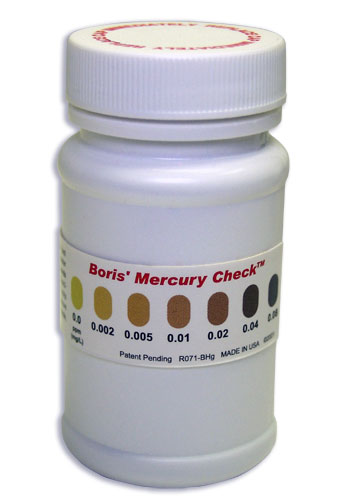
Do simple test methods exist for testing mercury in water? Yes. Boris’ Mercury Test Kit tests down to the EPA limit of 0.002 ppm (or 2 parts per billion) and yields its results quickly.

Boris' Mercury Check

For cases where people fear that larger scale mercury contamination may have taken place, a product named Mercury Check with a detection range of 50ppm to 1,000ppm may come in handy.

Dec
30

Information About Mercury

Water Testing BlogHome Water Testing, Max Contaminant Level, Metals, Water Quality Testing, Water Test Kit, Water Testing

Several of our Water Testing Blog readers have asked us to provide some basic information about mercury, its history, and how to test for it if they wanted to know if it had somehow gotten into their water supply. Below please find some very basic facts about mercury:

  • Mercury exists in several forms: Elemental/Metallic Mercury, Inorganic Mercury Compounds, Organic Mercury Compounds.
  • Mankind can neither create nor destroy mercury.
  • Pure Mercury is a liquid metal at room temperature and standard environmental conditions. It is sometimes referred to as ‘quicksilver’ and volatizes readily.
  • Industry has used Mercury in the manufacturing process of thermometers, switches and lightbulbs.
  • The burning of coal releases mercury into the environment.
  • Production of chlorine, burning of certain hazardous waste products, improper storage/disposal of mercury products, and the accidental spilling of mercury products releases mercury into the environment.
  • Mercury released into the environment typically winds up in soil and in bodies of water where certain microorganisms can convert into a highly toxic compound known as methylmercury.
  • The compound methylmercury can build up in animals such as fish and humans consume these animals so in the United States, the EPA and FDA work together issuing advisories and warnings when environmental samples reveal higher than normal levels of methylmercury in test specimens.

So… what can the average consumer do to protect themselves against accidental exposure to mercury and its highly toxic chemical derivatives such as methylmercury? First off, heed posted signs from local health departments regarding eating the fish from known or unknown bodies of water. Second, if you fear that your drinking water source may have gotten contaminated with mercury, or ANY other harmful element, get your water tested by a certified drinking water testing facility.

Can consumers test for the presence of mercury in water? Yes, but keep in mind that do-it-yourself testing kits for mercury in water serve only as screening tools, and not as the final word for determining whether or not a water supply meets the requirements for safe human consumption.

mercury test for drinking water
Boris Mercury Check (480049)
detects 0.002ppm – 0.08ppm

Dec
16

Water Quality Report / Consumer Confidence Report (CCR) — Brief Introduction

Water Testing BlogCity Water Test, Max Contaminant Level, Municipal Water Test, Water Quality Testing, Water Testing

Many consumers do not know that they can obtain the results of a comprehensive annual water test performed by their municipal water supplier for FREE — if they just knew where to look.

Consumer may click here to visit a page on the United States Environmental Protection Agency’s Safe Water Web Site where they can begin their quest for information on obtaining a copy of their state’s annual Drinking Water Quality Report.

When it comes to drinking water quality, a little education can go a long way — and can save the average consumer a lot of money!

A second piece of advice for anyone considering a consultation session with a water treatment specialist deals with knowing whether or not they have received or earned accreditation from a nationally recognized water quality organization such as the Water Quality Association. You can search for water quality professionals (commercial, retail, dealers, manufacturers, etc.) in your area in the Water Quality Association’s member database for free by clicking here.

Dec
9

Gender Changing Pharmaceuticals in Drinking Water

Water Testing BlogHome Water Testing, Max Contaminant Level, Water Filter, Water Quality Testing, Water Testing

Lots of (manly) men out there may start taking a greater interest in the quality of their drinking water after reading that scientists and researchers have positively identified drinking water contaminants known to alter the gender of wildlife over time — and have also found them in some public water supplies.

Scientists are warning that manmade pollutants which have escaped into the environment mimic the female sex hormone oestrogen.

The males of species including fish, amphibians, birds, and reptiles have been feminised by exposure to sex hormone disrupting chemicals and have been found to be abnormally making egg yolk protein, normally made by females, according to the report by Chem Trust, environmental group.

The authors claim that the chemicals found in food packaging, cleaning products, plastics, sewage and paint cause genital deformities, reduce sperm count and “feminise” males.

Fish have been specifically affected by the gender changing chemicals. In one study, half the male fish in British lowland rivers had signs of being feminised – as chemicals which block the male hormone androgen had been released- leading to the development of eggs in their testes.

Although the report only looked at the impact of gender bending chemicals on the animal world, its authors say the findings have disturbing implications for human health.

Gywnne Lyons, a former Government advisor on chemical pollution and author of the report, said: “Urgent action is needed to control gender bending chemicals and more resources are needed for monitoring wildlife.

“If wildlife populations crash, it will be too late. Unless enough males contribute to the next generation there is a real threat to animal populations in the long term,” she added.

The paper lists the affected species and include, flounder in UK estuaries, cod in the North Sea, cane toads in Florida, peregrine falcons in Spain, and turtles from the Great Lakes in North America.

Some male roaches have changed sex completely after exposure to oestrogen from the Contraceptive pill pouring out of sewage works. (source)

The obvious question becomes, “Does no one test the quality of our drinking water for potentially and seriously harmful contaminants?”

Yes and no. The United States Environmental Protection Agency has two sets of established ‘standards’ by which it judges drinking water quality: Primary and Secondary Drinking Water Standards. The first regulates known threats to human health such as known toxic chemicals, deadly periodic table elements, various forms of bacteria, pathogenic viruses, etc. The second regulates contaminants know to ruin drinking water’s aesthetic properties such as taste, color and odor.

Why have the chemicals and chemical by-products that scientists and researchers now believe may result in the mutation of and subsequent femininisation of males not gotten added to either of those Drinking Water Standards? Probably because no one had definitive proof of their potentially damaging effects on humans until now.

“Currently, federal and state legislation mandates testing and treatment for a wide array of tap water contaminants. A vast majority of public and private water utilities provide drinking water that meets or exceeds U.S. EPA and state drinking water safety standards. Additional legislation is being considered.” (source)

The next logical question which comes to most people’s minds at this point centers around learning how to effectively remove potentially dangerous chemicals such as pharmaceuticals from their drinking water. On that topic,  NSF International (National Sanitation Foundation) had this to say:

“While home water treatment systems are not specifically certified to reduce pharmaceuticals at this time, many of these products can help provide additional protection against a wide array of other contaminants, including arsenic, lead and cysts, sometimes found in drinking water.” (source)

More or less that means no one has stepped up and proposed a solid solution for getting the thousands of potentially harmful pharmaceutical and chemical waste and by-products out of our water supply. Kind of scary, right?

So for right now it seems as though the public’s best protection against drinking water contaminants comes in the form of arming itself with knowledge by testing its drinking water, or getting it tested, and applying that knowledge by installing the correct drinking water filtration system if needed.

Dec
6

Scared by the Water Treatment System Salesperson

Water Testing BlogHome Water Testing, Max Contaminant Level, Reverse Osmosis, Water Filter, Water Quality Testing

So many times we hear horror stories about home owners meeting with local water treatment professionals who use scare tactics to convince them that the water coming into their homes contains items which, unless IMMEDIATELY removed, will kill them, their kids, and most definitely all the plants and pets in the house.

Given that last statement, we have a question:

If you called a carpenter out to your home because you had a small section of uneven drywall in your garage, would you immediately and without hesitation sign up for a very costly and invasive construction process that involved ripping up just about every other room in the house because he/she told you all sorts of scary, frightening ‘facts’ that may or may not really pertain to your situation and you didn’t know any better?

Well the same goes for the matter of deciding whether or not to treat your home’s drinking water. The best decision you can make regarding the purchase, or non-purchase, of a potentially costly water treatment system will come from an educated, informed viewpoint — and the water treatment salesperson’s job is to SELL you a system, not tell you things that may make you not want to buy one… today… right now… right here… sign here, please.

Fact: You can access information about YOUR local water supply online via the United States Environmental Protection Agency for free. The EPA requires municipalities and water suppliers to file regular reports detailing the quality and condition of the water they distribute. Access the EPA’s Local Drinking Water Information online service here.

Fact: The use of simple, at-home drinking water test kits prior to their meeting with water treatment salespeople allows you to at least familiarize yourself with some of the basic terms the salespeople may try to throw at you — and give you the ability possibly ask important, relevant questions about the safety of your drinking water rather than get blindsided with ‘complicated’ sales talk and scientific terminology.

Fact: Getting your water tested by an independent certified water testing laboratory before meeting with water treatment salespeople may save you plenty of unnecessary headaches because your water may not even NEED treatment… so you can go ahead and cancel that appointment.

Fact: Just like when you go to the doctor and he/she tells you something really bad, you have the right to get a second opinion.

So in conclusion, no one should take the advice of a water treatment system salesperson as the gospel. You have options. Use them. It’s your water, your health, and your life!

Aug
14

Pesticides in Water Kill Fish and Humans

Water Testing BlogHome Water Test Kits, Home Water Testing, Max Contaminant Level, Pesticide, Water Quality Testing, Water Test Kit, Water Testing

Many people fail to realize the impact that pesticides in water can have on wildlife, on aquatic life, and in what humans consider ‘extreme’ situations, on human life.

In an article by Jeff Barnard (Associated Press Writer) published on Yahoo News on Thursday August 14, 2008. . .

“GRANTS PASS, Ore. – Three pesticides commonly used on farms and orchards throughout the West are jeopardizing the survival of Pacific salmon, the federal agency in charge of saving the fish from extinction has found.

Under the settlement of a lawsuit brought by anti-pesticide groups and salmon fishermen, NOAA Fisheries has issued a draft biological opinion that found the way chlorpyrifos, diazinon and malathion get into salmon streams at levels high enough to kill salmon protected by the Endangered Species Act.

. . .

Banned from many household uses, tens of millions of pounds of the chemicals are still used throughout the range of Pacific salmon on a wide range of fruits, vegetables, forage crops, cotton, fence posts and livestock to control mosquitoes, flies, termites, boll weevils and other pests, according to NOAA Fisheries.

. . .

The chemicals are the first of 37 that NOAA Fisheries and EPA must evaluate by 2012 under terms of a settlement reached last week in a lawsuit brought by Northwest Coalition Against Pesticides and the Pacific Coast Federation of Fishermen’s Associations, which represents California commercial salmon fishermen.

A total of 28 species of Pacific salmon are classified as threatened or endangered from overfishing, dams, logging, grazing, urban development, pollution, irrigation, misguided hatchery practices and other threats.

Lecky said he could not say where pesticides rank in the threats to salmon, but eliminating the harm from pesticides would boost efforts to save them.”

This naturally leads all of us here at Water Testing Blog to wonder what sort of effect those same compounds may have on human life.

With that in mind, we sought out testing methods for ‘common’ pesticides currently viewed as harmful and/or toxic to human life and sometimes found in well, surface, and drinking water. We discovered the Pesticides in Water test kit which detects Atrazine and Simazine in drinking water at levels established by the United States Environmental Protection Agency as harmful to humans.

The Pesticides in Water test kit detects Simazine at the Maximum Contaminant Level (MCL) of 4 parts per billion and Atrazine at the Maximum Contaminant Level (MCL) of 3 parts per billion.

As always, though, if you have serious reason to suspect the accidental or intentional addition of harmful chemicals to your drinking water supply, we suggest you seek the testing services of trained water professionals.