About
Do you know what's in YOUR water? Learn about water quality, water quality testing, and water quality testing products that can help you make informed, educated decisions regarding the water treatment options for your home, office, swimming pool... and life.
Contact Us
Got a question about water quality? Want to share a water quality article or water quality article with others?

Visit our Contact Us Page to ask a water quality question or submit water quality information.

RSS Feed
Get the most recent water quality posts and comments by subscribing to the Water Testing Blog RSS Feeds.
Subscribe to RSS! Subscribe to RSS Comments!

Archive for the ‘Well Water’ Category

Jan
27

Deeply Discounted Water Testing in Stamford, CT

Water Testing BlogGround Water, Home Water Testing, Reverse Osmosis, Water Filter, Water Quality Testing, Water Test Kit, Water Testing, Well Water

In the past we wrote about water quality issues in Stamford, CT possibly resulting from contaminants buried beneath a local field. Suspected contaminants include pesticides and volatile organic contaminants.

Hundreds of Stamford residents have registered for the health department’s new water testing program scheduled to launch early next month, leaving about a third of the tests budgeted for this fiscal year available.

Officials are encouraging Stamford homeowners to sign up for the public service, which is mandated under a new city ordinance the Board of Representatives approved late last year. The Health Department will share the data it gathers with state health and environmental agencies in an effort to better understand the scope of water contamination in the area of Scofieldtown Park.

The park is the site of a former landfill and had been thought for years to be the source of potentially cancer-causing chemicals discovered in nearby wells in 2009.

Premier Laboratory in Dayville won a competitive bid to perform the testing at a rate of $89.50 per test, Murray said. Homeowners will be charged a flat $100 fee, which will cover the cost of the test itself as well as mailing, printing and logistical expenses associated with the program. Murray said the public service is a good deal for Stamford residents, who would likely pay between $200 and $300 to have their well water tested privately. ( source )

Granted the testing will still cost residents $100, but one has to admit that the fee definitely ranks as a pretty decent bargain considering the alternative: full price. Local officials encourage residents to take advantage of this water testing deal and so do we.

A problem with well water clearly exists in that area and only a properly implemented (thorough) testing of well water in the region surrounding the suspected contamination site will allow officials to get a real good look at the scope and magnitude of the problem.

Removing and/or reducing VOC’s in drinking water?

Naturally the question that follows the discovery of contaminants in one’s drinking water has to do with how to remove or reduce them to ‘safe’ levels. In the article one family had a carbon block filter of some sort installed. Below you will find an example of a carbon block filter hooked up to the Pentek RO-3500 currently offered by numerous online water filter systems vendors like WaterFilters.Net and FiltersFast.Com.


Pentek US-1500 Under Sink Water Filter System certified to
NSF/ANSI Standard 42 for the reduction of Taste and Odor, Chlorine, and Particulate Class I as well as Standard 53 for the reduction of Lead, Mercury, VOC, Cyst, Asbestos, and Turbidity

Jan
25

River of Blood Flowing Into the Trinity River?

Water Testing BlogBacteria, Environmental, Ground Water, Well Water

OK, so if THIS does not tell you that owners of private wells should perform periodic testing of the water pulled from their wells, then we wholeheartedly doubt we will ever find a better reason. A hobbyist drone (unmanned aircraft) pilot in the Dallas, TX area captured a rather disturbing image of what looked like a river of blood exiting a meatpacking facility and heading towards a nearby river, the Trinity River.


Coliform Bacteria in Water Test Kit

Huh? What? A river of BLOOD? Has somebody taken their love of Twilight or any of the other vampire-themed shows a little too far as a prank?

Unfortunately not. We found this article posted on Yahoo News last night and as ridiculous as it sounds, it also appears quite real from the photograph and later statements made by a spokesperson for the Texas Environmental Crimes Task Force.

What danger does this pose?

Honestly, we lack the proper background to go into this one fully, but we do know that discharging that much untreated biological matter will throw the ecosystem in the Trinity River off in ways that would make ecologists stutter, sweat profusely, and probably possibly go into shock.

That stream appears to contain 100′s of gallons of untreated nitrates, nitrites, proteins, decaying organic matter, bacteria, and microscopic parasites — all capable of disrupting the Trinity River’s ecological balance and eventually making their way into public and private water supplies.


Well Driller Test Kit Makes an
Excellent Test Kit for Well Owners, Too!

Public water systems using wells

Pretty much all public water systems that pull ground water from wells test and treat the water for contaminants before distribution but in extreme situations even they can get overwhelmed if they receive massive, unexpected levels of biological contaminants in source water. While workers will make the necessary adjustments to chemical feeders and filters to counteract the influx of filth, making those changes may take time and some contaminated water may find its way into the water supply.

Owners of private wells

Most do not use any sort of disinfection system on their wells so events like this put them at great risk. Really not a whole lot more to say except… Only regular testing of your well water can warn you of contamination!

Think about this, private well owners: How long had material flowed out of that ‘secondary pipe’ before a random flyover by a hobbyist’s drone (unmanned aircraft) captured a picture?


SenSafe ‘Complete’ Home Water Test Kit

Moral of the story?

We believe one of two things happened at that meatpacking facility: 1) Not everyone played by the rules set forth by local officials and the facility broke the rules intentionally; 2) Unexpected events such as equipment malfunctioning or human error caused the slaughter waste to go down the wrong pipe. In either case this bloody mess may not have gotten noticed for quite some time and in that time countless people may have gotten sick from drinking contaminated water.

Periodic testing of well and ground water can help keep you safe from accidents like this one and many others that may take place without you knowing.

as we always like to say, “It’s your water, your health… and ultimately your LIFE!


Crystal Quest Countertop
Water Filter for Bacteria
(Cleanable & Replaceable)


Crystal Quest Under Sink
Water Filter for Bacteria
(Cleanable & Replaceable)

Jan
18

Orange Hair From Tap Water? Too Much Iron in the Water!

Water Testing BlogHome Water Testing, Iron, Metals, Personal Water Filter, Water Quality Testing, Water Testing, Well Water

Can you get orange hair from tap (or well) water? Some residents in the Boulder Hill area of Illinois have presented their local water department with evidence that it can happen… and have water test results documenting the presence of three times the normal level of iron in their tap water.

Last week, residents complained about the water quality at a Village Board meeting and brought pictures of children with orange hair, damaged pipes and water sample results that documented the iron content was some three times the normal level.

This week, after action taken by the village, residents say things are looking up.

“It is looking better, this is good news,” Karol Armbruster, one of the residents affected by the rusty water, said Tuesday.

Her daughter has had to visit a hair salon on two occasions due to the rust in the water, she said. “It was turning orange and a had a little green tint,” she said,

“It doesn’t seem to be as bad,” said Debbie Way, another resident.

The water problems began Nov. 19 when the motor that runs Well 14 broke. At that time, village officials began sending water to the area from other wells.

The rust is the result of a change in direction of the water flow in the pipes.

“The cause of the rust was a build-up of iron deposits inside the pipes for some 50 years,” said Michael Pubentz, Montgomery public works director. ( source )

For these folks water conditions will improve once the new well pump comes online, according to the article, but what about YOUR water? Do you know how much iron or other metals it contains? While some metals (like iron) usually pose more of an aesthetic problem, other metals such as lead, mercury, chromium, etc. can have lasting detrimental health effects.

Iron in Water Test Kit
Detects Fe+2 and Fe+3

Moral of the story?

If you notice sudden changes in water quality could mean problems with the safety of your water and only testing the water for its purity will let you know for sure if the changes mean action needs to get taken by your water company or, if your water comes have a private well, you need to take action.

In this case the water district had a pump fail and needed to redirect water through different lines that had not seen a lot of use in a long time and years of corrosion got pumped to people’s homes. We believe that local residents’ seeking testing and banding together to lobby for prompt action on the part of the water company resulted in the situation getting cleared up a lot faster than may have happened if residents had not presented test results along with their complaints.

Certified water testing data gets results. So, as we like to say, “It’s your water, your health… and ultimately your LIFE.”

Take an interest in the quality of your water and perform spot checks from time to time — especially if you notice a ‘change’ in the color, taste or smell of your water. Doing so could, in some cases, possibly save your life or the life of a loved one.

Interested in removing iron from drinking water? Whether you need a replacement 10″ iron filter cartridge, replacement 20″ iron filter cartridge or a whole house iron removal system, we believe FilterWater.Com may have the perfect solution for your water quality situation.

Filter Water: Whole House Greensand Water Filter
Whole House Greensand Water Filter
Reduces Iron, Manganese and Hydrogen Sulfide

Filter Water: Commercial Iron Removal Water Filter
Commercial Iron Removal Water Filter
Reduces Iron, Manganese and Hydrogen Sulfide

Dec
7

Multistage Water Filter Plus Softener… Do They Make One?

Water Testing BlogCity Water Test, Home Water Testing, Municipal Water Test, Personal Water Filter, Water Filter, Water Quality Testing, Well Water

Today’s question comes from ‘MarquisMark’ who asked,

“My girl and me just bought a new place but the water well it sucks. Got white buildup and other colors of stuff building up in the sinks and the water kit we bought, that sensafe one on your site, says we got all sorts of problems like metals too. A friend says we need a filter and a softener but I don’t know if they make a all-in-one type filter softener thing… but my girl says we gotta do something, so can you help?”

Thank you for your question Marquis and it sounds to us like you and your girlfriend have a real mess on your hands when it comes to the quality of your water.

Question: Well water or city water?

If well water, then we suggest looking in the phone book for a certified well contractor and having them come out to look at the condition of your well.

If city water we suggest contacting your local water department and requesting the latest copy of their Consumer Confidence Report, an annually published document that discusses how good (or bad) a job the department did at keeping its water quality readings in line with Federal Guidelines.

Multistage Water Filter & Water Softener
Crystal Quest CQE-WH-02136

In either case, certainly get your water tested by a qualified water testing laboratory before investing – and yes, we said investing – in a water filtration and/or water conditioner for your home. Otherwise you may run the risk of purchasing the incorrect unit for your specific water remediation requirements.

In other words you may buy the wrong tool for the job… and that could mean a whole lot of wasted money and continued water quality troubles.

Cost of combination water filter & water softener

Definitely not cheap, but if you have drinking water in desperate need of improvement then investing in a whole house water filter & water softener system such as the Whole House Filter and Anti-Scale Conditioner Combo made by Crystal Quest may make sense.

With pricing for the Whole House Filter and Anti-Scale Conditioner Combo (CQE-WH-02136) starting at around $2,900 you really, really, really want to make certain you 1) Need a water filter; 2) Need a water softener; 3) Know for sure that the unit will correct the specific water quality issues that you have.

Moral of the story?

Not all water treatment options will work in every application so before you plop down your hard earned money, get your water tested by a qualified drinking water testing laboratory. If you cannot locate a local laboratory we suggest you consider using the testing services of an accredited mail-in water testing laboratory such as National Testing Labs.

Filter Water: Test for Hard Water
Test for Hard Water

Filter Water: Test for Metals
Test for Metals

Filter Water: Test for Arsenic
Test for Arsenic

Nov
30

Why Might I Need a Water Filter?

Water Testing BlogEnvironmental, Fracking, Home Water Testing, Metals, Pesticide, Water Filter, Water Quality Testing, Water Testing, Well Water

We get asked this question more times than we care to count… and we don’t mind answering it because at least it means the people asking us have taken an interest in the quality of the water they drink, cook with and use for showering/bathing.

Disposable Water Filter for Nitrates
Easy to Install, No Maintenance
Water Filter for Nitrates and Other
Unwanted Drinking Water Contaminants

Natural Contamination

Contamination of natural bodies of water (including lakes, streams, aquifers and groundwater) can have numerous characteristics and sources. While many believe only ‘big business’ causes water pollution, all humans and animals release waste products that eventually find their way into lakes, rivers, streams, oceans, etc.

Scientists refer to this occurrence as ‘nutrient loading’ and when it happens too often in one location nutrient loading may result in bacterial contamination that eventually becomes detrimental to the environment and harmful to humans who unknowingly consume the water.

Contaminants often included in the list of ‘natural’ contaminants include things such as coliform bacteria, nitrates, nitrites, etc.

Therefore, if your drinking water comes from the ground (i.e. a well) you may have ‘natural’ things to worry about… and even municipal (i.e city, town, etc.) water sources have problems from time to time. Need proof? Ever hear of things called boil water advisories?

Unnatural Contamination

This type of contamination typically comes from accidental or intentional dumping of foreign matter into or too close to a body of water either on the the surface or under the ground.

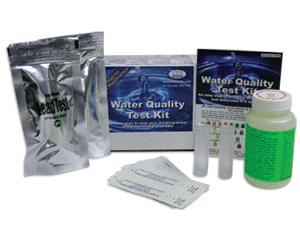
Water Quality Test Kit
Water Quality Test Kit for
15 Water Quality Parameters

Common sources of groundwater and surface water contamination include improper disposal of industrial waste products, faulty septic tanks and waste water storage or processing equipment, landfills, pesticides and fertilizers.

Many experts believe the practice of hydraulic fracturing certainly belongs in the category of unnatural water contamination and pollution… and, of course, many other experts (who often work for or get funding from gas drilling companies) believe hydraulic fracturing poses no (or extremely limited) risks to the environment.

Thus far OUR opinion falls more in line with the folks who suspect that fracking (the nickname for hydraulic fracturing) may pose risks and that more research needs to get done before we turn the Marcellus Shale Formation under the United States into swiss cheese whose holes we filled with ‘questionable’ fluids containing a host of unknown compounds.

Moral of the Story?

You will NEVER know if your water contains unwanted contaminants UNTIL YOU GET IT TESTED and for that task you have several options: 1) Test for the basics yourself using a drinking water test kit; 2) Have a qualified drinking water laboratory test your water; or 3) test for the basics yourself with a water quality test kit and enlist the services of a qualified water testing lab from the list posted on the EPA’s Safe Water Web Site

Nov
11

Well Water Question From Reidsville, NC

Water Testing BlogBacteria, Home Water Testing, Nitrate, Water Quality Testing, Water Testing, Well Water

We recently received an email from ‘Janelle’ in North Carolina who wrote,

“I’m trying to find someone to come test my well water. I’m in Reidsville, NC. And we are just renters I have never had well water before and I would like to know what’s in it. When it rains really hard for a few days the water smells like fish. Then sometimes like onion do you know of a company that test wells in Reidsville??”

While we do not know of a specific company that tests well water in your area, Janelle, we suggest contacting your local health department and asking them if they can provide you with a list of qualified local water testing laboratories.

Water Quality Test Kit
Water Quality Test Kit for Well & City/Tap Water

We took the liberty of doing a quick Google Search for ‘well water testing in Reidsville, NC’ (click the link, Janelle!) and while no immediate matches popped up, a few companies appeared to have locations w/in 20 or 30 miles of where you live, Janelle.

You should also check out the EPA’s North Carolina Water Page. It contains a number of links and phone numbers that may prove useful.

Regarding the ‘fishy smell’ in well water?

Without actually testing the water we suspect that your water may contain some form of organic matter whose levels change in accordance with the changing of the level of the aquifer from which your well draws its water. From what we have read the organic matter usually does not pose much of a health threat, though in some instances it can, and it typically poses more of an aesthetic nuisance than anything else.

Sources also indicated that certain types of bacteria in one’s well may also cause well water to possess a fishy smell at times.

High Flow Triple Filter
High Flow, Whole House Triple Filter Includes
Sediment, Multi-Stage & Carbon Filters

Regarding the ‘onion smell’ in well water?

Most resources we viewed suggested changing the anode rod in the hot water heater since it, over time, can begin collecting mineral deposits or fail in other ways that can result in water coming from the water heater smelling like onions and sometimes, though we neglected to mention this in the previous section, like fish.

Treating for onion water and fishy water?

As noted a moment ago, making sure the anode rod in the water heater has not gone bad or become encrusted with unwanted mineral deposits makes for a wise course of action if water in a home has taken on an onion or fishy smell.

One site we found said the following about diagnosing and treating water that contained foul odors:

“This type of odor may indicate the presence of organic (non-pathogenic) matter. The most common method of treatment for this type of odor is activated carbon filtration or chlorination followed by carbon filtration. It is helpful to attempt to diagnose the cause of the odor so that proper treatment is designed. You may also test your well water for bacteria and nitrates to confirm portability of the water.” ( source )

No matter what, though, Janelle, make sure you get the water tested by a certified water testing laboratory — preferably one that specializes in diagnosing problems with well water.

Oct
31

Well Water Testing and Fracking Contamination

Water Testing BlogBacteria, Coliform, Fracking, Ground Water, Home Water Testing, Nitrate, Nitrite, Water Quality Testing, Water Testing, Well Water

We have written about the importance of testing ground and well water before, during and after hydraulic fracturing many times in the past and will more than likely continue to do so for a long time to come. The potential (and real!) dangers posed by the injection of such large quantities of mysterious chemical cocktails deep into the Earth warrants our doing so.

Today’s question about well water testing and possible well water contamination by hydraulic fracturing came to us from a woman named ‘Terri’ in Pennsylvania who asked…

why is the cost so high to test water for fracking contamination? after the recent flooding it only cost $25.00 to see if the well water was safe to drink. is it best to have a local company test the water or should we send it to Penn State or out of state? how often after the drilling starts do you recommend water to be tested?

Thank you for this question, Terri, and we bet other folks facing the unwanted financial burden of paying for more ground/well water testing than the average homeowner with a well have wondered the exact same thing.

Well Water Testing (2 or 3 parameters)…

In our experience, well water testing that costs roughly $20 to $30 usually includes the following tests: Nitrates/Nitrites and Coliform Bacteria.

Some kits and marketed laboratory testing packages may include other tests, but not much more and definitely not nearly the number of tests included in the laboratory testing packages typically used to analyze water that may contain contamination resulting from hydraulic fracturing.

Testing for Fracking Fluid (potentially 100′s of parameters)…

From the very beginning companies that used hydraulic fracturing as a means of extracting natural gas from rock and shale formations deep in the Earth have kept the list of ingredients in their fracking fluids out of the public eye.

However, according to information posted on Wikipedia (10/28/11)…

“Chemical additives used in fracturing fluids typically make up less than 1% by weight of the total fluid. They are biocides, surfactants, adjusting viscosity, and emulsifiers. Many are used in household products such as cosmetics, lotions, soaps, detergents, furniture polishes, floor waxes, and paints.[33] Some are also used in food products. A list of the chemicals that have been used was published in a U.S. House of Representatives Report.[34] Some of the chemicals pose no known health hazards, some of the chemicals are known carcinogens, some are toxic, and the health hazards for the rest are unknown. The report does not include the concentration of each chemical used or the amount used.

A 2011 study identified 632 chemicals used in natural gas operations. Only 353 of these are well-described in the scientific literature; and of these, more than 75% could affect skin, eyes, respiratory and gastrointestinal systems; roughly 40-50% could affect the brain and nervous, immune and cardiovascular systems and the kidneys; 37% could affect the endocrine system; and 25% were carcinogens or mutagens. The study indicated possible long-term health effects that might not appear immediately. The study recommended full disclosure of all products used, along with extensive air and water monitoring near natural gas operations; it also recommended that fracking’s exemption from regulation under the US Safe Drinking Water Act be rescinded.[35]“

So as you can clearly see, the potential for harm befalling a person exposed to fracking chemicals could certainly clearly exist — even if it may take a while to happen through prolonged exposure to fracking chemicals in the air and/or in their drinking water.

With the number of chemicals and ‘other things’ possibly present in fracking fluid, and the mystery surrounding many of those additives true identities, responsible testing laboratories must use a shotgun approach when analyzing samples for the fracking fluid… because they have no solid idea of what exactly to look for.

The Best way to Test for Fracking Fluid?

Terri mentioned Penn State in her inquiry and at this point we feel the scientists at Penn State may very well have the best idea of what has transpired in that region due to their close proximity and the amount of time and resources that institution has dedicated to tracking the activities of gas drilling companies in the area.

Moral of the Story?

If companies intend to begin hydraulic fracturing in your area then you really ought to have the quality of your water tested before, during and after drilling.

If companies have already started drilling and you have not, yet, had a qualified water testing lab analyze your water, you really ought to have that testing done right away.

Aug
25

Preparing for a Hurricane — Water Quality Issues

Water Testing BlogEmergency Responder, Environmental, Ground Water, Well Water

Many of you have asked us what to do if (or more like when at this point) a hurricane makes landfall. For questions like that we suggest visiting the National Hurricane Center Web Site’s “Be Prepared” section. It has a ton of useful information on how best to get ready for the arrival of tropical storms and hurricanes.

Features and Specifications of the Doulton SS2 “Pour-Through” Gravity Fed System:

  • High Grade Stainless Steel Construction
  • Requires No External Plumbing
  • Compact and Easy to Operate
  • Easily Converted to the SS-4, a unit which utilizes 4 ceramic filters instead of 2
  • Dimensions: Assembled 8″ x 19″ / Stored 8″ x 13.5″
  • Capacity: 12 GPD (with 2 filters) 24 GPD (with 4 filters)
  • Upper Reservoir Holds 2.11 Gallons (8 liters) Untreated Water
  • Lower Reservoir Holds 2.11 Gallons (8 liters) Treated Water

    With regard to filtering capabilities, the Doulton W9361122, SS-2 Gravity Fed Water Filter reduces:

  • Chlorine by 99.99%
  • Cysts by 99.99%
  • Organic Chemicals by 99.99%
  • Parasites by 99.99%
  • Particulates by 99.99%
  • Pathogenic Bacteria (i.e. E. Coli, Cholera, Typhoid, etc.) by 99.99%
  • Rust & Sediment by 99.99%

  • One thing we know for SURE: If the authorities say, “Evacuate!”, don’t sit around like a lump on a log. Secure your property or properties as best you can (the link above has tips for that) and get out of the storm’s way!

    Too many people think a storm will ‘blow over’ by the time it reached them and that the government is ‘pulling their leg’ when it comes to flood predictions, wind estimates, etc.

    Entire cities have gotten leveled by hurricanes in the past. Don’t think it can’t and/or won’t happen again!

    What if my property gets destroyed and I wasn’t there?

    At least you’re ALIVE. Don’t think for one minute that you and a few family members or close friends pushing as hard as you can against the door to keep Mother Nature out of your home or business will do anything but put you and all those around you in the middle of something SHE intends to destroy — effectively making you and yours the meat filling in a demolished building sandwich.

    Water quality after the hurricane passes?

    Municipal Water: As a general rule of thumb, assume the worst when it comes to water quality after an event such as a hurricane until local health officials give the ‘all clear’ sign… and STILL test your water for contaminants such as bacteria, nitrates, and heavy metals such as copper, lead, iron, chromium, etc.

    Just because the water filtration plant either survived unscathed or received the necessary repairs does not mean the miles of pipes leading to your faucet didn’t suffer damage.

    Well Water: As we have said MANY times in the past and, will probably say several hundred more times in the future, no one but you has responsibility for the quality of the water coming out of your well.

    We suggest not using your well until all flood waters have subsided and the area around your wellhead has dried so you can examine it for signs of water breach.

    If ANY flood water (which definitely contained innumerable drinking water contaminants) seeped into the wellhead area you will definitely want to perform a thorough well disinfection… and for that we always suggest contacting a local water well servicing company or at the very least getting detailed instructions from your local health department.

    Then, even after you get the ‘thumbs up’ sign from a certified water testing laboratory such as National Testing Laboratories which will test your water for a LOT more (noteworthy!) parameters than you can test for on your own, we still suggest performing a battery of simple tests on a regular basis for at least three to six months after the visual aftereffects of a natural disaster have gone away.

    Why continue testing? Simple: Whenever flood waters enter an area and then leave, they leave behind a cornucopia of potentially harmful deposits that will, in time, find their way into bodies of surface water. Those bodies of water, at some point, do interact with, and often times directly affect, of surrounding water sources — despite the fact that drinking water aquifers exist deep in the ground.

    Minute and not-so-minute cracks in the rock formations encasing the aquifers will eventually allow potentially contaminated water from the surface access to the aquifers.

    Moral of the story?

    We wish everyone formerly in the path of, currently getting battered by, and about to get thrashed by Hurricane Irene the best of luck during these extremely difficult times.

    • Weather.Com — Great site for continuously updated Hurricane news.

    • National Hurricane Center — Excellent site created and maintained by the National Weather Service for the purpose of helping people get ready for, and hopefully recover after, a hurricane makes landfall in the United States. On our last visit to this site we noted that they had audio instructions in both English and Spanish.

    • Drinking Water Safety During/After Flooding — Similar to what we wrote above, but still might prove useful.

    Stay safe, play it smart and always have a plan!

    – Water Testing Blog Staff

    Aug
    2

    Reduced Fee Water Testing

    Water Testing BlogBacteria, Nitrate, Water Quality Testing, Water Testing, Well Water

    As a special treat for the lucky residents of McHenry County in Illinois, and in honor of Safe Drinking Water Month, the McHenry County Department of Health has decided to offer coliform bacteria and nitrate testing for the reduced rate of $18.

    While not the be all, end all signs of well and ground water contamination, the presence of either certainly warrants immediate action and, in our opinion, the performance of more thorough testing by a certified drinking water testing laboratory.

    Testing wells regularly is the only way to determine whether well water is safe to drink; many contaminants are colorless and odorless. Water from a public or municipal water system is regularly tested for contaminants regulated by federal and state standards. ( source )

    For those not living in McHenry County, we suggest contacting your local health department to see what sort of free or reduced water testing programs they have available. Many times programs of that nature go under advertised (or not advertised at all).

    If no options exist that way, do not simply do nothing… it’s you water, your health… and ultimately your life!

    Inexpensive screening methods exist that will allow you to quickly and economically perform basic water tests on your own that will let you know whether or not you should spend the money required for more laboratory testing.

    While at-home drinking and well water test kits work as great screening tools, one should not rely on them to fully diagnose every possible water contamination problem.


    Drinking/Well Water Test Kit


    Disposable Nitrate Plus Filter


    Whole House Nitrate Plus Filter

    Jul
    31

    Private Well Water and Natural Gas Drilling

    Water Testing BlogFracking, Water Quality Testing, Water Testing, Well Water

    Although most of the mainstream media outlets have moved on to new topics of interest, many people still find themselves dealing with the issue of natural gas drilling where they live and others, yet, find themselves faced with a tough decision: to allow a gas company to drill on their land or not.

    Mail Order Water Testing Lab
    Tests for 97 Water Quality Parameters
    and Provides Results in 10 to 15 Days

    No matter what side of the fence you sit on, enough data exists out there to make even the most adamant proponent of natural gas drilling agree with the idea that water testing needs to take place before, during and after natural gas drilling — if for no other reason than to prove a problem does not exist.

    Recently we came across the second portion of an article posted by the Penn State Cooperative Extension which gives some solid advice on the topic of private well testing, when and by whom it ought to get done.

    Moral of the story?

    Unless you have a baseline reading of, at the very least, basic water quality parameters before any drilling activity takes place, anything that shows up in your water after drilling starts could, as far as the gas company’s lawyers will say, have existed in the water before their client’s employees ever set foot on the property.

    Also, the more thorough the analysis, the better. Spring for the most comprehensive water test you can afford because the more you know about your water before drilling takes place, the better your chances of convincing a Court of Law that a problem exists as a result of drilling later.