About
Do you know what's in YOUR water? Learn about water quality, water quality testing, and water quality testing products that can help you make informed, educated decisions regarding the water treatment options for your home, office, swimming pool... and life.
Contact Us
Got a question about water quality? Want to share a water quality article or water quality article with others?

Visit our Contact Us Page to ask a water quality question or submit water quality information.

RSS Feed
Get the most recent water quality posts and comments by subscribing to the Water Testing Blog RSS Feeds.
Subscribe to RSS! Subscribe to RSS Comments!

Archive for August, 2011

Aug
9

Chromium Found in Chicago Water

Water Testing BlogChromium, City Water Test, Metals, Municipal Water Test, Personal Water Filter

We had a feeling that chromium would pop back up in the news again… and this time residents in the Chicago area had the (dis)pleasure of finding out that recent test result showed the presence of an unhealthy level of a heavy metal (chromium) in their water supply.

Chicago’s first round of testing for a toxic metal called hexavalent chromium found that levels in local drinking water are more than 11 times higher than a health standard California adopted last month.

But it could take years before anything is done about chromium contamination in Chicago and scores of other cities, in part because industrial polluters and municipal water utilities are lobbying to block or delay the Obama administration’s move toward national regulations. ( source )

As some of you may recall, we wrote about chromium showing up in drinking water in the past and from the sounds of things we will very likely find ourselves writing about it many more times.

The discovery of hexavalent chromium in drinking water is renewing a debate about dozens of unregulated substances that are showing up in water supplies nationwide. Potential health threats from many of the industrial chemicals, pharmaceutical drugs and herbicides still are being studied, but researchers say there is strong evidence that years of exposure to chromium-contaminated water can cause stomach cancer.

Test results obtained by the Tribune show that treated Lake Michigan water pumped to 7 million people in Chicago and its suburbs contains up to 0.23 parts per billion of the toxic metal, well above an amount that researchers say could increase the long-term risk of cancer. ( source )

For those of you not familiar with the articles previously written about chromium in drinking water on this site, the following links will really come in handy:

We have written more, but the ones above ought to give you a pretty good understanding of the chromium in drinking water situation facing many areas of the United States. Water supplies previously deemed ‘safe’, and we include both municipal and private water supplies in this statement, have come under new scrutiny and many do not measure up to the current quality standards.

Speaking of tests, can the average person test for chromium in drinking water? Of course they can — but as always the best testing solution comes in the form of analysis by a certified water testing laboratory.

If, however, you would like a fast and easy method to test for the presence of chromium in water, you will definitely want to take a look at the chromium test strips produced by SenSafe/WaterWorks. They make field testing for hexavalent chromium in water a simple and inexpensive process.
Aug
3

Is Demineralized Water Bad for Me?

Water Testing BlogArsenic, Chromium, Copper, Iron, Lead, manganese, Metals, Personal Water Filter, Reverse Osmosis

With so many people in the world out to make a dollar — usually at the expensive of others — it comes as no surprise that a number of companies have tried to find fault with reverse osmosis systems… because they do such a good job of removing contaminants from drinking water.

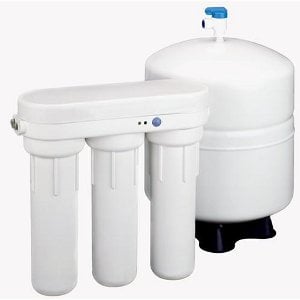
Pentek RO-3500 Reverse Osmosis Water Filter
Pentek RO-3500
Reverse Osmosis Water Filter
Certified by NSF/ANSI to Standard 58

Apparently some folks believe that water lacking ANY minerals will somehow cause problems for people who consume it as drinking water, cook with it, bathe in it, etc. While somewhat true that water produced by reverse osmosis may have ‘aggressive’ tendencies in certain plumbing situations, we have found that the largest ‘problem’ people have with demineralized reverse osmosis water… is its flat, boring taste and not its lack of minerals.

Water’s ‘taste’ comes from its dissolved minerals content so it stands to reason that without any minerals would also have no ‘taste’ — a problem easily remedied by the use of a remineralizing cartridge after the reverse osmosis system.

Don’t we need minerals in our water for health?

To this day we have not personally found any solid evidence to support the notion that an appreciable amount of necessary dietary elements gets absorbed by the body from drinking water — unless, of course, the water got used to wash down a vitamin or supplement. :P

Test for Metals in Drinking Water
Test for Metals
in Drinking Water

Humans obtain the bulk of nutrients required for healthy living from the foods they eat… EXCEPT when they eat mostly (and too much) fried stuff like this.

Moral of the Story?

Eat healthy and drink clean water… and don’t buy into every ‘health trend’ and health fad’ that flashes on your television screen or in banner ads that pop up on web sites you visit.

The water we drink needs to have unwanted impurities removed. End of story.

If given a choice, we’ll take flat-tasting water over water containing potentially dangerous and/or bothersome levels of dissolved heavy metals (i.e. lead, copper, iron, manganese, chromium, arsenic, etc.) and other junk any day of the week!

Aug
2

Reduced Fee Water Testing

Water Testing BlogBacteria, Nitrate, Water Quality Testing, Water Testing, Well Water

As a special treat for the lucky residents of McHenry County in Illinois, and in honor of Safe Drinking Water Month, the McHenry County Department of Health has decided to offer coliform bacteria and nitrate testing for the reduced rate of $18.

While not the be all, end all signs of well and ground water contamination, the presence of either certainly warrants immediate action and, in our opinion, the performance of more thorough testing by a certified drinking water testing laboratory.

Testing wells regularly is the only way to determine whether well water is safe to drink; many contaminants are colorless and odorless. Water from a public or municipal water system is regularly tested for contaminants regulated by federal and state standards. ( source )

For those not living in McHenry County, we suggest contacting your local health department to see what sort of free or reduced water testing programs they have available. Many times programs of that nature go under advertised (or not advertised at all).

If no options exist that way, do not simply do nothing… it’s you water, your health… and ultimately your life!

Inexpensive screening methods exist that will allow you to quickly and economically perform basic water tests on your own that will let you know whether or not you should spend the money required for more laboratory testing.

While at-home drinking and well water test kits work as great screening tools, one should not rely on them to fully diagnose every possible water contamination problem.


Drinking/Well Water Test Kit


Disposable Nitrate Plus Filter


Whole House Nitrate Plus Filter

Aug
1

The Big Thirst — by Charles Fishman

Water Testing BlogEnvironmental

While hunting for interesting (and hopefully useful) water news just now we accidentally tripped over a synopsis of a book called The Big Thirst, a book written by Charles Fishman about our planet’s abundance of water, dependance on water, and ironically, its shortage of water.

While the little kid in us found it hilarious that a man with the word ‘fish’ in his name wrote a book about water, the synopsis quickly wiped the smirk off our face and replaced it with a look of awe. In that synopsis on the Water & Wastewater Blog we found this:

  • Water is never destroyed or used up. Today we’re drinking the same water the dinosaurs drank. (Is that Tyrannosaurus Rex pee in your glass?)
  • Water is the lubricant that allows the continents to move.
  • A 150-pound man is 90 pounds water.
  • The average American flushes 18.5 gallons of clean drinking water down the toilet every day.
  • An IBM chip factory in Vermont uses 3.2 million gallons of water a day.
  • In water-short Australia, a single wool processing factory uses 380,000 gallons of water daily.
  • Also in Australia, a farmer pours 6 billion liters of water over 10,450 acres of rice fields.
  • A two-liter bottle of coke takes five liters of water to produce it.
  • 49 percent of water use in the US is for power plants.
  • The electricity you use at home requires 250 gallons of water per person per day.
  • 1 ton of steel takes 300 tons of water.
  • At lift-off the space shuttles used one million gallons of water per minute (not to keep it cool but to buffer it against being shaken apart by the noise).
  • Of the world’s 6.9 billion people, 1.1 billion don’t have adequate water.
  • 5,000 children die every day from lack of water or diseases from tainted drinking water.
( source )

Quite honestly, we already knew about the toilet flushing statistic and the amount of water in a human being, but some of the other statistics blew us away.

If you found yourself as astonished by some of those numbers as we found ourselves, then you, too will probably go and check out what else Mr. Fishman has to say in The Big Thirst.


Aug
1

NSF/ANSI Standard 55 Class A or Class B for Home UV Water Treatment Systems?

Water Testing BlogBacteria, Coliform, Personal Water Filter, UV Sterilizer, Water Filter

Every once in a while we find ourselves faced with a water quality question whose answer we thing we ought to know, but for some reason never had cause to seek out in the past. A reader named ‘Nikelhoss’ recently asked,

“Which part of the nsf ansi standard 55 for ultraviolet water treatment systems applies to home units? Much thanks and thanks for the site, useful stuff on here.”


Trojan UV Max Pro 10, 20 & 30
Tested & Certified to NSF/ANSI Standard 55
for Class A UV Water Treatment Systems

My friends, flattery may not get you everywhere, as the old saying claims, but it will make us blush. Plus we may answer your question faster. Ha ha. :P

Rather than bore you by quoting the official definition of NSF/ANSI Standard 55 for Ultraviolet Microbiological Water Treatment Systems, we would like to point out a simple, yet often overlooked, truth that many people forget when exploring the wide world of water treatment systems for their home or business: Not every system will work for every water quality situation… and then we will provide a very relevant example to illustrate our point.

In the case of ultraviolet water filtration systems, two classes of NSF Certified ultraviolet water filtration systems exist:

But first, let us preface this by saying NSF/ANSI Standard 55 applies only to point-of-use (POU) and point-of-entry (POE) ultraviolet systems not intended for use on public water supplies (i.e. in water treatment facilities).

  • Class A — These ultraviolet water treatment systems must have an ‘intensity & saturation’ rating of at least 40,000 uwsec/cm2 and possess designs that will allow them to disinfect and/or remove microorganisms from contaminated water. Affected contaminants should include bacteria and viruses and the devices should perform in a manner that reduces threats posed by affected to a safe level.

  • Class B — These ultraviolet water treatment systems must have an ‘intensity & saturation’ rating of at least 16,000 uw-sec/cm2 and possess designs that will allow them to provide supplemental bactericidal treatment of water already deemed ‘safe’ by an official (i.e. State or Local) health agency.

So… Which type (class) of ultraviolet water treatment system makes the most sense for home use? That all depends on the source water for the home. If the home has well water and uses no other disinfection method or draws its water from bodies of surface water, we think investing in an NSF/ANSI Standard 55 Class A ultraviolet water treatment system may work out best.

As an example, check out the Trojan UV Max Pro 10, Trojan UV Max Pro 20 or Trojan UV Max Pro 30 on the Trojan UV Water Systems page on WaterFilters.Net.

If, on the other hand, you live in town and have municipal water or use a reverse osmosis system with a large holding tank, we think an NSF/ANSI Standard 55 Class A ultraviolet water treatment system may work out best — though, as always, we suggest testing your tap water for a period of time to establish a water quality baseline (to make certain more sinister bacterial contamination issues do not exist) before investing in a water treatment system designed to serve as a backup disinfection device.

For the purpose of putting a final UV polishing on drinking water previously determined ‘safe’, a device such as those listed on the Water Quality Association’s Gold Seal Certified Class B Disinfection Ultraviolet Water Treatment Systems may work out best, though one could easily still use a Class A unit in a Class B unit’s place — but not the other way around!