About
Do you know what's in YOUR water? Learn about water quality, water quality testing, and water quality testing products that can help you make informed, educated decisions regarding the water treatment options for your home, office, swimming pool... and life.
Contact Us
Got a question about water quality? Want to share a water quality article or water quality article with others?

Visit our Contact Us Page to ask a water quality question or submit water quality information.

RSS Feed
Get the most recent water quality posts and comments by subscribing to the Water Testing Blog RSS Feeds.
Subscribe to RSS! Subscribe to RSS Comments!

Archive for the ‘Fluoride’ Category

Feb
14

Fluoride in Drinking Water Linked to Lower Intelligence?

Water Testing BlogFluoride, Water Quality Testing

Just when we thought we had seen and heard the full run of attacks on the addition of fluoride to public water systems, we came across the results of a study that claims children exposed to fluoride wind up less intelligent than children not exposed to fluoride.

Yes, you read that correctly. Fluoride causes stupidity… at least according to the results of the study discussed recently in a publication called ‘Environmental Health Perspectives’.

Fluoride is added to 70% of the U.S. water supply. Kids who drink this water suffer from decreased cognitive function, according to research published in Environmental Health Perspectives, a publication of the National Institute of Environmental Health Sciences. The study followed 512 children between the ages 8 and 13, with varying degrees of fluoride exposure. One group lived in a Chinese village with high fluoride levels, and the other in a Chinese village with low fluoride levels. The scientists conducting the study even eliminated other variables that may have affected brain health, such as iodine deficiency and lead exposure. With these variables eliminated, researchers found that the number of intelligent children in the village with low fluoride levels was 350 percent higher than those in the high fluoride village. Even more disturbing, 15% of the highly fluoridated children scored low enough to indicate mental retardation, verses 6% in the other village.

According to Paul Connett, Ph.D., director of the Fluoride Action Network, “This is the 24th study that has found this association, but this study is stronger than the rest because the authors have controlled for key confounding variables and in addition to correlating lowered IQ with levels of fluoride in the water, the authors found a correlation between lowered IQ and fluoride levels in children’s blood. This brings us closer to a cause and effect relationship between fluoride exposure and brain damage in children.” ( source )

How can you determine if your tap water contains fluoride? Call your local water company and ask them for the current or previous year’s Water Quality Report. By law, they must either provide you with a copy of that document or give you the online location where you can download it.

Testing for fluoride in drinking water?

Unfortunately no dip-n-read test kits or basic ‘wet chemistry’ test kits exist for fluoride. We know of only one test kit available to the general public at this time that has the ability to test for fluoride in drinking water and does not require users to have a degree in chemistry to preform the testing.

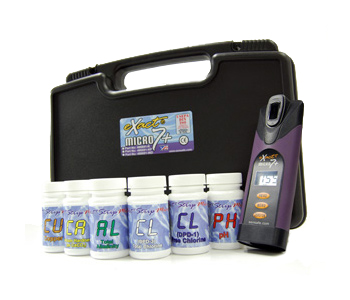
The eXact Micro 7+ Meter can test for fluoride levels between 0.1 and 1.1 mg/L (ppm) using time tested SPADNS chemistry. Do you need to know what that last bit means to use the kit? Nope. Yo will need to pick up the required fluoride reagentstrips separately for an additional $13, though, because they do not come with the basic meter kit.

Jan
31

Fluoride Removal Systems… Unaffordable?

Water Testing BlogFluoride, Reverse Osmosis, Water Filter

The other day we received an inquiry from ‘Margaret M’ regarding the affordability of fluoride removal systems for home use. Seems like every other day we get question about fluoride in drinking water, but we don’t mind. The more questions we get, the more interest in fluoride we know people have.

Although we have not, yet, decided for ourselves how we feel about the fluoridation of public water supplies, we do know that many people have already taken sides and line have already gotten drawn in the sand.

One one hand, some folks believe fluoridation of public water supplies has greatly helped the general public by making teeth more resistant to cavities and decay. On the other hand, with all the other sources of fluoride (i.e. dietary supplements, fluoride toothpaste, etc.) in the general public’s diet these days, some people have unknowingly received potentially unhealthy amounts of exposure to fluoride… and technically, fluoride counts as a toxic compound.


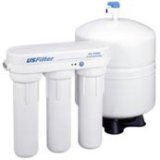
Pentek RO-3500
NSF/ANSI Certified for Fluoride Reduction

Getting back to the point of this article, though, Margaret asked, “I read on About.Com that reverse osmosis systems will remove fluoride from water an that they are too expensive for general use. Is that true?”

Quite honestly, we guess that the information on About.Com got posted a number of years ago when reverse osmosis water filtration systems did cost a small fortune — but those days have come and gone.

Nowadays the average homeowner can pick up an NSF/ANSI Certified point-of-use reverse osmosis water treatment for under $300.

As an example, the Pentek RO-3500 bears the NSF Mark (NSF/ANSI STANDARD 058) for its reduction of Arsenic (Pentavalent), Barium, Cadmium, Copper, Chromium (Hexavalent), Chromium (Trivalent), Cyst, Fluoride, Lead, Nitrate/Nitrite, Radium 226/228, Selenium, TDS, and Turbidity.

It also bears a second NSF Mark (NSF/ANSI STANDARD 042) for reduction of taste, odor and chlorine.

The first step towards choosing a water filter system?

Get your water tested by a certified water testing laboratory such as National Testing Laboratories to see what, if any, unwanted drinking water contaminants your water contains.

Jan
17

EPA Considering Removing ‘Safe Level’ Amounts for Pesticide Containing Fluoride

Water Testing BlogCity Water Test, Fluoride, Water Quality Testing, Water Test Meters, Water Testing

For those keeping tabs on the whole ‘fluoride overexposure’ issue, and especially those concerned about it, the following article ought to please you immensely.

In a recent announcement, the United States Environmental Protection Agency stated that it had taken another look at the topic of fluoride exposure and determined that with all the other sources of fluoride in our surroundings, allowing traces of fluoride in the form of a commonly used pesticide (sulfuryl fluoride) no longer makes sense.

The U.S. Environmental Protection Agency has re-evaluated the current science on fluoride and is taking steps to begin a phased-down withdrawal of the pesticide sulfuryl fluoride, a pesticide that breaks down into fluoride and is commonly used in food storage and processing facilities. Sulfuryl fluoride is currently registered for the control of insect pests in stored grains, dried fruits, tree nuts, coffee and cocoa beans, and for use in food handling and processing facilities. Although sulfuryl fluoride residues in food contribute only a very small portion of total exposure to fluoride, when combined with other fluoride exposure pathways, including drinking water and toothpaste, EPA has concluded that the tolerance (legal residue limits on food) no longer meets the safety standard under the Federal Food, Drug, and Cosmetic Act (FFDCA) and the tolerances for sulfuryl fluoride should be withdrawn. ( source )

So… if the EPA has admitted that it needs to reconsider its position on fluoride in drinking water, then perhaps we, as Americans, ought to wonder exactly how much fluoride our water contains, right? We think so. Ask your local water treatment facility for a copy of its annual Water Quality Report or for the web address where you can download a copy.

Visit the EPA SafeWater Program Web Site for information on water quality in your area.

Test Products: eXact Micro 7+ Meter
eXact Micro 7+ Water Testing Meter

( Required Fluoride ReagentStrips )

Testing for fluoride

Unfortunately the SPADNS chemistry required to perform fluoride testing in water does not lend itself to the development of a simple test strip or visual method… but that does not mean the average person cannot test for fluoride in their drinking water.

Over the past few months we have discussed the fact that a relatively inexpensive multiparameter water testing meter known as the eXact Micro 7+ has the ability to test for fluoride. Fluoride Test Strips for eXact Micro 7+ Photometer required and sold separately (under $15 for 25 tests) on the FiltersFast.Com web site.

As of January 17, 2011, the National Safety Products web site ( FilterWater.Com ) has the eXact Micro 7+ Meter on sale for about $240 for the basic kit.

Jan
11

Lower Levels of Fluoride in Drinking Water on the Way?

Water Testing BlogFluoride, Reverse Osmosis, Water Quality Testing, Water Testing

Time for an update about fluoride in drinking water from two different government organizations… The U.S. Department of Health and Human Services and the U.S. Environmental Protection Agency. Therefore, if you have concerns about fluoride in your drinking water, you may want to keep tabs on what happens after this announcement.

  • Government agencies considering lowering recommended level of fluoride from the range of 0.7 to 1.2 mg/L down to 0.7 mg/L.

  • Maximum level allowed in drinking water may also get reduced by the EPA.

  • Americans now exposed to fluoride from numerous sources.

  • The eXact Micro 7+ water testing meter can test for fluoride levels between 0.1 and 1.1 mg/L (ppm) using proven SPADNS chemistry.

Recently the U.S. Department of Health and Human Services and the U.S. Environmental Protection Agency stated publicly that they will soon recommend lowering the maximum amount of fluoride allowed in water to a level that will still give citizens the benefits of reduced tooth decay while hopefully preventing excess exposure to fluoride.

Current guidelines place the maximum allowable levels of fluoride between 0.7 and 1.2 milligrams per liter (mg/L or ppm) and the new recommendation would place that limit at 0.7 milligrams per liter.

Why the alleged need for guideline reform and upper limit reduction? Quite simply, the world has changed and no longer do Americans get their dose of fluoride from only one source. The quote below goes into more detail on that point.

“Today both HHS and EPA are making announcements on fluoride based on the most up to date scientific data,” Pete Silva, EPA assistant administrator for the Office of Water, said in statement. “EPA’s new analysis will help us make sure that people benefit from tooth decay prevention while at the same time avoiding the unwanted health effects from too much fluoride.”

The statement notes that Americans have access to more sources of fluoride than they did when water fluoridation was first introduced in the United States in the 1940s. Water is now one of several sources of fluoride. Other common sources include dental products such as toothpaste and mouth rinses, prescription fluoride supplements, and fluoride applied by dental professionals. Water fluoridation and fluoride toothpaste are largely responsible for the significant decline in tooth decay in the U.S. over the past several decades. ( source )

Will changes, if they occur as a result of these recommendations, have any effect on the lives of most people? No, not really. We will all most likely go on with our lives completely oblivious to the reduction in fluoride levels in our drinking water.

That does not mean, however, that some folks will stop their efforts to get all fluoride removed from drinking water. A certain element exists in our society that despises fluoride in all its forms and wants it vanquished from public water supplies altogether.

Fluoride reduction in drinking water?

If government agencies won’t mandate the removal and/or reduction of fluoride levels in drinking water, and people still want it, home water filters for fluoride reduction do certainly exist. Note that we said fluoride reduction and not fluoride removal.

To our knowledge no water filtration units commonly available to the general public will remove all fluoride from drinking water. Quality water filtration units will, however, bear certification to reduction standards established by organizations such as the NSF, an independent testing organization involved in many areas of quality and safety dealing with consumer goods.

As an example, NSF Standard 58 deals directly with the reduction of specific drinking water contaminants. See below.

NSF/ANSI Standard 58:

“Overview: This standard was developed for point-of-use (POU) reverse osmosis (RO) treatment systems. These systems typically consist of a pre-filter, RO membrane, and post-filter. Standard 58 includes contaminant reduction claims commonly treated using RO, including fluoride, hexavalent and trivalent chromium, total dissolved solids, nitrates, etc. that may be present in public or private drinking water. ( source )

Want an example of an affordable reverse osmosis system that has tested and certified to NSF Standard 58, the Pentek RO-3500 Monitored Reverse Osmosis System reduces for TDS, Fluoride, Turbidity, Lead, Nitrate, Selenium, Arsenic, Copper, Cadmium, Barium, Cyst, and Radium… and has a price tag under 270 dollars.

Jan
3

Chromium in Drinking Water Information

Water Testing BlogArsenic, Chromium, Copper, Environmental, Fluoride, Lead, Metals, Municipal Water Test, Nitrate, Nitrite, Reverse Osmosis, TDS, Water Testing

With all of the recent publicity that chromium has gotten as a result of EWG Reports Finding Chromium in Municipal Water Systems, we figured some of you might want to know a bit more about the health effects of chromium, where chromium comes from, how to test for chromium in drinking water, and most importantly… how to get rid of chromium if detected in one’s drinking water.

  • Chromium will appear in nature in one of three forms: Chromium(0), Chromium(III) or Chromium(VI).

  • Chromium(0) gets used in the production of steel.

  • Chromium(III) and/or Chromium(VI) may appear in compounds used for chrome plating, making dyes and pigments, tanning leather, and preserving wood.

  • Chromium(III) aids the human body in its use of sugar, protein and fat, though health officials suggest not using excessive amounts of dietary supplements containing chromium compounds.

  • Higher levels of chromium(VI) may cause irritation to the lining of the nose, ulcers in the nose, runny nose, and other breathing problems such as asthma, coughing, shortness of breath, and/or wheezing. While both Chromium(III) and Chromium(VI) in air can cause the aforementioned problems, effects occur at much lower concentrations of Chromium(VI) than Chromium(III).

  • Chromium(III) and Chromium(VI) may exist in drinking water and have no associated tastes or odors.

  • If ingested, Chromium(III) compounds tend to have less toxic tendencies and appear to cause fewer health problems than Chromium(VI) which causes anemia, irritation of the stomach, ulcers in the stomach, and ulcers in the small intestine.

  • Some laboratory animals exposed to Chromium(VI) experienced sperm damage and damage to the male reproductive system.

  • Some Chromium(VI) compounds may cause skin ulcers and a percentage of the population have extreme sensitivity to Chromium(VI) and/or Chromium(III) with allergic reactions manifesting themselves as severe redness and swelling of the skin.

  • The Department of Health and Human Services (DHHS), the International Agency for Research on Cancer (IARC), and the EPA have determined that Chromium(VI) compounds are known human carcinogens. ( source )

  • Some developmental effects have been observed in animals exposed to Chromium(VI). ( source )

Regulations, rules and recommendations pertaining to Chromium?

The EPA has determined that exposure to chromium in drinking water at concentrations of 1 mg/L for up to 10 days is not expected to cause any adverse effects in a child. The FDA has determined that the chromium concentration in bottled drinking water should not exceed 1 mg/L. The Occupational Health and Safety Administration (OSHA) has limited workers’ exposure to an average of 0.0005 mg/m3 chromium(VI), 0.5 mg/m3 chromium(III), and 1.0 mg/m3 chromium(0) for an 8-hour workday, 40-hour workweek. ( source )

What NSF/ANSI Standards apply to chromium in drinking water?

Standard 53, Standard 58, and Standard 62.

For more information on the specifics of those NSF/ANSI Standards and others, take a look at the NSF International Web Site. It offers a wealth of information for both the consumer AND water professionals alike.

Pentek, Ametek, US Filter -- RO-3500 Reverse Osmosis Water Filter
RO-3500 Reverse Osmosis Water Filter
NSF/ANSI Standard 58 Certified

Removing chromium from drinking water?

As far as units for the average consumer, pretty much only reverse osmosis makes any sense. One could use a process like distillation, but it has a flow rate that most likely would not meet homeowner needs and a much higher entry cost.

As an example of a reverse osmosis that carries NSF Certification for chromium reduction, you may want to take a look at the Pentek RO-3500 which has a price tag of under $270 and appears to offer a lot of filtering power for the money.

Pentek RO-3500 Reverse Osmosis Water Filters have tested and certified to NSF/ANSI Standard 58 for the reduction of Pentavalent Arsenic (Arsenic V), Barium, Cadmium, Copper, Hexavalent & Trivalent Chromium (Chromium VI & Chromium III), Cyst, Fluoride, Lead, Nitrate/Nitrite, Radium 226/228, Selenium, TDS and Turbidity.

Dec
28

Does Filtrete Water Station Remove/Reduce Fluoride?

Water Testing BlogFluoride, Water Filter

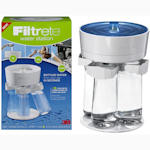
Filtrete Water Station by 3M

We received a very direct question from ‘HonestJr’ about a product we wrote about recently: The Filtrete Water Station manufactured by 3M.

“My question is regarding the Filtrete Water Station made by 3M. Does it remove fluoride from the water being filtered?”

Thank you for your question, Honestjr. As best we can tell from the information available online, the Filtrete system does NOT remove fluoride — but we suspected that even before beginning research.

Simple water filtration units will most often remove (or more likely reduce) chlorine levels to improve taste and odor of water — and not really do a whole lot more.

Reducing/removing fluoride requires technologies beyond simple GAC (granular activated carbon) filtration devices.

If you have serious concerns over fluoride in your drinking water you may want to consider taking a look at the following pages from our site, as they give more information about removing fluoride from drinking water.

We hope this helps. If not, please feel free to write back and we’ll do what we can to provide additional information!

Best regards,

– Water Testing Blog (www.watertestingblog.com)

Nov
10

Fluoride From Tea and Toothpaste Weakens Bones?

Water Testing BlogCity Water Test, Fluoride, Ground Water, Municipal Water Test

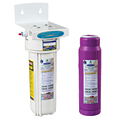
Inline Fluoride Filter for Refrigerators & Ice Makers
Inline Fluoride Filter
for Refrigerators & Ice Makers

According to a study released in a recent online Osteoporosis International edition, fluoride in water plus fluoride from other common sources (tea & toothpaste) can result in serious damage to human bones called skeletal fluorosis.

Sound ridiculous? It did to us as well until we took the time to think about the real point the researchers may have intended to make: We get exposed to potentially harmful compounds like fluoride all the time and from a number of sources we probably never even think about.

In all honesty, we knew about fluoride in toothpaste and the drinking water, but brewed tea? Really? Apparently so. It does make sense, though, since boiling water reduces the amount of water in the kettle/pot — thus increasing the concentrations of certain contaminants (like fluoride and metals) in the remaining water.

NEW YORK, Nov. 1, 2010 /PRNewswire-USNewswire/ — Fluoride consumption from tea and toothpaste damaged a woman’s bones, report researchers in Osteoporosis International published online October 9, 2010.

Fluoride, added to water intending to reduce tooth decay, accumulates in and can weaken bones. To prevent bone damage or skeletal fluorosis, in 1986 EPA set 4mg/L as water fluoride’s maximum-contaminant-level. In 2006, the National Research Council reported that 4 mg/L is too high to protect health. Some brewed teas contain almost twice that concentration.

This case describes a 53-year-old British woman with a broken bone in her foot and abnormally dense bones and badly decayed teeth.

“A striking feature of our case was the very high serum, urine, nail and bone fluoride levels, to our knowledge the highest ever reported in a patient with [skeletal] fluorosis,” the research team writes.

Her standard breakfast tea measured 7.6 mg/L fluoride. She drank six 8-ounce-cups daily, made with low-fluoride water (0.3 mg/L) and therefore 11 milligrams of fluoride daily.

She brushed her teeth 8-10 times a day. “…it is not uncommon to swallow about 25% of the toothpaste applied to the brush,” report the researchers estimating their patient’s fluoride intake from toothbrushing at 4 mg/daily.

Adding 2-3 mg of fluoride from other dietary sources, this woman ingested “a chronic daily dose of 17-18 mg [daily], an amount sufficient to cause the skeletal changes…,” the researchers report. ( source )

This story reminded us of the man who developed an illness as a result of exposure to diacetyl, an additive used in flavoring for microwave popcorn. Why? Because the man ate an unreal number of bags on a daily basis; kind of like the way this woman drank 8 cups of brewed tea a day and brushed her teeth 8 to 10 times a day.

We don’t know too many people who follow either of those people’s dietary and/or hygienic regimen but if we did, we’d probably suggest a few changes… and possibly some therapy. Having said that, though, the presence of fluoride in the water supply does make us wonder what amount the average person ingests on a daily basis.

Why do they add fluoride to the water supply?

Good question! The answer lies in fluoride’s ability to strengthen teeth and inhibit toot decay. Aside from that it serves no purpose — except, of course, to serve as the center of a raging debate where health officials have lined up on BOTH sides and each side has an arsenal of evidence to support its claims.

Do all water systems add fluoride? And if so, how much?

First of all, not all municipal water systems add fluoride to the water they distribute. Furthermore, the ones that do add different amounts depending upon things like water alkalinity and average water temperature. Suggested fluoride in water concentrations range between 0.5 mg/L and 1.2 mg/L since different organizations have different opinions on how much fluoride a water supply ought to contain.

I have well water so I don’t have to worry about fluoride, right?

Completely and totally false! Fluoride occurs naturally in the environment and concentrations in ground water can, in some cases, reach dangerously high levels. As for where naturally occurring fluoride in ground water comes from, “Fluoride is a common constituent of groundwater. Natural sources are connected to various types of rocks and to volcanic activity. Agricultural (use of phosphatic fertilizers) and industrial activities (clays used in ceramic industries or burning of coals) also contribute to high fluoride concentrations in groundwater.” ( source )

Testing drinking water for fluoride?

Although the eXact Micro 7+ Meter has the ability to test for fluoride levels as low as 0.1 mg/L and as high as 1.1 mg/L without the need for dilutions, most people will need to consult with a certified water testing laboratory such as National Testing Laboratories for assistance.

Water filters that will remove fluoride from drinking water?

As a general rule, “Pitcher or faucet-mounted water filters do not alter fluoride; the more-expensive reverse osmosis filters remove 65–95% of fluoride, and distillation filters remove all fluoride.” ( source )

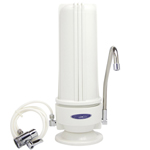
Filter Water: Countertop Fluoride Filter
Countertop Fluoride Filter

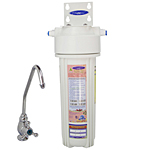
Filter Water: Undersink Fluoride Filter
Undersink Fluoride Filter

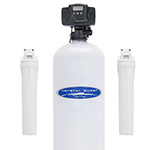
Filter Water: Whole House Fluoride Filter
Whole House Fluoride Filter

Oct
19

Fluoride Testing Questions — eXact Micro 7+ Meter

Water Testing BlogCity Water Test, Fluoride, Municipal Water Test, Water Quality Testing, Water Test Kit, Water Test Meters, Water Testing

Today we received an inquiry from ‘Tom’ who wanted to know more about, we assume, the eXact Micro 7+ Meter’s fluoride testing ability.

Want to use to determine if a water sample has flouride and is likely city water vs ground water. Site lists lots of chemicals but steers away from Flouride. What is the range of flouride the instrument will detect? Will the presence of other chemicals associated with drinking water efect result? How often is calibration needed and can user complete cal?

eXact Micro 7+ Meter
0.1ppm to 1.1ppm Fluoride Testing

With all of the publicity that fluoride in drinking water has gotten over the years it does not surprise us that we keep getting questions about fluoride in drinking water, its effects on people’s health and how to test for it in drinking water.

Until a few years ago fluoride in water testing required ‘sophisticated’ laboratory glassware and used chemical reagents not readily available to the public. Either that or you needed very expensive laboratory grade equipment and a degree in chemistry to operate it.

Now, however, companies like Industrial Test Systems, Inc., a US based manufacturer of water quality testing products have come out with hand held meters like the eXact Micro 7+ Water Testing Meter which uses proven SPADNS chemistry to detect levels of fluoride between 0.1 ppm and 1.1 ppm. See page 18 of the eXact Micro 7+ Meter’s Manual for more information or call the meter’s manufacturer at 1-800-861-9712.

How much fluoride does tap water contain?

While concentrations of fluoride in tap water will vary by location, A 1994 World Health Organization expert committee suggested a level of fluoride from 0.5 to 1.0 mg/L (milligrams per litre), depending on climate. ( source )

We would guess that most municipal water supplies fall somewhere in the range specified by the World Health Organization.

Oct
16

Replacement Media for Water Filter Systems

Water Testing BlogArsenic, Fluoride, hydrogen sulfide, Iron, manganese, Water Filter, Water Testing

‘Tanya1975′ asked…

We bought a house that has a system for water filtering in it and we think the earlier owners were kinda’ nasty and probably did not change the stuff in the system. Ever. And it looks like it’s been here a while. Do you know where we can get new filter stuff for out filter?

First of all, yes we know where you can get replacement water filter media, but we have no idea if they carry the right type of filter media for your filter. You will have to determine what type of filter you have (i.e water softener, iron/manganese removal system, fluoride removal system, arsenic removal system, general water filter, etc.) and what type of filter media it contains.

Filter Water: Granulated Activated Carbon
Granulated Activated Carbon
Replacement Filter Media

Filter Water: Acid Neutralizing Media
Acid Neutralizing
Replacement Filter Media

Filter Water: Arsenic Removal Media
Arsenic Removal
Replacement Filter Media

Filter Water: Fluoride Removal Media
Fluoride Removal
Replacement Filter Media

Filter Water: Iron & Hydrogen Sulfide Removal Media
Iron & Hydrogen Sulfide
Replacement Removal Media

Filter Water: Iron & Manganese Removal Media
Iron & Manganese Removal
Replacement Filter Media

Filter Water: Manganese Greensand Media
Manganese Greensand Media
Replacement Filter Media

Filter Water: KDF Filter Media Blend
KDF Filter Media Blend
Replacement Filter Media

Filter Water: Sediment Removal Filter Media
Sediment Removal Filter Media
Replacement Filter Media

Filter Water: Manganese Greensand Media
Manganese Greensand Media
Replacement Filter Media

So, as you can see, a number of different replacement water filter media types exist… each with its own unique set of physical and chemical characteristics which make it ideal for its intended filtering purpose.

Always make sure you check with your water filter’s manual before purchasing replacement water filter media. Otherwise you might accidentally order a whole bunch of something you don’t need, and worse yet, can’t use!

Sep
21

Inexpensive Countertop Fluoride Filter

Water Testing BlogArsenic, Arsenic in Water, Chlorine, Copper, Fluoride, Hardness, hydrogen sulfide, Iron, Lead, mercury, Metals, Pesticide, Water Filter, Water Testing

No Cartridge Fluoride Filter

While the jury has not come back with a decision on whether or not fluoride in drinking water poses a serious health risk to people who drink water spiked with it, if you don’t want it in your water Crystal Quest has recently come out with a convenient, easily installed countertop water filter for fluoride — and many other unwanted potential drinking water contaminants.

Crystal Quest manufactures a product called the Countertop Disposable Single Fluoride Multi PLUS Water Filter System which installs in seconds and effectively removes fluoride AND hundreds of drinking water contaminants — if present in the water to begin with.

Water travels through a series of seven filtration stages in this unit. You will find detailed information on those stages below:

Pre and Post One-Micron Filter Pads: Used in stages 1 and 7, this filtration method removes suspended particles including silt, sediment, cyst (Giardia, Cryptosporidium), sand, rust, dirt, and other undissolved solid matter.

Fluoride Removal Cartridge: Used as the second stage of filtration, water flows through a fine mesh synthetic aluminum oxide absorbent media which has an extremely high affinity for fluoride, lead and arsenic. Through a combination of adsorption and chemical reaction the media effectively removes metals over a wide pH range.

How much fluoride can the filter hold before it needs servicing? The filter will reduce 10ppm feeds to 0.2ppm for a total of 6,000ppm fluoride removed.

KDF Media Bed: The third and fifth stages of filtration feature proprietary blends of high-purity KDF resins (KDF-55D and KDF-85D) which work using electrochemical and spontaneous oxidation-reduction (REDOX) principles. In these stages compounds such as chlorine get neutralized. Laboratory testing has shown that combination KDF/GAC cartridges can remove more than 99% of chlorine from greater than 20,000 gallons of water.

During these stages iron and hydrogen sulfide also get oxidized and become an insoluble substance that attaches to the surface of the media. Additionally, heavy metals such as lead, mercury, copper, nickel, chromium, cadmium, aluminum, and other dissolved metals get removed from the water by an electrochemical process at this point.

Ion Exchange Resin: The fourth stage of filtration uses an ion exchange to further reduce/remove heavy metals such as lead, copper and aluminum. This stage also acts a water softener by reducing calcium and magnesium levels (aka: total hardness) in the water.

Granulated Activated Carbon (GAC): The sixth stage of filtration makes use of granulated activated carbon, a material universally accepted as a highly effective means of eliminating a wide range of unwanted contaminants such as chlorine, potential carcinogens (i.e. THM’s, benzene, etc.), pesticides, herbicides, insecticides, volatile organic compounds (VOC’s), PCB’s, MTBE’s and many more chemical contaminants that may show up in water. Many of these compounds create a ‘bad’ color, taste and/or odor in drinking water, but not all.

Important note regarding carbon filters… Some manufacturers use a lesser grade of carbon, but this filter uses a highly porous, and therefore more useful, carbon derived from coconut shells.

How do I know if I need a water filter like this one?

If you have concerns regarding fluoride in your drinking water, contact your local water department and ask for a copy of the most recent drinking water report. Some water districts have made their annual reports available online so you may want to look on your water district’s web site first.

If your concerns deal with potential water contaminants that may have entered your water supply after it left the water treatment plant — bacteria, lead, heavy metals, etc. — then at-home drinking water test kits like the following may work just fine for you.

WaterFilters.Net: Chlorine, Iron, Nitrates and Hardness Test Kit
Culligan TK-2 Water Test Kit

WaterFilters.Net: WaterSafe All in One Test Kit
WaterSafe All in One Test Kit

WaterFilters.Net: WaterSafe Well Water Test Kit
WaterSafe Well Water Test Kit


WaterFilters.Net: Complete Home Water Test Kit
Complete Home Water Test Kit

WaterFilters.Net: WaterSafe Science Fair Project Kit
WaterSafe Science Project Kit

WaterFilters.Net: Well Drillers Test Kit
Well Drillers Test Kit


WaterFilters.Net: Arsenic in Water Test Kit
Arsenic in Water Test Kit

WaterFilters.Net: Bacteria in Water Test Kit
Bacteria in Water Test Kit

WaterFilters.Net: Water Cooler Bacteria Test Kit
Water Cooler Bacteria Test Kit


WaterFilters.Net: Radon in Water Test Kit
Radon in Water Test Kit


Keep in mind, though, that if you have serious reason to suspect drinking water contamination, you should seek the assistance and expertise of a certified water testing laboratory.

WaterFilters.Net: National Testing Labs 27 Parameter Test Kit
National Testing Labs
27 Parameter Test Kit

WaterFilters.Net: National Testing Labs 83 Parameter Test Kit
National Testing Labs
83 Parameter Test Kit

WaterFilters.Net: National Testing Labs 97 Parameter Test Kit
National Testing Labs
97 Parameter Test Kit