About
Do you know what's in YOUR water? Learn about water quality, water quality testing, and water quality testing products that can help you make informed, educated decisions regarding the water treatment options for your home, office, swimming pool... and life.
Contact Us
Got a question about water quality? Want to share a water quality article or water quality article with others?

Visit our Contact Us Page to ask a water quality question or submit water quality information.

RSS Feed
Get the most recent water quality posts and comments by subscribing to the Water Testing Blog RSS Feeds.
Subscribe to RSS! Subscribe to RSS Comments!

Archive for the ‘mercury’ Category

Jul
27

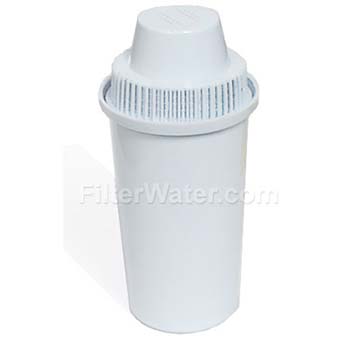
Crystal Quest Replacement Pitcher Filter (CQE-RC)

Water Testing BlogBacteria, Chlorine, Copper, Hardness, Iron, Lead, mercury, Metals, Personal Water Filter, Pesticide, replacement water filter, THM, Trihalomethane, Water Filter

Crystal Quest pitcher replacement filter

Manufacturer: Crystal Quest
Model Number: CQE-RC

4 stages of convenient filtration with a 2,000 gallon capacity.

In stages 1 and 2 KDF55 and KDF85 media reduce iron, mercury, copper, nickel, chromium, other dissolved metals, and harmful bacteria.

Stage 3 features an ion exchange resin that reduces heavy metals (such as lead, copper, aluminum) and lowers water hardness.

The fourth and final stage, a bed of granulated activated carbon (GAC) reduces chlorine by 99.9%, gets rid of bad tastes and odors, reduces pesticides and chemicals that are linked to cancer risks (i.e. benzene, THM’s, toxaphene).

How do you know if you need a water filter?

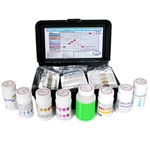
The answer, quite simply, involves testing your water. You can either test it yourself using a home water testing kit like the Water Quality Test Kit from SenSafe… or you can have a certified water testing laboratory such as National Testing Labs analyze your water.

In cases where homeowners suspect contamination, we always suggest using a certified water testing lab. Better to play it safe than sorry because… It’s your water, your health… and your LIFE!

Jul
17

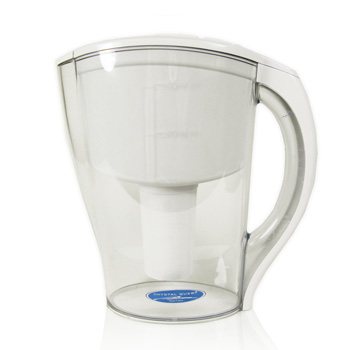
Water Pitcher Filter to Remove Chlorine and Heavy Metals

Water Testing BlogBacteria, Chlorine, Copper, Hardness, Iron, Lead, mercury, Metals, Pesticide, THM, Water Filter, Water Testing

Crystal Quest Pitcher Water Filter
Manufacturer: Crystal Quest
Model Number: Pitcher-Ultimate

Large capacity water pitcher w/ built-in filter provides clean, great-tasting water conveniently chilled and stored in your refrigerator.

Capable of removing more than 99% chlorine from more than 2,000 gallons of water, this large 10-cup (2.5 quarts) pitcher features a slim, space-saving shape that fits neatly in pretty much any refrigerator. Filters have a life expectancy of between 6 and 12 months depending upon water usage rate.

The Crystal Quest Pitcher Water Filter makes use of a high quality 4 filter technology to produce drinking water of superior quality:

  • Stages 1 & 2 — Two types of specialized filtration media (KDF55 and KDF85) greatly reduce and/or eliminate dissolved metals such as iron, mercury, copper, nickel, chromium. Bacteria also gets filtered out at this stage.

  • Stage 3 — Ion exchange resin reduces heavy metals such as lead, copper, and aluminum. Water hardness levels get drastically reduced in this stage as well.

  • Stage 4 — Granulated activated carbon (GAC) reduces chlorine (99.9%), removes bad taste(s) and odor(s), and reduces pesticides and chemicals linked to increased cancer risks (i.e. benzene, TTHMs and toxaphene).

    Need another great reason to consider the Crystal Quest Pitcher Water Filter? Consumer Digest rated it as a best buy for 2 years in a row (2006, 2007).

    Your Cost at FilterWater.Com: Around $25

Jul
6

Old Sewer Lines Can Threaten Water Quality?

Water Testing BlogBacteria, Coliform, Copper, Environmental, Home Water Testing, Lead, mercury, Metals

Drinking Water Test Kit

We said it before and we will say it again: Ultimate responsibility for the quality of the water you drink rests with YOU.

Far too often we trust that the water entering our homes contains no harmful contaminants because our water treatment plant ‘has one of the best reputations in the business’ or has ‘never had a violation or failed an inspection’. We forget our local water treatment plant’s crystal clear, safe travels through many miles of different types and sorts of pipes before it reaches our faucets.

At any point in that journey a tiny crack in any one of the pipes could allow potentially harmful contaminants to enter the water stream… and travel to our faucets. A multitude of coliform bacteria can work their way through openings far smaller than half of a millimeter in size with the greatest of ease.

Oh, and at one point in time or another, health officials deemed materials like lead safe for use in drinking water pipelines.

Most people take for granted every day that the water from kitchen taps and the vegetables from home gardens or stores will be clean and safe.

But if sewer pipes lying beneath local streets and yards are damaged or broken, there’s potential for serious problems, say health, environmental and utility officials.

Because pipes carrying fresh, clean water often lie in the same ditches, tunnels and infrastructure rights of way as sewer lines, there is tremendous potential for drinking water or irrigation water to be contaminated.

“Your water can be contaminated right out in the street in front of you,” said Dr. Mark LeChevallier, director of innovation and environment stewardship for American Water Co., the parent company of Tennessee-American Water Co., which serves Chattanooga.

Dr. Rand Carpenter, an epidemiologist and waterborne illness specialist with the Tennessee Department of Heath, says once that contamination is there, all it takes is contact and an unwashed hand.

Sewage contains pathogens, bacteria and viruses, he said, and if people touch something bearing those germs, they can get sick.

“These are big concerns to us in the health department,” he said.

Emerging strains of E. coli have proven very dangerous, especially to the young, the elderly or people whose immune systems are deficient.

Even a norovirus, “what we grew up calling the 24-hour virus,” can be a culprit of contamination that began with sewage, Dr. Carpenter said. ( source )

Periodic testing of tap water for simple things like heavy metals (i.e. lead, copper, mercury, etc.) and bacteria helps ensure the safety of everyone in your home.

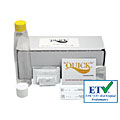
Test Products: Test Kit for Coliform Bacteria
Test Kit for Coliform Bacteria

Filter Water: Bacteria in Water Test Kit
Bacteria in Water Test Kit

Filter Water: Bacteria in Water Test Kit
Bacteria in Water Test Kit

Jun
21

Chemicals Found in Mountain Island Lake Fish (Metals and PCB’s)

Water Testing BlogArsenic, Arsenic in Water, Environmental, Lead, mercury, Metals, Water Testing

A recent study done on fish and sediment taken from Mountain Island Lake in North Carolina detected higher than expected, and some cases safe, levels of toxic metals and PCB’s.

Toxic chemicals and heavy metals are collecting in the tissue of fish and the sediment beneath the water of Mountain Island Lake, according to a new study out this week.

A recent independent study by the Catawba Riverkeeper Foundation determined that drinking water supplied by the lake is safe but the fish and sediment from the lake contains high levels of unacceptable industrial matter, according to David Merryman, Catawba Riverkeeper.

“I think from these results we should at least evaluate our fish consumption for PCBs, and that’s something I’ll be calling for,” said Merryman.

A PCB concentration of 70.7 parts per billion was found in largemouth bass that were tested. That is more than 20 points higher than levels considered safe by the U.S. Environmental Protection Agency, said Merryman.

Mountain Island Lake provides water to Gastonia, Mount Holly and several other municipalities and is also a popular fishing spot for anglers in the area.

Samples of fish also showed signs of barium, mercury and selenium.

Any advisories about the consumption of fish would have to come from the N.C. Department of Health and Human Services.

The water in Mountain Island Lake proved to be free of PCBs but did include arsenic and barium. Sediment contained arsenic, barium, lead, selenium and mercury. These elements may not surpass acceptable levels, but they are alarming to Merryman.

“This is important. This is the water we drink. It’s where we swim,” he said.

Many of the chemicals detected during the independent test come from the neighboring coal-ash ponds operated by area power plants, according to Merryman.

While the coal-ash ponds are independent of Mountain Island Lake, water is skimmed off the top of the ponds regularly and dumped into the lake.

“Those coal-ash ponds are a source of heavy metals to that lake that a million and a half of us depend on to drink, to cook and wash our clothes,” said Merryman. “We really shouldn’t let industry pump heavy metals into a lake that we depend on.”

Duke Energy is allowed to discharge into the river system under a permit.

The Catawba Riverkeeper Foundation contracted with Pace Analytical Laboratories in Huntersville to conduct the tests on Mountain Island Lake.
( source )

We will post more information about the water quality in Mountain Island Lake as we learn it. For now, though, please take a look at the test kits below, as they will work for testing lake water, tap water and well water for potentially hazardous levels of metals in water.

Filter Water: Water Metals
Heavy Metals in Water

Filter Water: Arsenic in Water Test Kit
Arsenic in Water Test Kit

Filter Water: Lead in Water Test Kit
Lead in Water Test Kit

May
31

Testing for Copper in Water… and Other Metals

Water Testing Blogalkalinity, Copper, Ground Water, Home Water Testing, Iron, Lead, mercury, Metals, Pool Water, Test Strip, Water Quality Testing, Water Test Kit, Water Testing, Well Water

Copper in Water Test Strips

A naturally occurring reddish metal that appears in rock, water, soil, sediment and in the air, copper has unique physical properties which make it perhaps one of the most commonly used and important metals. You can find copper in pennies, as part of electrical wiring systems, and in plumbing. You can also find it used in some pesticides and algaecides.

As humans we require a minute amount of copper to live, but as with anything, too much copper in a short period of time and prolonged exposure to excess copper can have detrimental effects on our health.

For that reason health officials suggest testing your drinking water for copper, and other things obviously, on a semi-regular basis… especially if you live in an older home, in an area that has older water delivery lines, or if you have well water.

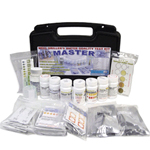
Well Water Test Kit: Master

How can you test for copper?

Previously you would have to use a test kit that used drops, tablets, powders, etc. or have your water tested by a water testing laboratory. As usual we suggest that people use water testing labs if they have serious reason to suspect drinking water contamination and that owners of wells have their water tested by a certified water testing lab at least once a year, for occasional testing needs you can use copper test strips such as the John’s Copper product manufactured by SenSafe.

If you think you may have a need to test your water for copper, then you may also want to test for other metals such as iron, manganese, mercury, and lead.

A test kit such as the Well Driller Master Test Kit has all those tests and more.

Filter Water: Arsenic Mini Test Kit
Arsenic Mini Test Kit

Filter Water: Manganese Test Kit
Manganese Test Kit

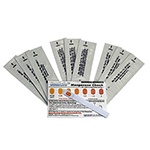
Filter Water: Water Metals
Water Metals Check

Filter Water: Well Driller Test Kit
Well Driller Test Kit

Filter Water: Mercury Test Kit
Mercury Test Kit

Filter Water: Ida's Iron Check
Ida’s Iron Check

Mar
30

Question: Where Can I Get a Water Test Kit for a Science Project?

Water Testing BlogArsenic, Arsenic in Water, Bacteria, Chlorine Testing, Copper, Environmental, Hardness, Home Water Test Kits, Home Water Testing, Iron, Lead, mercury, Metals, Nitrate, Pesticide, pH, Water Quality Testing, Water Test Kit, Water Testing

Lisa wrote in on behalf of her son who wishes to perform water testing on the water in the creek near their home for a science project:

My son is doing a science project on the water in the creek by our house. He wants to measure the runoff contaminants after a rain storm and then measure again a few weeks later to see the change and what was washed into the creek. What test kits should he buy and where should he get it.

thank you.

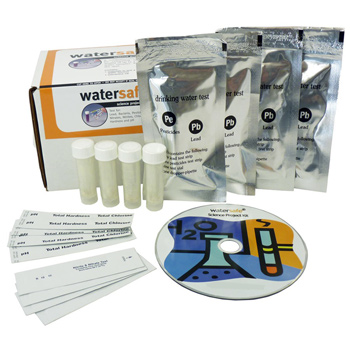
WaterSafe manufactures a science project test kit which may prove useful for your son’s project. The WaterSafe Science Project Kit includes tests for Lead, Bacteria, Pesticides, Nitrates, Chlorine, Hardness and pH. It comes with enough testing materials to test a total of four separate bodies of water or the same body of water on four separate occasions.

The kit also comes in a larger size which includes ten sets of tests for the parameters mentioned above. See Science Project Kit 10-Pack for additional details.

Testing for Chemical Pollutants and Contaminants

Water Metals (Heavy) Test Kit

As a general rule, you will not find a test kit that can test for chemical pollutants because testing for such items typically requires the use of advanced laboratory techniques and/or equipment.

This does not mean, however, that you cannot test for other, more natural forms of pollution. The USEPA forbids the dumping excessive amounts of iron, copper, chromium, arsenic, mercury, cyanide, etc. into the environment… and at-home test kits DO exist for those compounds.

Filter Water: Lead in Water Test Kit
Lead in Water Test Kit

Filter Water: Arsenic in Water Test Kit
Arsenic in Water Test Kit

Test Products: Mercury in Water Test Kit
Mercury Test Strips

Test Products: Chromium in Water Test Kit
Chromium in Water Test Kit

Test Products: Cyanide in Water Test Kit
Cyanide in Water Test Kit

Test Products: Total Iron in Water Test Kit
Total Iron in Water Test Kit

Mar
12

Safer, Cleaner Water For Babies

Water Testing BlogBottled Water, Lead, mercury, Metals, Water Filter

Whether you have just celebrated the birth of a new baby or have already gone through a few sleepless nights with a young one that arrived a few months ago, you know you need to keep your baby safe from danger… so you have car seats, plugs for electrical outlets, gates by the stairway, childproof locks on the lower cabinets in the kitchen and bathroom, etc. You may have even stopped smoking and/or invested in a better air filters for your furnace and/or air filters for your air conditioning unit to make sure your baby has clean air to breathe at home.

Now think about this: The last time you made bottles for your little one, did you give any thought to the quality of the water you mixed in with that nutrient-rich, and usually very expensive, formula or cereal?

Water Metals (Heavy) Test Kit

Even if you boiled the water before use, which would effectively kill off most microorganisms, contaminants such as heavy metals (i.e. lead and mercury) will remain in the water and actually become greater in concentration.

So if boiling the water first may not make the water safe, then what will?

If you take a stroll down through the baby section of your local Wal-Mart or Kmart you will see that you can buy purified ‘baby water’ in various bottle sizes… which means purchasing the products would a support the bottled water industry and many people do NOT want to do that.

With pretty much all other options exhausted, it looks as though point-of-use water filtration systems such as countertop, faucet, and undersink water filters may provide the most economical, convenient, and environmentally friendly solutions.

WaterFilters.Net: Reverse Osmosis Water Filter
Reverse Osmosis Water Filter

WaterFilters.Net: Under Sink Water Filter
Under Sink Water Filter

WaterFilters.Net: Faucet Water Filter
Faucet Water Filter

WaterFilters.Net: Countertop Water Filter
Countertop Water Filter

WaterFilters.Net: Water Coolers
Water Coolers

WaterFilters.Net: Whole House Filters
Whole House Filters

How Do Know If I Have Good/Bad Water?

We get emails asking that question in an email at least three or four times a week and we answer the same way each time: TEST YOUR WATER or HAVE YOUR WATER TESTED.

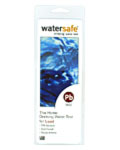
Home Water Quality Test Kit

Another good place to start involves requesting a copy of your local water system’s most recent Consumer Confidence Report (CCR). If your local water system serves more than 100,000 customers the Federal Government requires that it make its CCR for the previous year available on a public web site by July 1st.

Keep in mind, though, that the CCR reports the quality of water as it exited the water treatment facility, not the quality of water as it came out of your tap. Only testing water at your tap will tell you the full story about the quality of your tap water.

For assistance with drinking water testing, take a look at the following links:

Mar
5

Bass in Juniata Reservoir Test Positive for Mercury

Water Testing BlogCopper, Environmental, Home Water Test Kits, mercury, Metals, Test Strip, Testing Devices, Water Quality Testing, Water Test Kit, Water Testing

A while back we posted an article about the extent of mercury contamination in freshwater streams and rivers in the United States and in that article we told you how fish from ALL 291 bodies of water tested came up positive for mercury. Therefore an article which recently appeared on the Denver Post web site about smallmouth bass in the Juniata Reservoir coming up positive for mercury contamination did not surprise us.

How certain government officials proposed to DEAL with the problem, however, DID shock us.

GRAND JUNCTION — A reservoir that provides drinking water for Grand Junction is closed for fishing because smallmouth bass there have tested positive for mercury contamination.

Steve Gunderson, director of the Colorado Department of Public Health and Environment’s water- quality division, says the mercury levels in Juniata Reservoir are extremely low, but mercury accumulates in fish. He says state health officials are meeting with city officials about keeping the reservoir off a list of bodies of water that don’t meet water- quality standards, if they can get rid of all contaminated fish or isolate the reservoir. ( source )

Sounds to use like the officials seem more concerned about keeping this body of water off the ‘contaminated list’ than they do about the actual underlying problem: Mercury in the water!

Granted the article only gave a brief overview of the situation at Juniata Reservoir, but we really find it strange that the proposed method of ‘solving’ the problem involves removing (killing) all the smallmouth bass… and/or keeping those fish from migrating to another body of water.

No matter how you look at it, once again it seems that certain government bodies care more about regional revenue from tourism, revenue from sport fishing, and revenue in general than they do about finding the underlying cause of all the problems… and this means, to some extent, that the general public must keep a vigilant eye on issues involving contamination of lakes, rivers, ponds, streams, and any other bodies of water because government agencies have their own agendas which may or may not include keeping toxic materials out of the water.

SenSafe Heavy Metals Check

Testing for Metals in Water

A quick and efficient way of testing for the presence of metals in your water involves the use of a water testing product such as the SenSafe Water Metals Check which provides users with semi-quantitative water metals levels in under three minutes.

SenSafe Water Metals Check requires no iodine indicator solution, no meter, and no specialized training. Just dip the strip for 20 seconds, wait two minutes, and match color on the end of the strip to the color chart provided on the bottle.

Metals detected by SenSafe Water Metals Check include, but are not limited to, copper, cobalt, zinc, cadmium, and nickel.

SenSafe Water Metals Check has a low detection limit of 10ppb (parts per billion), much lower than any comparable product on the market.

What About Testing for Mercury in Water?

Simple test kits exist for testing mercury levels in drinking water as well. SenSafe manufactures two different Mercury in Water Test Kits and both, like SenSafe Water Metals Check, require no meter or special training to use and yield results in a matter of minutes.

Test Products: Mercury in Water Test Kit
Mercury in Water Test Kit
Detection Range: 0.002ppm to 0.08ppm

Test Products: Mercury in Water Test Kit
Mercury in Water Test Kit
Detection Range: 50ppm to 1,000ppm

Jan
20

Puralytics Named as Finalist in Imagine H2O Prize

Water Testing BlogArsenic, Bacteria, Lead, mercury, Metals, Personal Water Filter, Water Filter

Puralytics Solar Bag

It always pleases us to see companies thinking outside the box when it comes to coming up with new and efficient ways to produce safe, clean drinking water. In this case, a company called Puralytics has developed a chemical-free solar powered water purification system that creates no waste stream.

By combining the work of five photochemical processes at once, Puralytics water purification systems break down or remove contaminants from water by actually destroying contaminants rather than capturing them and creating a hazardous waste disposal problem.

  1. Photocatalytic Oxidation — Previously unobtainable, selected wavelengths of UV light generate unprecedented levels of hydroxyl radicals (OH-) without any chemical additives.

  2. Photocatalytic Reduction — Reduces toxic species such as mercury (Hg II), silver (Ag I), arsenic (As V, and chromium (Cr VI) to more readily adsorbed materials.

  3. Photolysis — Direct disassociation of contaminants by high intensity UV light, including atrazine, amoxicillin, DEET, and all estrogenic chemicals.

  4. Photoadsorption — The catalyst strongly adsorbs heavy metals including mercury, lead, selenium, and arsenic, permanganate, and other compounds.

  5. Photo Disinfection — Multiple wavelengths and high intensity UV disinfect pathogens more effectively than standard UV germicidal.

Below you will find the Press Release issued by Puralytics on January 14th, 2010 from their Beaverton, Oregon office:

Puralytics, an emerging leader in advanced water purification technology, announced it has been selected as a finalist in the first Imagine H2O prize. This year’s prize focuses on water efficiency, and Puralytics is able to remove contaminants from water without water loss and without generating a waste stream, which is common with other technologies.

Imagine H2O is a non-profit organization founded in 2007 by a team of leading venture capital firms and financiers, water technology leaders and academics from Harvard Business School. The Imagine H2O Prize Competition highlights new technology that can address critical water challenges. Puralytics was selected as a finalist because of their unique, chemical-free purification capability, and water savings of thousands of gallons per day.

Puralytics has developed a new photo purification technology for water which uses precise wavelength LEDs in conjunction with a fixed photocatalyst to effectively remove organic compounds, heavy metals, and pathogens from water. For more information on the Puralytics technology and products, please visit: www.puralytics.com. The Shield 500 is available for industrial and commercial applications, and the sunlight powered SolarBag for developing world and disaster relief applications will be available in early 2010.

About Puralytics

Puralytics is an early stage company in Beaverton, Oregon, developing water purification products that effectively remove all of the emerging contaminants such as petrochemicals and pharmaceuticals, eliminate heavy metals like arsenic, lead, and mercury, and provide disinfection of bacteria, viruses, and other pathogens. These products have wide applicability for ultrapure and laboratory processes, well water purification, waste and grey water processing, and remote drinking water purification. Puralytics was also chosen by The Artemis Project as a Top 50 Global Water Technology Company competition winner, announced on Earth Day 2009.

Contact:
Dave Moser
Vice President of Business Development
Puralytics, Inc.
15250 NW Greenbrier Parkway
Beaverton, OR 97006-5764
USA
Ph: +1 503 913-5194
dave.moser@puralytics.com
www.puralytics.com (source )

So you may now wonder what exactly this company has created that has gotten them all this attention. Stay tuned for future Water Testing Blog entries on the topic of Puralytics Water Treatment Devices.

Jan
13

Metals in Drinking Water

Water Testing BlogArsenic, Arsenic in Water, Copper, Home Water Testing, Iron, Lead, manganese, mercury, Metals, Water Quality Testing

Many of the emails we receive ask questions about topics involving testing for metals in drinking water and/or ways to effectively remove metals from drinking water.

Whether listed by the United States Environmental Protection Agency as a serious health concern or just a general nuisance, most people care about only one thing: Testing for metals in drinking water and removing them ASAP!

Commonly asked about metals include…

Lead in Water Test Kit

Dissolved Lead

Low Range Iron in Water Test Kit
Iron in Water Test Kit

Dissolved (Ferrous) Iron

Mercury in Water Test Kit

Dissolved Mercury

Questions about other metals such as manganese, copper, chromium and, of course, our dear friend arsenic, also make their way into emails sent through our Contact Us page.

Why the Concern Over Metals in Water?

Health officials unanimously agree that excessive exposure to dissolved metals in water can in many cases lead to serious side effects such as cancer, organ damage, impairment of the nervous system, the development of a life-threatening condition where the immune system attacks its own cells, a reduction in the growth and development of cells, joint problems/diseases, circulatory system problems, and last, but definitely not least… death.

Younger people stand to suffer the effects of exposure to metals more than adults do to their small body masses. In other words, an 8 oz glass of water containing X ppm (parts per million) of heavy metals will result in a much higher dose in a child than it will in an adult who drinks the same glass of water.

Some health officials theorize that very young children and unborn babies whose bodies develop at a rapid pace absorb the metals readily into their systems. Exposure of this nature often results in learning difficulties, damaged nervous systems, memory deficiencies, and even behavioral problems such as hyperactivity and aggressiveness.

More Information on Metals in Water: