About
Do you know what's in YOUR water? Learn about water quality, water quality testing, and water quality testing products that can help you make informed, educated decisions regarding the water treatment options for your home, office, swimming pool... and life.
Contact Us
Got a question about water quality? Want to share a water quality article or water quality article with others?

Visit our Contact Us Page to ask a water quality question or submit water quality information.

RSS Feed
Get the most recent water quality posts and comments by subscribing to the Water Testing Blog RSS Feeds.
Subscribe to RSS! Subscribe to RSS Comments!

Archive for the ‘Nitrite’ Category

Jun
2

Province to Pay for Well Water Testing — Winnipeg

Water Testing BlogBacteria, Coliform, Environmental, Ground Water, Home Water Testing, Nitrate, Nitrite, Pesticide, Water Quality Testing, Water Testing, Well Water

Once again flooding has potentially contaminated private wells, and this time it happened up in the province of Winnipeg in Canada where government officials recently announced that the Province would pick the tab for well water testing.

Although we hate to hear about areas getting flooded out, we do love to read about governments stepping in to assist victims with making sure they have safe, clean drinking water once the flood waters have gone down.

The provincial government is encouraging people with wells in flood-affected areas to get them tested once flood waters recede.

Officials said the province will cover the full costs of testing.

The province normally subsidizes well-water testing but the well owner’s share is now also being waived for the month of June for flooded areas, said officials.

Manitoba Water Stewardship is also recommending that people with wells in flooded areas boil their water or use alternatives such as bottled water until test results confirm the bacterial safety of their water.

Water samples should be marked 2010 Flood and sent to Maxxam Analytics, Unit D, 675 Berry St., Winnipeg, MB R3H 1A7. More information is also available by calling 204-772-7276 or 1-800-665-8566 (toll-free). ( source )

As a general rule victims of flooding whose wells may have gotten contaminated should, at the very least, test their wells for bacteria, nitrates/nitrites, heavy metals (i.e. copper, lead and iron) and pesticides. Individual situations may merit additional and/or repeated testing.

Interested in having a certified water testing lab take a look at your drinking and/or well water? National testing Laboratories has several different levels of testing available to the general public for reasonable rates.

May
15

Question: Springtime Testing Well Water in Farming Community?

Water Testing BlogBacteria, Environmental, Ground Water, Home Water Testing, Nitrate, Nitrite, Water Quality Testing, Water Testing, Well Water

Once the warmer weather starts to creep into the Heartland of the United States, snow in the high country begins to melt, the ground thaws out, and water flows freely over manure and fertilizer laced soil. As it does, it undoubtedly picks up elements of whatever it comes in contact with.

Potentially harmful drinking water contaminants such as nitrates, nitrites and certain types of bacteria enter the water and may eventually find their way into aquifers tapped for drinking water.

For that reason, along with a host of others, the staff at Water Testing Blog encourage all owners of private wells in agricultural regions to test their wells for nitrates, nitrites and bacteria not just in the Spring, but several times throughout the year.

WaterSafe Well Water Test Kit

For the task of testing well water, WaterSafe makes a handy Well Water Test Kit that tests for the following parameters: bacteria, lead, copper, iron, pesticides, nitrates, chlorine, pH, and water hardness.

Bacteria – strains of E.coli can cause serious illness or even death.

Lead – causes developmental harm, neurological and kidney damage.

Copper – causes liver and kidney damage in infants.

Iron – causes staining in laundry, dishes, bathtubs and sinks. Clogs pipes and gives off offensive odor.

Pesticides – from agricultural uses, linked to increased cancer rates.

Nitrates – from fertilizers and animal waste, causes developmental problems.

Chlorine – can increase cancer risk, gives water bad taste and smell.

pH level – can cause heavy metal (lead) leaching and plumbing damage.

Water Hardness – causes lime scale and higher detergent use.

Or, if you prefer to test for parameters individually w/o having to buy parameters you do not wish to test for, the following links ought to come in handy.

Free Chlorine Water Check Test Strips

Free Chlorine Water Test

Bacteria Check Water Test Kit

Bacteria Check Test Kit

Test Strips for Mercury in Water

Mercury Check
Water Test Kit

Water Quality Test Kit

Water Quality Test Kit

Total Hardness Test STrips

Total Hardness Test Kit

Water Metals (Heavy) Test Kit

Water Metals Test Kit

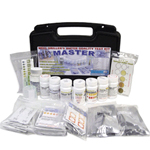
Well Driller Test Kit: Master

Well Drillers
Master Test Kit

Manganese Check Water Test Kit, 24 Strips

Manganese Check
Water Test Kit

Well Driller Test Kit: Standard

Well Drillers
Standard Test Kit

A final word… or more accurately a sentence

If you have serious reason to suspect your well water has become contaminated, get your water tested by a certified water testing lab such as National Testing Labs

May
6

Water Quality Test Kit for Homeowners

Water Testing BlogBacteria, Chlorine, Chlorine Testing, Copper, Free Chlorine, Hardness, Home Water Test Kits, Home Water Testing, hydrogen sulfide, Iron, Lead, Nitrate, Nitrite, Pesticide, pH, sensafe, Total Chlorine, Water Quality Testing, Water Test Kit, Water Testing

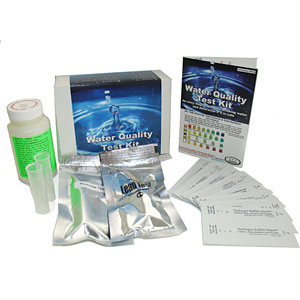
Water Quality Test Kit

We recently visited the Filter Water web site to see what new products they offered and discovered that they have LOWERED THE PRICE on the Water Quality Test Kit manufactured by SenSafe to $32 plus shipping.

Why do we keep talking about this particular home water quality test kit? Simple: It offers homeowners the opportunity to easily and safely test 15 different water quality parameters in a matter of minutes — except for the bacteria test which must sit for a day or two.

Why Should You Test Your Own Drinking Water?

We often get asked that question and our reply typically sounds like, “Have you paid any attention to the news lately? Areas all OVER the country have ‘issues’ with drinking water quality and we know other areas have problems, too, bu they just didn’t make the evening news.”

Need proof? OK, below you will find excepts from RECENT news stories related to water quality issues and water quality testing:

  • According to WBZTV, the repairs on the massive pipe that burst over the weekend have been completed and water quality testing has begun. At least two tests have to be performed to determine if the water meets the Federal standards for drinking water.

    According to Boston Globe, State officials are expecting clean water to be available to greater Boston residents within the next 24-48 hours. Ria Convery, a spokeswoman for the Massachusetts Water Resources Authority said “Whoo-hoo, the pipe held. We are back on the regular system and pending water tests, we expect to have (drinking water restored) within 24 to 48 hours.” For now though, the boil water order is still in effect. ( source )

  • Park Rapids is issuing the results of monitoring done on its drinking water for the period from Jan. 1 to Dec. 31, 2009.

    During the year, the city had a violation for Nitrate (as Nitrogen). The nitrate result that was over the MCL was collected from a well that is designated as an emergency back-up source. The system has an agreement with the MDH to use this source only in an emergency situation such as fire protection.

    The city’s system returned to compliance as of Aug. 25, 2009.

    Nitrate in drinking water at levels above 10 parts per million is a health risk for infants of less than 6 months of age. High nitrate levels in drinking water can cause blue baby syndrome. Nitrate levels may rise quickly for short periods of time because of rainfall or agricultural activity. ( source )

  • WASHINGTON – May 5 – A new testing method by the U.S. Environmental Protection Agency reveals that pollutants such as arsenic, antimony, chromium and selenium, can leach from coal ash at levels dozens and sometimes hundreds of times greater than the federal drinking water standard. This news comes on the heels of EPA’s proposal to regulate coal ash, in which the agency offered two options: a plan to regulate coal ash as hazardous waste and another to regulate it as non-hazardous. ( source )

So you see, water testing takes place all the time. Some people do it because they have to, as in the case of municipal water systems, others do it because of a problem, as in the case of city workers after a water main break, and others do it because they want to put an end to some form of pollution… as in the case of the EPA looking to regulate coal ash because of its ability to leach arsenic and other dangerous metals into the public water supply.

WaterFilters.Net: Chlorine, Iron, Nitrates and Hardness Test Kit
Culligan TK-2 Water Test Kit

WaterFilters.Net: WaterSafe All in One Test Kit
WaterSafe All in One Test Kit

WaterFilters.Net: WaterSafe Well Water Test Kit
WaterSafe Well Water Test Kit

WaterFilters.Net: Complete Home Water Test Kit
Complete Home Water Test Kit

WaterFilters.Net: Arsenic in Water Test Kit
Arsenic in Water Test Kit

WaterFilters.Net: Well Drillers Test Kit
Well Drillers Test Kit

Apr
19

Question: Are All Water Test Meters Complicated?

Water Testing BlogAmmonia, Bromine, Chlorine, Chlorine Testing, Copper, eXact Strip DPD, Free Chlorine, Hardness, Home Water Testing, Iron, manganese, Metals, Nitrate, Nitrite, Ozone, pH, Testing Devices, Total Chlorine, Water Quality Testing, Water Test Kit, Water Test Meters, Water Testing

Kyle from Florida asked,

My company does a lot of plumbing work for residential and commercial customers. Not all the time, but many times we get asked to test the water once we finish a job. I see a lot of test kits that use drops and those test strips on the market, but I want to use something a bit more professional like a meter of some sort. All the meters I’ve seen out there that test for a bunch of parameters have a ton of buttons, vials, powders and an instruction manual you could use to knock out a cow. Do they make a multipurpose water testing meter for the simple guy? Thanks for your help and I love the site. Lot of good info here!

Stop it, Kyle, before you make us blush!

To answer your question directly, yes you can find a reliable water testing meter made for the ‘simple guy’ and no you will not have to attend night school just to figure out how it works.

The eXact Micro 7+ Water Testing Meter offers extreme versatility, has only one button to worry about, does not use vials, and comes with a handy, compact manual barely capable of killing a fly.

Below you will see a quick demonstration of how easily you can test water:

eXact Micro 7+ Water Testing Meter

Now Kyle, if that looked like too much work, or like it involved way too much ‘technical stuff’, then you may as well hang up your water testing hat(?) and send all your samples out to a place like National Testing Labs ‘cuz testing water in the field does not get any easier than it does with the eXact Micro 7+ Water Testing Meter.

eXact Micro 7+ Water Testing Meter

  • Direct read parameters — Total Alkalinity, Bromine, Calcium Hardness, Free Chlorine, Total Chlorine, Copper, Ozone, Permanganate, and pH

  • Additional parameters — Ammonia, Chloride (as NaCl), Chlorine Dioxide (DPD-1), Chromium Hexavalent, Cyanuric Acid, Fluoride, Hydrazine, Hydrogen Peroxide (Low, Mid and High Range), Iodine (DPD-1), Iron (Fe+2), Total Iron (Fe+2/Fe+3), LR Total Hardness (as CaCO3), Magnesium, Manganese, Nitrate (as NO3), Nitrite (as NO2), pH (Acid and Alkali), Potassium, Protein (as BSA), Sulfate, Sulfide, and Turbidity. Kit includes conversion chart for these parameters.

  • USEPA Compliant meter for Free & Total Chlorine — 0.01 ppm (mg/L) precision

  • Built-in, permanent cell — no loose glass or plastic cells to lose

  • Easy fill testing — Simply fill or dip meter into water

  • Automatic countdown timer for accurate timing of testing

  • 140 test memory — saves 20 tests per menu item

  • No-slip grip housing — ideal for wet testing conditions

  • Lightweight — weighs only 6 ounces w/ batteries installed

  • Waterproof — IP-67 Rated and meter will float if dropped into water

  • Easy-to-read LCD display — no color matching required

  • Environmentally friendly — recyclable parts & uses 60% less reagents than 10mL sample tests

  • CE certification
Mar
4

Feds Testing Lower Valley Wells for Bacteria and Nitrates

Water Testing BlogBacteria, Coliform, Environmental, Ground Water, Home Water Testing, Nitrate, Nitrite, Water Quality Testing, Water Testing, Well Water

We recently read that the Federal Government has decided to investigate the severity and cause elevated nitrate and bacteria levels in well water out in the State of Washington.

From the sounds of things, the situation has gone on for quite some time… and residents in rural Lower Yakima Valley may have had elevated nitrate and bacteria for quite some time now w/o anyone really looking into where the contaminants came from.

Stories like this one ought to make EVERY private well owner seriously consider having their water tested by a certified water testing laboratory and performing routine checks themselves with at-home well water test kits — because the responsibility for the safety of private well water rests solely with well owners.

YAKIMA, Wash. — An effort to address polluted groundwater consumed by many rural Lower Yakima Valley residents was formally launched Thursday as local, state and federal officials pledged to tackle a stubborn problem that’s been decades in the making.

“It’s going to be a big challenge. It’s a difficult problem,” said Tom Tebb, regional director for the state Department of Ecology in Yakima.

“But it matters because we have people drinking water contaminated by nitrate and bacteria and at unsafe levels in some cases,” Tebb said at a news conference to announce the effort.

Five agencies released the final version of a report on groundwater quality that is a wide-ranging compilation of historical data about the contamination, health effects, regulatory responsibilities and recommendations for action.

Of some 30,000 private wells in the Lower Valley, 20 percent have elevated levels of nitrate and bacteria.

This week, federal regulators began their own testing program on 150 wells to try and determine the source of the nitrates and bacteria.

To make sure the samples are tested in a timely fashion, a mobile laboratory has been driven to Yakima from Manchester, Wash., on the Kitsap Peninsula, home of the regional lab for the U.S. Environmental Protection Agency.

Two microbiologists will test for coliform bacteria, fecal coliform and e. coli and conduct “microbial source tracking” to determine if the bacteria are human or ruminant. Cattle are ruminants, and manure from dairy and feedlots is one suspected source of both nitrate and bacterial contamination.

Another round of testing in April will help the agency determine the link between elevated levels of nitrate and sources of nitrate, which can come from manure, chemical fertilizer or septic systems.

If the test results allow regulators to identify obvious sources of pollution, enforcement action could follow, said Tom Eaton, director of the Washington operations office of the EPA in Seattle.

Results are expected sometime this summer. ( source )

If you own a private well and do not have your water tested on a regular basis you run the risk of exposure to an almost limitless number of contaminants that can get into the aquifer at any time and for a number of reasons. Natural disasters, changes in weather patterns, heavy demand from other well owners, etc. can all affect the quality of the water in your well.

Water Tests by a Certified Drinking Water Testing Lab

National Testing Labs

Short of having the Environmental Protection Agency come out and test your well and/or water, no better option exists than to have your water tested by a certified drinking water testing laboratory like National Testing Laboratories which offers three levels of testing:

Basic Test Kit — Tests for 27 Common Drinking Water Contaminants: Aluminum, Arsenic, Barium, Cadmium, Calcium, Chromium, Copper, Iron, Lead, Magnesium, Manganese, Mercury, Nickel, Selenium, Silver, Sodium, Zinc, Alkalinity, Chloride, Fluoride, Nitrate as N, Nitrite as N, Sulfate, Hardness, pH (Standard Units), Total Dissolved Solids, and Turbidity (Turbidity Units).

Most Popular Test Kit — Tests for 83 Drinking Water Contaminants: Bacteria (presence/absence for coliform and E.coli), (19) heavy metals and minerals, (6) other inorganic chemicals, (5) physical characteristics, (4) trihalomethanes and (47) volatile organic chemicals.

Most Popular + Pesticides — Tests for 83 Drinking Water Contaminants: Bacteria (presence/absence for coliform and E.coli), (19) heavy metals and minerals, (6) other inorganic chemicals, (5) physical characteristics, (4) trihalomethanes and (47) volatile organic chemicals plus an additional 20 tests for pesticides, herbicides and PCB’s.

Feb
18

Question: How Does a Reverse Osmosis Filter Work?

Water Testing BlogArsenic, Arsenic in Water, Copper, Iron, Lead, Metals, Nitrate, Nitrite, Reverse Osmosis, TDS, Water Filter, Water Testing

SusanB wrote us recently to ask a question that many people people have probably asked after reading some of the postings here on the Water Testing Blog, but never bothered to ask anyone at the Water Testing Blog

Your site and many others talk about ‘reverse osmosis‘ water treatment systems all the time but never really explain how they work. Are they just some sort of fancy carbon filter or something? I really want to know because I need to do something about my bad water and if they’re no different, except in price, than a simple carbon filter then I won’t waste my money on one. Can you explain the difference? IS there a difference? Thanks!

Actually, SusanB, we have posted information on Reverse Osmosis Water Filters in the past that addresses most of the questions you asked… :)

And now, after re-reading our own posts we have decided that we really ought to locate and re-post a more user-friendly definition and explanation of reverse osmosis water filtration.

There are a range of water filtration systems available to today’s consumer to meet the different challenges of raising water quality. Often, a simple activated carbon filter does the trick, but many people have more complicated water problems, and find that they need more complex water filtration systems because of this. A reverse osmosis water filtration system will, in many cases, solve these more advanced problems.

Reverse osmosis (RO) water filtration is a multi-step water filtering process which works slowly but is extremely effective. Reverse osmosis systems are generally used to treat cooking and drinking water supplies. It’s often used in industry but works very well in the home. Reverse osmosis uses the principles of osmosis (in which material passes slowly through a membrane and is concentrated and purified in the process) to produce very clean water.

The first step is that a simple sediment filter is installed and all water to be used passes through it; the filter catches large particles of materials such as rust or calcium carbonate (a compound which is not at all harmful but which isn’t desirable in your drinking and cooking water – it’s commonly used as an antacid). Sometimes a second filter of a similar design, but more fine, is used after the initial filtering. An activated carbon filter traps organic chemicals, and then the RO filter, which is a very fine membrane, is used. It may be helpful to think of all these filters as being similar to sieves with differently-sized holes. Basically, the process of reverse osmosis water filtration would be akin to draining cooked food through a series of increasingly-fine sieves, rather than just emptying the pot into a basic perforated colander. Reverse osmosis water filtration systems, being more complex and increasingly sensitive, can trap far more contaminants than just one simple carbon filter. Some RO systems will, even after the water has passed through the RO membrane, use yet another carbon filter or, alternatively, an ultra-violet lamp, to purify the water even further. The result of all of this filtering is extremely high quality water.

Reverse osmosis is not the most efficient of all water filtration systems, and some have expressed concern about the fact that it takes approximately four gallons of processed water to result in one gallon of clear water. However, its effectiveness makes it a preferred water filtration method for many. Some describe it as “ultrafiltration,” which gives a sense of how powerful RO is. RO results in very pure water. The Water Quality Association says that RO filter systems produce water purity levels as high as 95 percent, which is extraordinary.

The fact remains that reverse osmosis water purification systems remove an astounding range of contaminants from your water. Arsenic, barium, cadmium, chromium (hexavalent), chromium (trivalent), copper, lead, nitrate, nitrite, radium 226/228, selenium, iron and TDS are all removed from your water with an RO system.

A reverse osmosis water filtering system is obviously more complicated than a simple carbon-filter water pitcher, but the benefits of its complex design are also obvious. For those who are concerned not merely with the aesthetics of their water – taste – but have more concrete problems with water quality, an RO water filter may be the best solution to your problem. ( source )

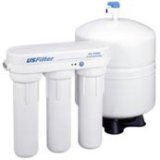
Well, SusanB, and everyone else reading this, we hope the information above helped you to understand a little bit more about the ways in which reverse osmosis water filters operate and the benefits they offer. Below you will find links to three popular reverse osmosis water filters units available from WaterFilters.Net.

WaterFilters.Net: Pentek RO-3500
Pentek RO-3500
3-Stage RO System

WaterFilters.Net: PuROLine 5000 RO System
PuROLine 5000 RO System
5-Stage RO; 100 Gallons/Day

WaterFilters.Net: PuROTwist 4000 Gold Series
PuROTwist 4000 Gold Series
4-Stage RO; 50 Gallons/Day

Feb
1

Test Strips for Unusual Water Parameters

Water Testing BlogAmmonia, Bacteria, Chlorine, Free Chlorine, Home Water Test Kits, hydrogen sulfide, Nitrate, Nitrite, Ozone, Peroxide, sensafe, Test Strip, Testing Devices, Water Test Kit, Water Testing

Over the past 2 years we have mentioned test strips for commonly tested water parameters such as chlorine, pH, water hardness, bacteria, and heavy metals on a regular basis. Recently someone asked us if we knew of test strips for other, less commonly tested water parameters.

Without knowing exactly WHICH unusual water parameters to look for we just started searching for odd water contaminants and came up with the following:

Ozone Check
Ozone Check

Ultra Low Hydrogen Sulfide

Bacteria, Nitrate, Nitrite, Ammonia
Bacteria/Nitrate/Nitrite/Ammonia

Chloride Check
Chloride Check

Zinc Check
Zinc Check

High Range Free Chlorine

Peroxide Check
Peroxide Check

Iodine Check
Iodine Check

Jan
26

Simple Test for Nitrates and Nitrites in Water

Water Testing BlogNitrate, Nitrite, Test Strip, Testing Devices, Water Quality Testing, Water Test Kit, Well Water

Nitrate: In inorganic chemistry, a nitrate is a salt of nitric acid with an ion composed of one nitrogen and three oxygen atoms (NO3). In organic chemistry the esters of nitric acid and various alcohols are called nitrates. Nitrogen trioxide is an alternative name for nitrate. ( source )

Nitrite: The nitrite ion is NO2. The anion is bent, being isoelectronic with ozone. More generally, a nitrite compound is either a salt or an ester of nitrous acid. ( source )

Nitrate/Nitrite Test Strips

WaterWorks™ Nitrate / Nitrite (as Nitrogen) test strips make in-home and field testing for nitrates and nitrites in water a fast, easy process. This product requires no tablets, powders, or counting of drops… making it well-suited for on-site well testing or the occasional testing of drinking water at home.

Each WaterWorks™ Nitrate / Nitrite test strip performs (1) one nitrate test and (1) one nitrate test.

* Dip strip into sample for a period of two seconds
* Remove strip and wait one minute
* Compare developed colors on test pads to color charts on bottle label

Each bottle of WaterWorks™ Nitrate / Nitrite test strips comes with a total of (50) fifty nitrite tests and (50) nitrate tests.

Detection Ranges:

Total Nitrate (NO3): 0, 0.5, 2, 5, 10, 20, 50 ppm (mg/L).

Total Nitrite (NO2): 0.15, 0.3, 1, 1.5, 3, 10 ppm (mg/L)

Dec
29

Question: All-in-One Home Water Test Kit for Around $30?

Water Testing BlogBacteria, Chlorine, Copper, Hardness, Home Water Test Kits, Home Water Testing, Iron, Lead, Metals, Nitrate, Nitrite, Pesticide, pH, sensafe, Total Chlorine, Water Quality Testing, Water Test Kit, Water Testing, watersafe

Spencer wrote in and asked…

Hello,

I am looking for an all-in-one home test kit that will show ppm levels. I thought I saw a product that was around $30 but now I can’t find the web-site.

Do you have any suggestions?

Thanks,

Spencer

WaterSafe All in One Water Test Kit

Thank you for your question, Spencer. For the most part all drinking water test kits (worth buying) should the majority of their results in parts per million, with the exception of some tests for metals which report their results in parts per billion. Example: Heavy Metals Check.

Getting to the rest of your question, a brand of home water test kits called WaterSafe manufactures a test kit called the All-in-One and it tests drinking water for the following: Bacteria, Lead, Pesticides (atrazine & Simazine), Iron, Total Chlorine, Total Hardness, pH, and Nitrates/Nitrites.

In our experience the average consumer can pick up the WaterSafe All-in-One Water Test Kit for around $20 from several online vendors including, but not limited to, the following:

Filters Fast: Water Quality Test Kit

Hopefully we have given you the information you asked for. In the event that you did not mean the WaterSafe All-in-One Water Test Kit specifically, and instead used the term ‘all-in-one’ in a more general manner, you may want to take a look at another brand of home water test kits: SenSafe.

Under the SenSafe brand you will find test kits such as the Drinking Water Quality Test Kit which typically costs a little bit more than the WaterSafe All-in-One Water Test Kit, but tests for additional parameters: Copper, Free Chlorine, Sulfate, Chloride and Hydrogen Sulfide (rotten egg smell).

You can usually find the Drinking Water Quality Test Kit by SenSafe selling online for around $32 to $36 depending upon where you look.

Feel free to contact us again, Spencer, if you have any other water quality testing questions!

Dec
11

Testing Water in Ponds, Lakes, Rivers, Streams, Etc.

Water Testing BlogBacteria, Environmental, Nitrate, Nitrite, Water Quality Testing, Water Testing

Ever wonder about the quality of the water in the stream running on the edge of your property where the kids play? How about the water in the pond or lake where you go swimming in the Summer?

If you have not, then you probably don’t know that those bodies of water can sometimes contain high levels of nitrates, nitrites, bacteria, and other natural ‘things’ which can, in the right concentrations, cause illness in animals and humans.

  • Health officials closely monitor water conditions at public beaches for a reason: High levels of the aforementioned naturally occurring compounds, and others, can make swimmers ill.

  • Pond owners monitor the conditions of the water in their ponds for a reason: Too much of the aforementioned naturally occurring compounds makes the water in their ponds toxic to fish… and it costs money to replace fish.

  • Environmentalists pay close attention to nitrate, nitrite and bacteria levels in surface water for a reason: Too much or too little of any may signal the growth or lack of growth of plant and animal-life critical to the ecosystem.

So whether you want to take a dip in the lake, wade out into the river, play in the stream, or raise healthy coy in your pond, chances are you will want to keep tabs on water quality.

Filters Fast: Eco Check
Eco Check

In less than a minute and a half, you can discover if your water has dangerous or high levels of nitrate, nitrite, hardness, alkalinity of pH using SenSafe’s Eco-Check 5 in 1 Test Strips.

Filters Fast: eXact Micro 7+
eXact Micro 7+

The new eXact Micro 7+ Standard Photometer Kit from Industrial Test Systems offers homeowners and water quality professionals the ability to test for 26 different parameters to ensure their water is safe and suitable for a variety of uses.

Filters Fast: WaterWorks 9-Way Test Kit
WaterWorks 9-Way Test Kit

The Water Works 9-Way Test Kit, part number WW-18K, is ideal for any user concerned with water quality. The 9-Way test kit effectively tests for 9 different contaminants and is an economical alternative to conventional testing.