About
Do you know what's in YOUR water? Learn about water quality, water quality testing, and water quality testing products that can help you make informed, educated decisions regarding the water treatment options for your home, office, swimming pool... and life.
Contact Us
Got a question about water quality? Want to share a water quality article or water quality article with others?

Visit our Contact Us Page to ask a water quality question or submit water quality information.

RSS Feed
Get the most recent water quality posts and comments by subscribing to the Water Testing Blog RSS Feeds.
Subscribe to RSS! Subscribe to RSS Comments!

Archive for August, 2010

Aug
13

ChlorineTests.Com — New Chlorine Testing Web Site

Water Testing BlogChlorine Testing, DPD, DPD Tablets, pH, Test Strip, Testing Devices, Water Quality Testing, Water Test Kit, Water Test Meters, Water Testing

Whether you need a basic test kit for chlorine & pH, a set of easy-to-use chlorine test strips, or an electronic chlorine testing meter, you will find the product to suit your testing needs on ChlorineTests.Com.

You can also find replacement reagents for several different chlorine test kits on ChlorineTests.Com, which naturally means you will find DPD tablets on the site for sure.

chlorine test kits: liquid
Chlorine Test Kits: Liquid

chlorine test strips
Chlorine Test Strips

chlorine testing meters
Chlorine testing Meters

And now for a few basic chlorine testing facts:

  • Test kits containing only OTO as their chlorine testing reagent will test for total chlorine only.

  • Free chlorine testing requires DPD-1. Adding DPD-3 to the sample after adding DPD-1 allows a person to test for total chlorine.

  • The USEPA has set the maximum contaminant level for chlorine in drinking water at 4.0ppm. This limit applies to both free chlorine levels and total chlorine levels.

  • When testing for parameters other than chlorine, some test kits will require the use of chlorine eliminating agents such as sodium thiosulfate before testing can take place.

  • Water containing the same amount of total chlorine as it does has very little or no free chlorine.

  • The difference between the free chlorine level and the total chlorine level equals the chloramine concentration.
Aug
6

Question: Swimming Pool Water Not Holding Chlorine Levels?

Water Testing BlogChlorine, Copper, Hardness, Iron, pH, Pool Water, Water Quality Testing, Water Testing

Ah, yes… a question about a swimming pool not holding its chlorine residual came in recently and we must say that it took longer this year than usual.

Hi – We just got a pool put in (a 24′ round) and it does not hold any chlorine. We pour a gallon in at a time and test the next day and we have almost no chlorine showing up and also our water stays cloudy. What are we doing wrong? Thanks. Annie.

Well, Annie, we will start with the type of chlorine you most likely have: liquid. Sodium hypochlorite works very well as a chlorinating agent, disperses into pool water seamlessly, and has a relatively low cost (usually around $2 per gallon if bought in 5 gallon jugs).

Aside from liquid chlorine’s tendency to bleach any clothing it touches and weigh a lot in those bulky 5 gallon containers, liquid chlorine also lacks any kind of stabilizing compound in its chemical makeup. Without a stabilizer such as cyanuric acid, the chlorine added to a pool via liquid chlorine can readily exit the pool for a number of reasons (i.e direct sunlight, warm water temperatures, etc.)

If you have not already added pool stabilizer (cyanuric acid), you may want to do so pretty soon. We do, of course, suggest you test your pool for cyanuric acid before adding any chemicals… in case some other, more insidious reason exists for your pool not holding a chlorine level.

Unsure as to how you can test pool water for cyanuric acid? You can take water to your local pool store, use a liquid test kit or use something like the 6 Way Pool Check test strip.

Other Chlorine Eaters

By any chance do you have a fair amount of leaves, tree branches, dead animals, dead neighbors, or other debris in the water? If so, the chlorine will act like a human and choose the easiest (biggest) target to attack rather than go after smaller, harder to attack targets. Get the debris out right away.

Don’t Skimp on the Filtration/Circulation

The cloudy water in your pool may come from poor water circulation and/or filtration as well as the low chlorine level you initially inquired about. Until you clear up the water, try running the filter 24 hours a day if you do not already do that.

If after running the filter a full day you do not see an increase in pump pressure on the gauge attached to the filter and/or the strength of the jets pushing water back into the pool has not diminished, you may have filter problems. Now on the other hand, if you DO see increased pressure and diminished return jet strength, backwash the filter and it will begin collecting more junk from your water at a faster rate.

Simplified List of Steps for Annie to Take

Granted we cannot possibly address Annie’s problems completely since we do not know all of the factors affecting her water condition, but the we have personally used slight variations of this advice to help quite a few people clear up their pool water.

  • Remove large debris from pool, if present… especially any dead bodies.

  • Test stabilizer level and adjust if needed by adding cyanuric acid per the instructions given by the chemical’s manufacturer.

  • Test other critical water parameters such as pH, Alkalinity, Copper, Iron, Hardness, etc. and make corrections as needed — per instruction(s), of course.

  • Add more liquid chlorine… roughly 1 gallon per 10,000 gallons of pool water.

  • Run filter 24 hours a day until problem clears up.

  • Backwash filter when necessary to improve filtration and water circulation.

Never hesitate to go in and pester your local pool store employees for pointers, free water testing and advice. They relish the opportunity to snicker behind your back because they cannot believe you cannot figure out what pool chemicals you need… but try not to let that deter you because they know a lot about how to properly maintain pools and generally give good advice!

In the Swim: Cyanuric Acid Test Kit
Cyanuric Acid Test Kit

In the Swim: 6 Way Test Strip w/ Cyanuric Acid Test
6 Way Test Strip w/ Cyanuric Acid Test

Aug
5

Question: TDS Meter for Use in Gas Drilling Region?

Water Testing BlogEnvironmental, Ground Water, TDS, Water Quality Testing, Water Testing, Well Water

Over the past few years we have written a few blog postings about the potential effects on water quality that gas drilling may have. Today, a woman named ‘Sylvia’ who lives in an area where a lot of drilling has started asks,

Looking to by a TDS monitor for personal use.

We have a lot of gas drilling starting where I live, I’m having my well and water checked by a professional well service. But there are a few of us that would like to have a tds monitor for after the fact to keep a check on our water instead of constantly having to pay a professional to find out if there has been any change. I would like to know if you have a tds monitor that would pick up pH, barium, chloride, and methane. iron manganese, hardness (calcium and magnesium), sodium, total organic carbon, strontium, oil&grease, detergents, lead, arsenic, alkalinity, coliform bacteria, sulfate and nitrate. Volatile organic compounds (VOC’s) or a subgroup of VOC’s called BTEX (benzene etc.) along with radionuclides like gross alpha, radium and radon.

The first thing we need to point out: TDS Meters cannot detect all of those things. This does not mean, however, that they do not have their use in monitoring water quality in regions where gas drilling, or other industrial activities, take place.

Wikipedia describes TDS in the following manner: “Primary sources for TDS in receiving waters are agricultural and residential runoff, leaching of soil contamination and point source water pollution discharge from industrial or sewage treatment plants. The most common chemical constituents are calcium, phosphates, nitrates, sodium, potassium and chloride, which are found in nutrient runoff, general stormwater runoff and runoff from snowy climates where road de-icing salts are applied. The chemicals may be cations, anions, molecules or agglomerations on the order of one thousand or fewer molecules, so long as a soluble micro-granule is formed. More exotic and harmful elements of TDS are pesticides arising from surface runoff.” ( source )

Given the possibilities of what TDS meters COULD possibly detect, one could safely say that regardless of whether or not a person lives near gas drilling or not, a sudden change in TDS readings might warrant further investigation.

Sudden and/or drastic changes in the pH levels of source water may also serve as good reason to perform additional testing so having a pH meter handy may also prove beneficial.

At-Home Testing vs. Laboratory Testing

In a situation like Sylvia’s where a myriad of both simple and complex drinking water contaminants could show up at any time, we feel confident saying that no at-home test kit will protect her and her neighbors fully and we hope that local health officials will step up to the challenge of keeping tabs on local water quality by implementing a full regimen of independent testing… instead of blindly trusting the results handed down from private industry.

Without knowing how much your local lab charges for a ‘full battery’ of testing, Sylvia, we will suggest contacting companies like National Testing Labs to see what they have to offer.

Inexpensive Spot Checking Options

As we previously stated, occasionally testing the TDS and pH levels of source water may provide clues as to whether or not it contains contaminants. You may also want to test for the following:

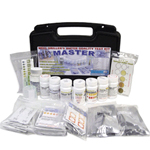
A company by the name of Industrial Test Systems, Inc. manufactures an excellent test kit known as the Well Driller Master Test Kit which offers a number of useful tests designed for use on well water at a reasonable price — usually around $200 — and the kits come with multiple tests for each parameter.

Aug
4

6-Stage Inline Filter for Arsenic

Water Testing BlogArsenic, Arsenic in Water, Arsenic Test, Chlorine, Copper, Lead, mercury, Metals, Pesticide, Trihalomethane, Water Filter

This multi-stage (six) inline filter does a lot more than just remove arsenic from water at a rate of up to 1 gallon per minute, a rate perfect for use with water fountains, bottleless water coolers, commercial coffeemakers, and ice machines. It uses all six of its filtration layers to effectively remove a number of drinking water contaminants.

  • In stages 1 and 6 water flows through pre and post one – micron filters capable of removing suspended particles such as silt, sediment, cyst (Giardia, Cryptosporidium), sand, rust, dirt, and other types of unwanted matter.

  • In stage 2 water flows through a specially engineered arsenic removal/reduction media.

  • In stages 3 and 4 water flows through a media bed comprised of high purity KDF-55D ®, and KDF-85D ®, which operate using electrochemical and spontaneous oxidation/reduction (REDOX) principles. The combination of these two special media completely oxidizes any chlorine in the water.

    As an added bonus, heavy metals such as lead, mercury, copper, nickel, chromium, cadmium, aluminum, and other dissolved metals also get removed/reduced during this stage of filtration.

    While some KDF media beds can harbor unwanted bacteria, studies have shown that this particular unit reduces the likelihood of bacteria growth by as much as 90%, thus eliminating the need for silver, an element considered by some to pose health risks.

    Worried about the possible addition of copper or zinc to the water in any significant amount? On a sample of water containing 2.3 ppm chlorinated water, testing after filtration detected <0.05 mg/l copper and only 0.46 mg/l zinc. The EPA has set the aesthetic levels for copper at 1.0 mg/l and 5.0 mg/l for zinc. Additionally, the human body requires both zinc and copper for good health. The FDA recommends a daily intake of 15 mg of zinc and 2 mg of copper.

  • In the fifth stage of filtration, water flows through granulated activated carbon (GAC) which adsorbs a wide variety of organic contaminants, such as any remaining chlorine (99.9%), chemicals linked to cancer such as Trihalomethanes and benzene, pesticides, herbicides, insecticides, volatile organic compounds (VOC’s), PCB’s, MTBE’s and a laundry list of other chemical contaminants that may exist in your source (i.e. tap or well) water.

What about replacement filters? Will I have difficulty finding them? Highly unlikely! The manufacturer of this inline arsenic filter, Crystal Quest has existed in one form or another in the commercial water purification industry for more than thirty years.

You can order replacement filters for the inline arsenic filter on FilterWater.Com, a leading online vendor of water quality improvement products from Crystal Quest and other manufacturers.

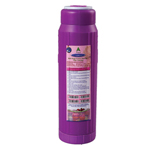
Filter Water: Replacement Arsenic Filter Cartridge
Replacement Arsenic
Filter Cartridge

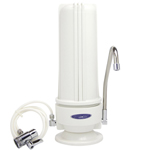
Filter Water: Countertop Arsenic Filter
Countertop Arsenic Filter

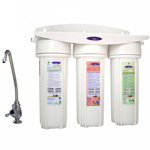
Filter Water: Undersink Triple Arsenic Filter
Undersink Triple Arsenic Filter

Aug
3

Aquasana AQ-4000 Premium Water Filter — With Free Shipping

Water Testing BlogWater Filter

We recently posted a blog entry about the benefits of Aquasana AQ-4000 Water Filtration Systems and informed you that you could purchase Premium faucets featuring brushed nickel or chrome finishes separately.

Well you COULD do that, OR you could simply order the Aquasana AQ-4501 Deluxe Under Counter Water Filter System that comes with your choice of Premium faucets.

Oh, and by ordering the complete kit from FilterWater.Com you will also get free Ground Shipping.

All the benefits of NSF/ANSI 42 and NSF/ANSI 53 certification plus an attractive polished metal faucet… delivered right to your door w/o you having to pay for shipping.

Yes. Yes, you may have died and gone to water filter heaven.