About
Do you know what's in YOUR water? Learn about water quality, water quality testing, and water quality testing products that can help you make informed, educated decisions regarding the water treatment options for your home, office, swimming pool... and life.
Contact Us
Got a question about water quality? Want to share a water quality article or water quality article with others?

Visit our Contact Us Page to ask a water quality question or submit water quality information.

RSS Feed
Get the most recent water quality posts and comments by subscribing to the Water Testing Blog RSS Feeds.
Subscribe to RSS! Subscribe to RSS Comments!

Archive for the ‘Free Chlorine’ Category

Jun
14

Question: Why is My Lawn Yellow?

Water Testing BlogChlorine, Chlorine Testing, Free Chlorine, Home Water Testing, Total Chlorine, Water Quality Testing

Today’s question comes from a woman in Illinois named ‘Gretchen246′ who asked a very interesting question… about her lawn.

“Why is my lawn green? A healthy lawn is the sign of a healthy home and my lawn is yellow. Allthe lawns here are yellow and we all fertilize and feed and do all we’resupposed to but the lawns are still yellow. Could it be the water?”

Sad to say, but the little kid in us wants to say, ” Gretchen, your neighborhood needs a leash law to keep wandering dogs from peeing all over your lawns!” Ha ha. Yep. The kid in us has not, yet, grown up all the way… and we hope it never does! :)

On a more serious note, if every lawn in your neighborhood has the same issue (bad grass), then it stands to reason that all of your lawns have at least SOMEthing in common. Typically all yards in a development will share a similar soil type (i.e. composition, pH, etc.), environmental conditions (rainfall, amount of sunlight, etc.) and quality of water used to keep them hydrated.

Since we know very little about soil we will pass on the opportunity to discuss that topic and move in for the kill on a topic we DO know something about: Water. Since you say your lawns stay yellow, a sure sign of a dead or dying lawn, perhaps your lawns don’t particularly care for something in the water?

As our first guess, we cast our vote for chlorine. Most municipal water systems use a form of chlorine to keep biological contaminants from growing in the water and water lines. Once out of the water line, however, chlorine will continue to wage war on biological organism… like the grass in your lawn.

Chlorine in my water?

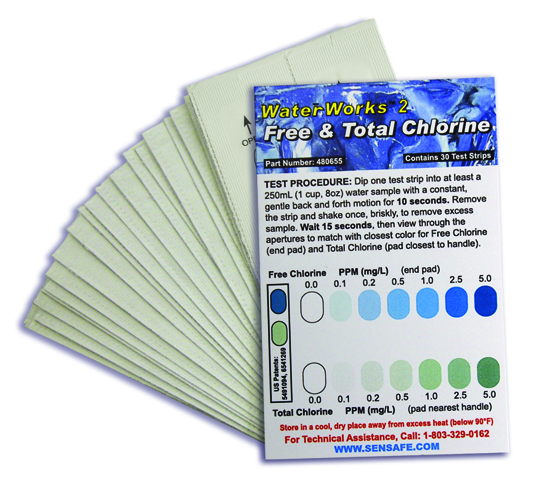
How do you know if your tap water contains chlorine? Perform a simple test for chlorine using a product such as the WaterWorks 2 Free & Total Chlorine Test Strip. We like this product because it provides reliable test results for both free and total chlorine concentrations in water at the same time and in just a few minutes.

There’s chlorine in my water… Now what?

Well if the chlorine poses a problem (i.e. it kills your grass!) then we heartily suggest removing it from the water you use on your lawn. The products below from Gar’n'Gro should have the ability to help with that task.


Gard’n'Gro Chlorine Removal Filter


Pre-Filter for Gard’n'Gro Filter


Replacement Gard’n'Gro Chlorine Filter


Replacement Gard’n'Gro Pre-Filter

For those interesting removing chlorine from their drinking water, you may want to consider installing a simple, yet effective, faucet filter such as the Crystal Quest W2 in your kitchen.

Jun
13

What Does Cyanuric Acid Do in Pool Water?

Water Testing BlogChlorine, Free Chlorine, Pool Water

Although not often (these days) that we get many questions pertaining to pool water, this one question does tend to get asked at least five or six times a year: “What does cyanuric acid do for pool water?”

Calcium Hypochlorite Powdered Chlorine
Calcium-Based Chlorine Powders & Tablets
Require the Use of Stabilizer Stabilizer

Honestly, cyanuric acid does more for the chlorine in your pool water than it does the pool water itself. As an element in water chlorine LOVES to more or less run wild and leave the water first chance it gets if not controlled (stabilized) by a compound like cyanuric acid.

In the absence of a chlorine stabilizing compound things like sunlight, wind and just plain chlorine’s tendency to ‘off gas’ would make it extremely difficult to maintain a free chlorine residual in pool water. Without a free chlorine residual pool water can easily turn green with algae, become cloudy and most CERTAINLY become a breeding ground for water dwelling bacteria and other pathogens.

Two forms of cyanuric acid?

Back in the day you could only get cyanuric acid as granules that you had to mix in a pail to form a slurry and pour down the skimmer (slowly!) with the pool pump running.

Now, however, you can purchase cyanuric acid as a concentrated liquid… which we can ASSURE you saves a lot of time!

Anyone who has ever had to mix, swirl, pour, mix, swirl, pour, mix, swirl, pour, etc., etc., etc., over and over again for a large pool will know EXACTLY what we mean by that last statement. Pouring too much of the cyanuric acid granules into the skimmer too quickly could result in dangerously high levels of pressure in the filter.

In the Swim: Cyanuric Acid Granules
Cyanuric Acid Granules

In the Swim: Cyanuric Acid Liquid
Cyanuric Acid Pre-Mixed Liquid

Jun
13

Best 3-Inch Tablets for Chlorine Feeders?

Water Testing BlogChlorine, Free Chlorine, Pool Water

We recently got asked for information about the best ‘brand’ of 3-inch chlorine tablets for use in floating chlorinators and chlorine feeder systems and quite honestly we do NOT have an opinion — except that we suggest avoiding using chlorine tablets purchased from large retail chains such as T#rg#t, W#lm#rt, To#s’#'us, K#a#t, etc. if possible.

Will chlorine from those (and other large retail) stores work? Yes, but you will go through more of it faster because it typically has a lower available chlorine content than 3-inch chlorine tablets purchased from pool stores. Why? Last we heard it has something do with the chemical licenses held by large retailers which take into account the ways (and places) in which they store/display chlorine products.

Another thing to consider: Chlorine Stabilizer (cyanuric acid). Most floating chlorinators and chlorine feeder systems do not work properly if you attempt to use non-stabilized chlorine tablets in them. Plus, non-stabilized forms of chlorine tend to volatilize out of the water quickly making it harder to maintain free chlorine residuals in the water.

Also, do NOT use fast/rapid dissolving tablets in chlorine feeder systems. Dangerous situations involving the rapid (no pun intended) formation of dangerous pressure levels in your pool’s plumbing may result!

So… Where can you purchase stabilized 3-inch chlorine tablets that will provide the higher level of available free chlorine? In the Swim carries a quality product that comes in a variety of sizes:

May
20

Electronic Pool Testing Meter

Water Testing Blogalkalinity, Chlorine, Chlorine Testing, Copper, DPD, eXact Micro 7+ Meter, Free Chlorine, Hardness, pH, Pool Water, Testing Devices, Total Chlorine, Water Quality Testing, Water Test Kit, Water Test Meters, Water Testing

As usual the warmer weather (in most of the US) has brought out the folks who have questions about pool water and how best to take care of it. Today’s question comes from ‘ActionLassie007′ who asked,

eXact Micro 7+ Pool Testing Meter
eXact Micro 7+
Pool Testing Meter

“Do they make meters for pool testing that regular people can afford? Last yr our poolguy had a meter and I asked him how much it cost. He told me one thousand and some change. He lie to me so I would not go get one and he loses a customer?”

Wow. Interesting situation, right? Personally we’d have fired the guy for telling an outlandish lie. Yeah, sure, SOME equipment used to test pool water MAY cost upwards of a thousand dollars or more, but would the average pool maintenance person REALLY spend that kind of money? We doubt it.

We suggest, Lassie, that you take a look at the eXact Micro 7+ Pool Water Testing Meter… which costs well under a thousand dollars, by the way. :P


2009 Pool & Spa News Readers' Choice Award
Pool & Spa News
Readers’ Choice Award Winner

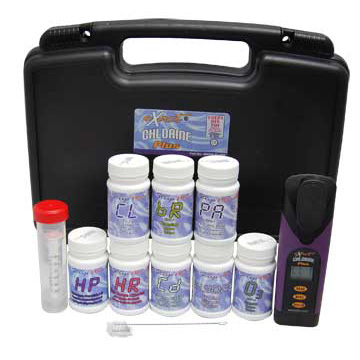
Combining the reliability and repeatability of a photometer w/ the dependability of proven chemistry methods such as DPD (for chlorine testing) and phenol red (for pH testing), the eXact Micro 7+ Pool Testing Meter puts the power of accurate water testing into the hands of the people who need it most: pool owners.

A definite advantage offered by this particular pool meter: Versatility. The pool testing meter tests for 7 critical pool water parameters directly and with the use of a conversion chart and correct reagentstrip it can test for a number of other water parameters, as well.

What comes in pool water test kit?

In the basic kit you will find everything you need to test for free chlorine, total chlorine, pH, calcium hardness, total alkalinity, dissolved copper, and cyanuric acid.

May
12

Filter to Remove Chloramines

Water Testing BlogArsenic in Wood, Arsenic Test, Bottled Water, Chloramines, Chlorine, Chlorine Testing, Coliform, Combined Chlorine, Copper, Disinfectant, Disinfection Byproducts, Fluoride, Free Chlorine, Testing Devices, Total Chlorine, Water Filter, Water Quality Testing, Water Testing

Not a fan of chloramines in your drinking water? You now have a means of removing those pesky chloramines!

Chloramines? What are chloramines? Take a look at this earlier Water Testing Blog entry on Free Chlorine, Combined Chlorine and Total Chlorine and get a quick education on the topic!

Whether created as a byproduct of disinfection via free chlorine or the intended disinfectant in a water system, most people do NOT like the taste and odor of chloramines in their water.

Thankfully Pentek has come out with a product called the Pentek ChlorPlus 10 Chloramine Removal Water Filter Cartridge that fits in standard 10″ (x 2.5″) filter housings used in filter sytems produced by companies such as Pentek (obviously!), US Filter (recently acquired by Pentek!), Cuno, Filterite, Keystone, US Water, Water Resurces, Harmsco, and many other popular brands of water filtration systems. If your system uses a standard 10″ x 2.5″ housing, the Pentek ChlorPlus 10 ought to fit just fine!

Having said that last bit, please check the dimensions of your current filter and/or housing before ordering this product!

Looking for a 10″ replacement filter with NSF Certification? The Pentek ChlorPlus 10 uses a component tested certified to NSF Standard 42.

What does the Pentek ChlorPlus 10 remove/reduce? Using 1 micron carbon block technology this product (255416-43) should seriously reduce chloramine concentrations in drinking water and in doing so remove the (offensive) taste and odor associated with chlorine while also helping to pull out unwanted sediment, if present.

Filter Water: Free & Total Chlorine Testing
Free & Total Chlorine Test

Filter Water: DPD-1 for Free Chlorine Testing
DPD-1: Free Chlorine Testing

Filter Water: Chlorine Testing Meter
Chlorine Testing Meter

Apr
28

Question: When Disinfecting My Well, How Do I Know That I’ve Put Enough Chlorine Bleach In?

Water Testing BlogChlorine, Chlorine Testing, DPD, Free Chlorine, Home Water Testing, Testing Devices, Water Quality Testing, Water Test Kit, Water Testing, Well Water

We may have addressed this matter in the past, but we would rather repeat ourselves a dozen times on a topic like this than have people not properly disinfecting their wells.

Today’s inquiry comes from ‘DdavidD’ who asked, “Hi hope you can hlep. We got a well bleach kit from the hardware store to clean our well and want o know how we know when enough has been added. Directions tell us to test but what do we test with? Thanks”

Most kits for disinfecting a well contain instructions for properly using their contents and we HIGHLY suggest that you follow the darn things — else risk using too little and not getting the job done or adding too much and risk damaging your well equipment.

Most kits will recommend maintaining levels of free chlorine much higher than any DPD Reagent Based Water Test Kit can possibly detect without messy dilutions which, if not done carefully, can easily result in flawed free chlorine readings.

So… how can a person test for 20, 50 or even 100+ ppm free chlorine? Simple: SenSafe/WaterWorks manufactures a product called High Range Free Chlorine which can detect up to 120 ppm free chlorine in just a few minutes without the user needing to mix chemicals or perform dilutions.

If you need to test for even HIGHER levels of free chlorine than 120 ppm, then we suggest you take a look at the Ultra High Range II Free Chlorine Test Strips contained in the Childcare Sanitizer/Disinfectant Water Test Kit.

Don’t let the word ‘childcare’ in the name fool you. The makers of this ultra high range free chlorine test strip designed it specifically for use in average tap/well water that contains super high levels of free chlorine — up to 2,000 parts per million free chlorine!


Detect Up to 2,000 ppm Free Chlorine w/ a Test Strip!

Apr
28

Question: What Do I Need to Start Up My Pool?

Water Testing Blogalkalinity, Chlorine, Free Chlorine, pH, Pool Water, Total Chlorine

We get this question countless times… because some pool companies either don’t do a good job explaining to customers what they will need to do when swimming season rolls around again OR because people have purchased homes that have a pool — and the former owners didn’t leave instructions.

In either case, we get this question a lot. Below you will find links to four areas of interest for pool owners in the Spring:

In the Swim: Pool Opening Kits
Pool Opening Kits

In the Swim: Pool Chlorine
Pool Chlorine

In the Swim: Solar & Winter Covers
Solar & Winter Covers

In the Swim: Equipment & Accessories
Equipment & Accessories

And, of course, an area that too many pool owners neglect: Pool Water Test Kits.

Can’t I just dump a bunch of chlorine in and call it a day?

Sure… but then you will more than likely waste money correcting the problems you’ve created or didn’t solve by simply adding chlorine.

Testing your pool water for at LEAST the basics (metals, pH, alkalinity, free chlorine, total chlorine, calcium hardness and cyanuric acid) will give the knowledge you need to purchase the correct pool chemicals and add the correct amounts so you can get your pool started properly and avoid annoyances such as staining caused by the addition of chlorine to water containing high levels of metals, algae caused by poorly balanced water in which chlorine cannot do its job, etc.

Consider This : 99% of the time it costs MORE money to fix a pool water chemistry issue than it does to test in the first place and add the correct chemicals the first time!

Apr
22

Inexpensive Free Chlorine Meter

Water Testing BlogChlorine, Chlorine Testing, Combined Chlorine, Free Chlorine, Home Water Testing, Testing Devices, Total Chlorine, Water Quality Testing, Water Test Meters

No matter how many ‘new’ and/or ‘innovative’ methods scientists devise to make water safe for drinking, we believe a certain faction in society will still put its trust in the sanitizing effects of free chlorine. This also means we believe a need for chlorine testing will always exist.

As an immediate example of this need, a Water Testing Blog reader named John recently asked, “Hi I am installing a 5000 litre water tank which i intend to add chlorine to and need an inexpensive free chlorine meter could you advise me on what to purchase as this is a new venture for me. Regards,John M.”

Thank you, John, for your question and more importantly for reminding us that we needed to examine the cost of chlorine meters at some of our favorite online merchants: FiltersFast.Com, WaterFilters.Net, FilterWater.Com, IsoPureWater.Comand Test Products.

In no particular order…

And in conclusion…

The USEPA approves of using DPD when testing drinking water and/or wastewater for chlorine content. Therefore, we suggest you invest in a system that uses DPD for free chlorine and/or total chlorine residual testing.

Meter for Chlorine Testing
EPA Compliant Meter for Free & Total Chlorine Testing
. . . When Used w/ Reliable, Trusted DPD Chemistry

Mar
16

Disinfecting a Well After a Flood

Water Testing BlogBacteria, Chlorine, Free Chlorine, Ground Water, Home Water Testing, Water Quality Testing, Water Testing, Well Water

Neglecting to disinfect your well after a flood can have dire consequences on your health. In some cases it could even KILL you.

Rising and swirling flood waters pick up a tremendous amount of waste, debris and other unwanted drinking water contaminants. As those waters recede and dry ground reappears, all of the junk and crud swept up by the flooding gets deposited on all surfaces — including the equipment used to draw fresh drinking water from drinking water wells.

Taking the time to properly clean and disinfect well equipment after a flood will help to prevent the accidental introduction of flood water contaminants into wells if you have to open the well cap in the future.

Also, it takes only the slightest breach in the seal of your well head to allow potentially harmful bacteria, dissolved metals, nitrates, nitrites, etc. access to your drinking water supply.

So, after flooding, or twice a year (as recommended by drinking and well water experts) it makes sense to clean off the well head area thoroughly and disinfect the well itself using some form of chlorine.

Looking for a quick and dirty disinfection method? Not necessarily the best way to go, but any amount of disinfecting beats performing no disinfecting, right? Right.

The South Dakota Department of Health suggests allowing a well to spend a minimum of 8 hours in direct contact with water containing at least 50 ppm of free chlorine. From what we read, it would seem as though they would actually prefer people allow a well to sit, undisturbed, with at least 50 ppm of free chlorine for a longer period of time, such as from sundown to sun up. ( source )

One could use unscented household bleach which contains an average of a little over 5% of hypochlorite solution (remember that free chlorine concentration domes from hypochlorous acid and hypochlorite ions). We cannot stress enough that one should use UNSCENTED bleach for disinfecting a well or other drinking water source!

As a general rule, health officials suggest adding the following amounts of unscented bleach solution to a well for each 10 feet of water it contains if it has an inner diameter of…

  • 2 inches — add 1/4 ounce of bleach
  • 4 inches — add 3/4 ounce of bleach
  • 6 inches — add 2 ounces of bleach
  • 8 inches — add 3 1/2 ounces of bleach
  • 10 inches — add 5 ounces of bleach
  • 12 inches — add 1 cup of bleach
  • 18 inches — add 2 1/4 cup of bleach
  • 24 inches — add 3 3/4 cup of bleach
  • 36 inches — add 8 3/4 cup of bleach

Lift the well pump, add the bleach solution, lower the well pump back in place, and allow the treated well to sit for at least 8 hours. Do not turn on any faucets or do anything else that would draw water from the well.

Once the waiting period has ended, turn on all faucets and allow the water to run until the smell of chlorine has vanished.

Get the water tested for bacterial contamination within a day of disinfection by a certified water testing lab in your area. After flooding many health departments team up with local labs to provide discounted bacteria in well water testing for local residents.

We, of course, would suggest having the well’s water tested for other critical water parameters at the same time since regional flooding can certainly have other effects on the quality of water coming from aquifers.

What about well water disinfection kits?

For those who would like a bit more instruction and procedure when disinfecting a drinking water well after a flood, or twice a year as suggested by many well water professionals, kits such as the Well Safe Well Sanitizer Pack will work very well.

This particular well disinfecting kit contains chlorinating pellets, chlorinating granules, and step-by-step instructions to to guide users through the process of treating a well.

Products like Well Safe have uses down in the body of a well, inside a well’s storage tank, throughout the plumbing between a well and connected buildings, in a cistern sanitation system, etc.

Moral of the story

Clean and disinfect/sanitize your well before returning it to use after local flooding!

Well Safe Well Sanitizer
Well Safe Well Water Sanitizer Pack

Earlier we mentioned that a well ought to sit undisturbed with at least 50 ppm of free chlorine and since we get asked this all the time, we will go ahead and tell you how you can test easily for free chlorine levels that high — without fancy (expensive) test equipment or complicated testing procedures.

For the task of testing higher levels of free chlorine residuals we suggest products like the WaterWorks High Range Free Chlorine Test Kit which has the ability to detect free chlorine concentrations between 0 ppm and 120 ppm in a matter of a few minutes.

Feb
16

Chlorine in Drinking Water & Chlorine Testing Methods

Water Testing BlogChlorine, Chlorine Testing, Combined Chlorine, Free Chlorine, Test Strip, Total Chlorine, Water Quality Testing, Water Test Kit, Water Test Meters, Water Testing

Sniff test: If you smell chlorine, then your water most likely contains some amount of chlorine. To determine the exact amount, however, you will need to use other testing methods.

As a general rule, if your water has a chlorine smell to it, then you most likely have, at the very least, chloramines (combined chlorine) present. This does not, however, rule out the possibility that your water also may contain a free chlorine residual, too.

Chlorine Chemical Symbol
chlorine testing products &
information at ChlorineTests.Com

For the record, health officials and scientists agree that chlorine gas does NOT do the body any favors and in too great a quantity can cause lung and eye irritation… so we suggest not performing the ‘sniff test’ if you can help it.

Taste test: Not all water that contains chlorine will smell like a swimming pool. While combined chlorine (chloramines) has a strong odor associated with it, free chlorine does not. Therefore water that may not stink like chlorine may still possess a strong chlorine taste.

We do NOT advocate the taste test method for any reason. We mentioned it just so that we could talk about why water can lack a strong chlorine smell and yet still have a strong chlorine taste.

Chemical test kit: We know of many different test kits that the general public can use to determine the free and/or total chlorine concentrations in their drinking water.

“Wait… Did you just talk about two different types of chlorine?”

Yes, because as we discussed during a few moments ago, one can have free chlorine and/or combined chlorine in their water. Typically free chlorine acts as the main sanitizing and/or disinfecting agent in a chlorinated water supply and once the free chlorine finds an organic contaminant to ‘kill’, it becomes entangled with the contaminant and forms a combined chlorine molecule.

Therefore, it stands to reason that a chlorinated water supply may contain both free and combined chlorine at the same time if the free chlorine molecules have successfully neutralized all biological contaminants and the effort did not require the use/exhaustion of all free chlorine molecules present in the water supply.

Getting back to chemical test kits, please…

Now that we have established the existence of different types of chlorine which may or may not exist in a water supply, we will now discuss different ways of testing for chlorine in a water supply.

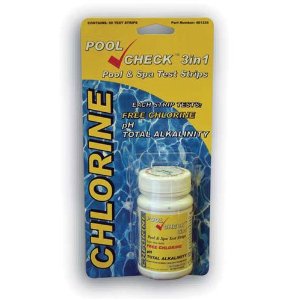
  • Test Strips — Perfect for field testing because they require the user only to dip the strip into the water and compare the color of the test pad/area to a color chart that came with the package of test strips. Products exist for the detection of both free and total chlorine. People can even get a single test strip to test for both at the same using a product called WaterWorks 2

  • ‘Wet’ Chemical Test Kits — Considered by most as the traditional, tried and true method for testing the quality of water. Most ‘wet’ kits typically require dissolving DPD as a tablet, powder or liquid into water samples and either comparing the colors of resultant solutions to color charts or adding drops of an additional chemical until a second color change reaction occurs.

    Simpler ‘wet chemistry’ test kits for chlorine (i.e. 2-way pool water test kits) use a different chemical called OTO (Orthotolidine) and detect total chlorine (free chlorine + combined chlorine = total chlorine).

    Problem w/ using OTO: No way exists to use OTO in a way that will allow a person to determine the free chlorine concentration.

    The DPD reagent system does, however, allow for differentiation between the two if a water sample has DPD-1 added first, gets analyzed, and then has DPD-3 added… and then get analyzed again.

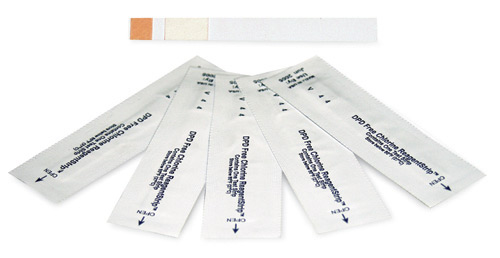
  • Water Testing Meters — Most water testing meters for chlorine (i.e. the eXact Chlorine Photometer) require the use of DPD, a chemical indicator which turns a shade of pink/red in the presence of chlorine molecules. DPD-1 indicates the presence of free chlorine and a combination of DPD-1 plus DPD-3 indicates the presence of free and/or combined chlorine (total chlorine).

So… Which method of chlorine testing will work best for you? Ask yourself the following questions:

1) Do you need to test for free chlorine, total chlorine or both?

2) How much accuracy and precision will you need in your results?

3) If performing testing for reporting purposes, what do the rules and regulations governing your profession say you must use as a testing methods?

Once you have answered those three questions you will have a clear idea of whether you should use chlorine test strips, wet chemistry test kits for chlorine testing or chlorine testing meters to determine chlorine concentrations in your water.