About
Do you know what's in YOUR water? Learn about water quality, water quality testing, and water quality testing products that can help you make informed, educated decisions regarding the water treatment options for your home, office, swimming pool... and life.
Contact Us
Got a question about water quality? Want to share a water quality article or water quality article with others?

Visit our Contact Us Page to ask a water quality question or submit water quality information.

RSS Feed
Get the most recent water quality posts and comments by subscribing to the Water Testing Blog RSS Feeds.
Subscribe to RSS! Subscribe to RSS Comments!

Archive for the ‘Water Test Meters’ Category

Jan
17

EPA Considering Removing ‘Safe Level’ Amounts for Pesticide Containing Fluoride

Water Testing BlogCity Water Test, Fluoride, Water Quality Testing, Water Test Meters, Water Testing

For those keeping tabs on the whole ‘fluoride overexposure’ issue, and especially those concerned about it, the following article ought to please you immensely.

In a recent announcement, the United States Environmental Protection Agency stated that it had taken another look at the topic of fluoride exposure and determined that with all the other sources of fluoride in our surroundings, allowing traces of fluoride in the form of a commonly used pesticide (sulfuryl fluoride) no longer makes sense.

The U.S. Environmental Protection Agency has re-evaluated the current science on fluoride and is taking steps to begin a phased-down withdrawal of the pesticide sulfuryl fluoride, a pesticide that breaks down into fluoride and is commonly used in food storage and processing facilities. Sulfuryl fluoride is currently registered for the control of insect pests in stored grains, dried fruits, tree nuts, coffee and cocoa beans, and for use in food handling and processing facilities. Although sulfuryl fluoride residues in food contribute only a very small portion of total exposure to fluoride, when combined with other fluoride exposure pathways, including drinking water and toothpaste, EPA has concluded that the tolerance (legal residue limits on food) no longer meets the safety standard under the Federal Food, Drug, and Cosmetic Act (FFDCA) and the tolerances for sulfuryl fluoride should be withdrawn. ( source )

So… if the EPA has admitted that it needs to reconsider its position on fluoride in drinking water, then perhaps we, as Americans, ought to wonder exactly how much fluoride our water contains, right? We think so. Ask your local water treatment facility for a copy of its annual Water Quality Report or for the web address where you can download a copy.

Visit the EPA SafeWater Program Web Site for information on water quality in your area.

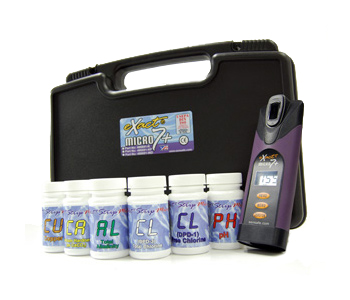
Test Products: eXact Micro 7+ Meter
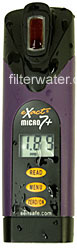
eXact Micro 7+ Water Testing Meter

( Required Fluoride ReagentStrips )

Testing for fluoride

Unfortunately the SPADNS chemistry required to perform fluoride testing in water does not lend itself to the development of a simple test strip or visual method… but that does not mean the average person cannot test for fluoride in their drinking water.

Over the past few months we have discussed the fact that a relatively inexpensive multiparameter water testing meter known as the eXact Micro 7+ has the ability to test for fluoride. Fluoride Test Strips for eXact Micro 7+ Photometer required and sold separately (under $15 for 25 tests) on the FiltersFast.Com web site.

As of January 17, 2011, the National Safety Products web site ( FilterWater.Com ) has the eXact Micro 7+ Meter on sale for about $240 for the basic kit.

Jan
12

Meter to Test Chromium in Water

Water Testing BlogChromium, Home Water Testing, Metals, Testing Devices, Water Quality Testing, Water Test Kit, Water Test Meters, Water Testing

Naturally, with all the discussion about an environmental group finding chromium in municipal water supplies across the United States, someone asked if we knew of a meter that could test for chromium… and not cost a thousand dollars.

eXact Micro 7+ Water Test Kit
Has Ability to Test for Chromium (VI)
w/ Inexpensive Add-On ReagentStrips

No, really. Someone asked us that.

A reader named ‘WetterBetterH2O’ from Iowa asked…

“Do you have a way to test for chromium besides test strips? I don’t like test strips. I want a meter that doesn’t cost a thousand dollars though. Do they make one like that?”

Tell the truth, we’d bet that other people share your dislike, or distrust, of test strips. Although very different from when they first came out, test strips will always get looked at as the ‘least preferred’ testing method due to a few bad brands back in the day.

Having said that, we would now like to direct your attention to the eXact Micro 7+ Water Testing Meter, a multi-parameter water testing meter capable of testing for chromium (VI), also called hexavalent chromium, levels between 0.02 and 4.89 parts per million.

In addition to the affordable cost of the very useful eXact Micro 7+ Meter, which typically costs under $260 for the basic kit, you will need to pick up a bottle of ReagentStrips for Chromium Testing for use with the meter.

Don’t worry, though, because a bottle of 50 Chromium ReagentStrips costs less than $20 — less than $0.40 per test.

Jan
6

Water Quality, Coal Mining, Jobs and… Conductivity?

Water Testing BlogTesting Devices, Water Quality Testing, Water Test Meters, Water Testing

In areas of the United States where mining coal puts food on the tables of local workers’ families while also providing always-in-demand coal to power plants around the country, an interruption in the issuance of mining permits makes a lot of people nervous.

Conductivity TDS Meter: Digital (DCM22CT) with Built-In Thermometer
Digital Conductivity Meter
w/ Built-In Thermometer

Conversely, an interruption in the issuance of mining permits in those regions also makes environmental ‘watchdogs’ like Rick Handshoe who has nothing to do with coal mining very happy since they believe improper, or just plain illegal, mining techniques destroy the quality of well and surface water near mining operations.

How do average people keep tabs on big business? Some use conductivity meters… and call for professional testing when the readings get high.

On a personal note, it saddens all of us at Water Testing Blog to know that citizens of the United States, or any country, for that matter, must sometimes decide between having safe, clean water in their environment and employment opportunities in their community.

HUEYSVILLE — Every Sunday, Rick Handshoe strolls from his mobile home across a two-lane paved highway, down the hill to Raccoon Creek, which is sometimes orange, sometimes silty, sometimes clear.

He notes whether any frogs or crawdads can be found, dead or alive, and he notes how much water is flowing from the pond built at the head of the Floyd County creek by a coal company about five years ago.

Handshoe has been watching his creek ebb and flow, die and come alive and die again, as the cycle of blasting, mining and reclamation has continued on land surrounding his retirement home. Until a year ago, his observations were just that; he couldn’t afford to send periodic water samples to a laboratory to find out what minerals were leeching into his creek.

But for the past year, Handshoe has been armed with a new weapon: a conductivity meter given to him by the Sierra Club.

The small beige instrument, which looks like an oversize digital thermometer, measures the amount of dissolved minerals and ions by sending an electrical current through the water. It is cheap, compared to lab testing, and it can be used over and over.

And Handshoe has been using it every Sunday for a year, measuring the microSiemens of electricity passing through his water at 500, 600, 1,200, 1,600, and marking them on a calendar.

A conductivity meter won’t tell you what’s in the water, just that there’s stuff in it.

Coal industry advocates say that’s the problem. They perform extensive tests and report monthly averages to the state over the life of their permits. They know how much manganese, iron and other minerals they’re discharging. They know how alkaline their water is, and they adjust additives every month to try to keep the water pollution within permitted levels.

But they say the conductivity benchmark of 200 to 500 microSiemens is impossible to meet — by a coal mine or any other industry. Even runoff from building a house or salting a road in winter can raise the conductivity of nearby streams.

“I would like to think that you’ve got more than a guy rolling around with a hand-held conductivity meter calling that real science,” said Paul Jackson of Perry County Coal, a subsidiary of TECO Coal.

The Sierra Club provided Handshoe’s conductivity meter a year ago, before EPA benchmarks were handed down in April, and the club itself has tested water in Eastern Kentucky.

The club’s tests of Raccoon Creek in November, done as a favor to Handshoe, found high levels of aluminum, manganese and zinc; high alkalinity; and the presence of caustic soda, or lye, added to the water by the coal company to lower the acidity of the water.

Sierra Club Water Sentinels head Tim Guilfoile said he was glad not to find high levels of mercury or selenium, which can cause deformities and reproductive problems in aquatic life.

Clewett said the legal realm of conductivity isn’t a sure thing yet, so it’s unclear whether benchmarks set in April will stick.

“Things haven’t really shaken out there yet,” he said.

If they do stick, then environmentalists might have a cheaper tool in their box, but time will tell. ( source )

Yep. Simple testing using basic instrumentation such as conductivity meters can, in some cases, provide the right amount of ‘proof’ needed by local officials to begin investigating potential sources of well and ground water pollution.

Conductivity Meter: Digital Pen Style 10-9990 µS/cm (CO502) ATC
Digital Pen Style Conductivity Meter
w/ 10-9990 µS/cm Detection Range

So… High conductivity means water is polluted?

No, not at all. Not in the classic sense that the water contains harmful contaminants. As the article pointed out, runoff from salt applied to roads in the winter to prevent icing can elevate conductivity levels in local water ways.

Those elevated levels, however, ought to dissipate at the appropriate moments. On the other hand, if high levels of conductivity continue over a prolonged period of time — for no apparent reason — one may want to seek the assistance of a professional, certified water testing service.

So… Low conductivity readings mean water is safe?

Not at all! Conductivity measures the ability of water to pass an electrical charge via ions. Some pollutants will not possess conductive capabilities representative of the true danger they present.

Need an example? Harmful strands of bacteria will most likely have little, if any, effect on the conductivity of drinking water… but would you really want to drink a glass of water if you already knew the water contained harmful strands of bacteria — even if a conductivity meter gave a low reading when testing the water?

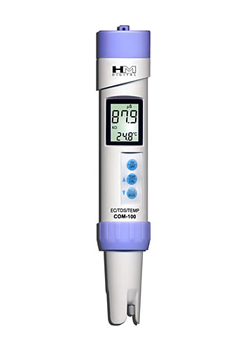
Test Products: Conductivity Meter
Conductivity Meter
Around $150

Test Products: Conductivity Meter
Conductivity Meter
Around $140

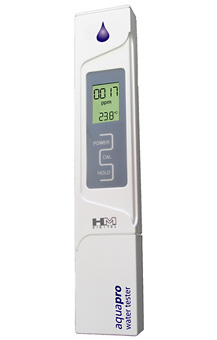
Test Products: Conductivity Meter
Conductivity Meter
Around $60

Dec
29

Question: Have They Come Out With the eXact Micro 8 Water Tester, Yet?

Water Testing BlogWater Quality Testing, Water Test Kit, Water Test Meters, Water Testing

Filter Water: eXact Micro 8 Photometer
eXact Micro 8 Photometer

Over the weekend we received an email from ‘Franny5Franny’ who asked the following question:

“Hi. You guys always talk about the eXact Micro 7+ meter and I just wanted to know if you know if the 8 version has been released yet. My friend works in a wastewater treatment plant and he said he talked to Industrial Test Systems at a tradeshow and the lady told him they were working on the 8 version over the summer. So do you know? Thanks.”

Thanks for writing in, Franny. We, too, had heard that the makers of the eXact Micro 7+ Photometer planned to release a new meter soon… but until you asked we had not really looked into the matter all that much.

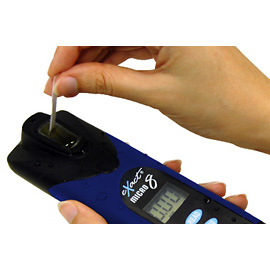
Since you asked, though, we did some digging and discovered that Industrial Test Systems, a Rock Hill, SC based manufacturer of water testing products, has actually released a new meter called the eXact Micro 8 Advanced Photometer which performs direct read testing for 7 different water parameters (Cyanide, Total Iron, Ferrous Iron, Ammonia, Phosphates, BT-pH, Sulfide).

The meter also has the ability to test for 11 other water quality parameters: Total Alkalinity, Biguanide, Calcium (as CaCO2), Chloride, Cyanuric Acid, Magnesium, CG-pH, Potassium, Protein (as BSA), Sulfate (as SO4), and Turbidity.

If you any additional information about the eXact Micro 8 Water Testing Meter, you should take a look at the product description on the FilterWater.Com web site.

Are other eXact Meters still available?

Yes. Industrial Test Systems appears to have committed itself to the eXact 7+ / eXact 8 chassis and reagentstrip reagent delivery technology which uses smaller sample sizes and smaller amounts of chemicals per test. Smaller sample sizes and fewer reagents per test both mean less chemical waste generated during mandatory and precautionary testing.

eXact Chlorine Photometer

eXact Micro 7+ Standard Kit

eXact Micro 7+ Pool Kit

Oct
19

Fluoride Testing Questions — eXact Micro 7+ Meter

Water Testing BlogCity Water Test, Fluoride, Municipal Water Test, Water Quality Testing, Water Test Kit, Water Test Meters, Water Testing

Today we received an inquiry from ‘Tom’ who wanted to know more about, we assume, the eXact Micro 7+ Meter’s fluoride testing ability.

Want to use to determine if a water sample has flouride and is likely city water vs ground water. Site lists lots of chemicals but steers away from Flouride. What is the range of flouride the instrument will detect? Will the presence of other chemicals associated with drinking water efect result? How often is calibration needed and can user complete cal?

eXact Micro 7+ Meter
0.1ppm to 1.1ppm Fluoride Testing

With all of the publicity that fluoride in drinking water has gotten over the years it does not surprise us that we keep getting questions about fluoride in drinking water, its effects on people’s health and how to test for it in drinking water.

Until a few years ago fluoride in water testing required ‘sophisticated’ laboratory glassware and used chemical reagents not readily available to the public. Either that or you needed very expensive laboratory grade equipment and a degree in chemistry to operate it.

Now, however, companies like Industrial Test Systems, Inc., a US based manufacturer of water quality testing products have come out with hand held meters like the eXact Micro 7+ Water Testing Meter which uses proven SPADNS chemistry to detect levels of fluoride between 0.1 ppm and 1.1 ppm. See page 18 of the eXact Micro 7+ Meter’s Manual for more information or call the meter’s manufacturer at 1-800-861-9712.

How much fluoride does tap water contain?

While concentrations of fluoride in tap water will vary by location, A 1994 World Health Organization expert committee suggested a level of fluoride from 0.5 to 1.0 mg/L (milligrams per litre), depending on climate. ( source )

We would guess that most municipal water supplies fall somewhere in the range specified by the World Health Organization.

Sep
23

Does the eXact Micro 7+ Meter Test for Fluoride?

Water Testing BlogHome Water Test Kits, Home Water Testing, Testing Devices, Water Quality Testing, Water Test Meters

We recently received an email from ‘Tyler’ who asked…

It looks like your Tester will test for Fluoride but on the actual page it doesn’t say that it Does? I specifically want a Device that measure Fluoride levels. Do you have this or does this 199$ machine do this?

This question, we believe, came in response to the following blog entry: EPA Compliant Chlorine Testing Meter

In that entry we mentioned that the eXact Micro 7+ Water Testing Meter has the ability to test for a number of things… including fluoride.

After checking the Filter Water page for the eXact Micro 7+ Water Testing Meter we also noticed that it did not specifically mention fluoride testing… EXCEPT in the final bullet point which reads, “Can test for 25 parameters: with use of test-specific reagents and conversion chart: Ammonia, Bromine, Chloride/Salt, Chlorine Dioxide, Chromium Hexavalent, Copper, Cyanuric Acid, Fluoride, Iodine, Iron, Low Range Total Hardness, Manganese, Nitrate, Nitrite, Ozone, Acid pH, Alkali pH, Potassium, Sulfate, Sulfide, and Turbidity.”

The kit, as sold, does not come with the reagents (Hach SPADNS replacements, to be exact!) to test for fluoride, but you can get them on the meter manufacturer’s web site: www.sensafe.com. Click on the word ‘fluoride’ in the list and it will take you to the exact (no pun intended) place on their site where you can order the product you need for approximately $13.

For instruction on how to use the meter for fluoride testing, please refer to page 18 of the eXact Micro 7+ Meter User’s Manual.

Aug
16

EPA Compliant Chlorine Testing Meter

Water Testing BlogChlorine, Chlorine Testing, DPD, eXact Strip DPD, Free Chlorine, Testing Devices, Total Chlorine, Water Quality Testing, Water Test Kit, Water Test Meters, Water Testing

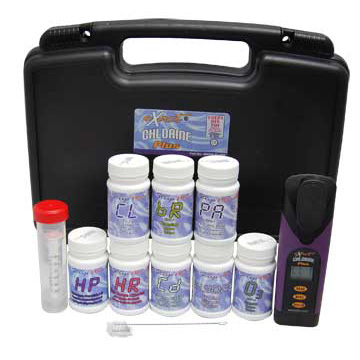
We recently learned that the maker of SenSafe Water Test Kits has released a new version of the eXact Micro Meter Water Testing Kit that makes accurate chlorine testing with DPD-based chemistry easy for experienced testers and novices alike.

Introducing, for all your chlorine testing needs, the eXact Chlorine Photometer… a digital meter for testing chlorine that has a detection range of 0 to 11 parts per million for both free and total chlorine without the need for drop counting, crushing tablets or dissolving powders.

Using the same hardware platform as the eXact Micro 7+ Meter, this new kit comes with 100 tests for free chlorine (using DPD-1) and 100 tests for total chlorine (using DPD-4)

Aside from the 0.01 ppm resolution with +/- 0.02 ppm accuracy between 0.00 and 2.39 ppm chlorine and its high detection limit of 11 parts per million, the eXact Chlorine Photometer also offers a great deal of versatility for those who may want to test for other water quality parameters such as… Ammonia, Bromine, Chloride/Salt, Chlorine Dioxide, Chromium (in Hexavalent Form), Copper, Cyanuric Acid, Fluoride, Iodine, Iron, Low Range Total Hardness, Manganese, Nitrate, Nitrite, Ozone, Acid pH, Alkali pH, Potassium, Sulfate, Sulfide, and Turbidity.

If the need arises where you need, or want, to test for parameters other than free and total chlorine, simply pick up a bottle of the appropriate reagentstrip and follow the simple instructions in your meter’s manual.

eXact Micro 7+ pH Test: 486639
eXact Micro 7+
pH Test
486639

eXact Micro 7+ Copper Test: 486632
eXact Micro 7+
Copper Test
486632

eXact Micro 7+ Free Chlorine: 486637
eXact Micro 7+
Free Chlorine
486637

eXact Micro 7+ Total Chlorine: 486670
eXact Micro 7+
Total Chlorine
486670

eXact Micro 7+ Total Alkalinity: 486641
eXact Micro 7+
Total Alkalinity
486641

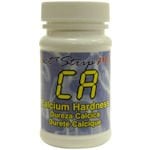
eXact Micro 7+ Calcium Hardness: 486629
eXact Micro 7+
Calcium Hardness
486629

Aug
13

ChlorineTests.Com — New Chlorine Testing Web Site

Water Testing BlogChlorine Testing, DPD, DPD Tablets, pH, Test Strip, Testing Devices, Water Quality Testing, Water Test Kit, Water Test Meters, Water Testing

Whether you need a basic test kit for chlorine & pH, a set of easy-to-use chlorine test strips, or an electronic chlorine testing meter, you will find the product to suit your testing needs on ChlorineTests.Com.

You can also find replacement reagents for several different chlorine test kits on ChlorineTests.Com, which naturally means you will find DPD tablets on the site for sure.

chlorine test kits: liquid
Chlorine Test Kits: Liquid

chlorine test strips
Chlorine Test Strips

chlorine testing meters
Chlorine testing Meters

And now for a few basic chlorine testing facts:

  • Test kits containing only OTO as their chlorine testing reagent will test for total chlorine only.

  • Free chlorine testing requires DPD-1. Adding DPD-3 to the sample after adding DPD-1 allows a person to test for total chlorine.

  • The USEPA has set the maximum contaminant level for chlorine in drinking water at 4.0ppm. This limit applies to both free chlorine levels and total chlorine levels.

  • When testing for parameters other than chlorine, some test kits will require the use of chlorine eliminating agents such as sodium thiosulfate before testing can take place.

  • Water containing the same amount of total chlorine as it does has very little or no free chlorine.

  • The difference between the free chlorine level and the total chlorine level equals the chloramine concentration.
Jun
9

Home Test Kit for Fluoride in Drinking Water

Water Testing BlogFluoride, Home Water Test Kits, Home Water Testing, Testing Devices, Water Quality Testing, Water Test Kit, Water Test Meters, Water Testing

Do they make a test kit consumers can use to test fluoride levels in drinking water?

Once again we find ourselves drawn back to the eXact Micro 7+ Water Testing Meter which tests for up to 36 different water parameters… including fluoride.

With regard to detection levels of fluoride, the eXact Micro 7+ Meter detects as low as 0.1 ppm fluoride and as high as 1.1 ppm fluoride. The USEPA has set the maximum contaminant level (MCL) for fluoride at 4.0 ppm.

Chemistry method used: “SPADNS”

For water containing levels in excess of 1.1 parts per million the manufacturer of the meter suggests diluting the sample with distilled or deionized water.

Also, please note that the basic eXact Micro 7+ Meter Kit does not include the reagent required for fluoride testing. You can find that available on the manufacturer’s web site

I have well water so I’m safe, right?

Even your water comes from a well, fluoride may still show up in your water supply because it can erode from natural deposits in the Earth and it may also enter the environment as discharge from fertilizer and aluminum factories.

Jun
4

Direct Reading Digital Chlorine Meter

Water Testing BlogChlorine, Chlorine Testing, Disinfectant, DPD, DPD Tablets, Testing Devices, Total Chlorine, Water Quality Testing, Water Test Kit, Water Test Meters, Water Testing

With so many news stories surfacing about pool water and/or drinking water not having adequate disinfectant levels many health officials have started pushing for increased testing and they don’t mean testing for chlorine residuals with test strips or liquid test kits which both require testers to match colors to get readings.

Rather than trust test personnel to use established methods of chlorine testing such as the Taylor FAS DPD Test Kit and/or the recently EPA Approved SenSafe Free Chlorine Water Check product, some folks want to remove as much subjectivity from the chlorine testing process as possible… and that means using meters to test chlorine residuals.

One example of a meter that some folks have turned to goes by the name of Extech (CL200) Exstik Direct Digital Reading Chlorine Meter and you can see a picture of that meter to the left.

The Extech CL200 Chlorine Testing Meter tests only for TOTAL chlorine, uses DPD as its reagent, requires roughly 2 minutes for testing, stores up to 15 readings internally, and detects total chlorine levels down to 0.01ppm (mg/L).

Extech, the manufacturer, claims the EPA has deemed the meter, with its associated DPD testing method, acceptable for wastewater compliance monitoring of Total Chlorine.

From what we can see on the IsoPureWater web site, this meter cannot used generic DPD tablets, DPD powder pillows, or DPD liquids designed for 10 mL sample sizes… and that means having fewer shopping options when the time comes to acquire replacement DPD reagents.

Not necessarily a show-stopper by any stretch of the imagination since a pack of 100 DPD reagent tablets for this meter costs under $30.

Definitely keep this meter in mind should you need a fast, compact meter for testing total chlorine levels in water.