About
Do you know what's in YOUR water? Learn about water quality, water quality testing, and water quality testing products that can help you make informed, educated decisions regarding the water treatment options for your home, office, swimming pool... and life.
Contact Us
Got a question about water quality? Want to share a water quality article or water quality article with others?

Visit our Contact Us Page to ask a water quality question or submit water quality information.

RSS Feed
Get the most recent water quality posts and comments by subscribing to the Water Testing Blog RSS Feeds.
Subscribe to RSS! Subscribe to RSS Comments!

Archive for June, 2008

Jun
5

Nitrates in Well Water / Private Well Testing

Water Testing BlogGround Water, Home Water Test Kits, Home Water Testing, Nitrate, Nitrite, Water Quality Testing, Water Test Kit, Water Testing, Well Water

May 30, 2008: A local paper in Odessa, TX reported that officials began testing water a few years back and found elevated levels of nitrates in private wells in the East 67th Street area. With no obvious fertilization due to farming in the area, officials determined that the elevated nitrate levels found in the well water they tested most likely came malfunctioning septic systems.

The article went on to warn that homeowners with septic systems located too close to wells have a greater risk of contamination, but that malfunctioning septic systems, regardless of proximity to the well, can still leach nitrates into the aquifers which provide water to wells not located too close to septic systems.

Owners of private wells, as noted in the article, do NOT have to test their wells with any frequency. No laws or regulations exist that force private well testing and as a result, many private well owners do not test their well water unless a specific problem develops — and usually that problem comes in the form of an unexplainable illness illness in the family or a sudden(?) malfunctioning of their well equipment.

Dangers of Nitrates in Drinking Water?

The United States Environmental Protection Agency states the following with regard to the dangers of nitrates in drinking water:
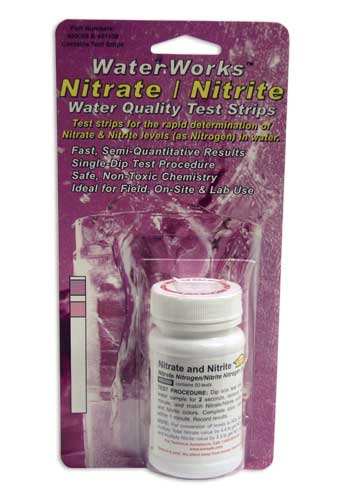
nitrate/nitrite test strips

Short-term: Excessive levels of nitrate in drinking water have caused serious illness and sometimes death. The serious illness in infants is due to the conversion of nitrate to nitrite by the body, which can interfere with the oxygen-carrying capacity of the child’s blood. This can be an acute condition in which health deteriorates rapidly over a period of days. Symptoms include shortness of breath and blueness of the skin.” ( source )

Long-term: Nitrates and nitrites have the potential to cause the following effects from a lifetime exposure at levels above the MCL: diuresis, increased starchy deposits and hemorrhaging of the spleen.” ( source )

Testing for Nitrates?

First of all, the Maximum Contaminant Level for Nitrates (as Nitrogen) in drinking water is 10.0 ppm (mg/L). This means water distributed for human consumption from ANY source should not contain more than 10.0 ppm (mg/L) of Nitrates (measured as Nitrogen).

Well owners, or pretty much anyone who wants to test for Nitrates can use a simple Nitrate Test Strips for that purpose and get accurate test results in just over a minute. This product also gives a reading for Nitrites, which also pose a health risk to humans. The Maximum Contaminant Level for Nitrites (as Nitrogen) in drinking water is 1.0 ppm (mg/L)

Jun
4

Definitions of MCL, MCLG, MRDL and MRDLG

Water Testing BlogMax Contaminant Level

A huge percentage of the general public does not know the difference between MCL, MCLG, MRDL and MRDLG. They ought not feel ashamed, though, because we took a short survey of people connected to water treatment, water testing, water processing, etc. and found that many of them had just as little knowledge on the topic as the general public.

Therefore we decided to visit the United States Environmental Protection Agency web site to find clear, concise definitions of MCL, MCLG, MRDL and MRDLG. See below:

Maximum Contaminant Level (MCL) – The highest level of a contaminant that is allowed in drinking water. MCLs are set as close to MCLGs as feasible using the best available treatment technology and taking cost into consideration. MCLs are enforceable standards.

Maximum Contaminant Level Goal (MCLG) – The level of a contaminant in drinking water below which there is no known or expected risk to health. MCLGs allow for a margin of safety and are non-enforceable public health goals.

Maximum Residual Disinfectant Level (MRDL) – The highest level of a disinfectant allowed in drinking water. There is convincing evidence that addition of a disinfectant is necessary for control of microbial contaminants.

Maximum Residual Disinfectant Level Goal (MRDLG) – The level of a drinking water disinfectant below which there is no known or expected risk to health. MRDLGs do not reflect the benefits of the use of disinfectants to control microbial contaminants.

( source )

Jun
3

Coliform Bacteria Test Kit

Water Testing BlogBacteria, Coliform, Home Water Test Kits, Home Water Testing, Water Quality Testing, Water Test Kit, Water Testing, Well Water

We have all read about folks getting sick from bacteria in water or seen the television reports about entire communities contracting strange ailments which eventually trace back to the indroduction of bacteria into the public water supply.

Believe it or not, not all forms of bacteria pose a danger to human life. In fact, the killing off of too much naturally occuring bacteria in the human body will lead to illness. Hence the reason why we now have yogurts and other products which encourage the growth of specific cultures in the human digestive tract.

Fact remains, though, that the introduction of harmful bacteria such as E. Coli, a bacteria strain well known for its ability to harm and even kill people, into potable water is an issue that all people who maintain their own wells or live, perhaps, at the tail end of a public water system’s line ought to check on a regular basis.

How Can People Test for Coliform Bacteria in Water?

A very safe and easy test called Bacteria Check detects the presence of coliform bacteria down to 1 cfu per 100 ml — the EPA limit for coliform bacteria in drinking water — and requires no incubation. The test takes 48 hours and gives results much faster in the case where the sample water contains higher levels of coliform bacteria.

48 hour presence/absensce test for coliform bacteria
WaterWorksTM Bacteria Check

Please note that Bacteria Check will not tell you what KIND of coliform bacteria it detected. Instead it will tell you that the sample water contained at least ONE coliform unit of bacteria in the 100 mL sample.

Jun
2

Potential Harm of Disinfection Byproducts

Water Testing BlogBromine, Chlorine, DBP, Disinfection Byproducts, HAA5, Haloacetic Acid, THM, Trihalomethane

While oxidizers such as chlorine, bromine and chlorine dioxide do an excellent job of cleaning up water so that it contains no microorganisms and/or harmful strains of bacteria, their success as disinfectants does not come without a price.

Byproducts of the chemical reaction between the ‘bad’ components and the oxidizers form each time one of those ‘bad’ components gets eliminated and we call the disinfection byproducts. See below for a list of the ones listed in the National Primary Drinking Water Regulations for Disinfection ByProducts along with their MCL’s (Maximum Contaminat Levels) and potential hazards to humans:

  • Bromate — Associated with an increased risk of cancer. Maximum Contaminant Level: 0.01 mg/L
  • Chlorite — Associated with Anemia; infants and young children: nervous system effects. Maximum Contaminant Level: 1.0 mg/L
  • Haloacetic acids (HAA5) — Associated with an increased risk of cancer. Maximum Contaminant Level: 0.06 mg/L
  • Total Trihalomethanes (TTHMs) — Associated with liver, kidney or central nervous system problems; increased risk of cancer. Maximum Contaminant Level: 0.08 mg/L
Jun
1

Sources of Bacteria and Microorganisms in Drinking Water

Water Testing BlogBacteria, Coliform, Home Water Test Kits, Home Water Testing, Water Quality Testing, Water Test Kit, Water Testing

Many microorganisms and forms of bacteria, including coliform bacteria, occur naturally in our environment and not all forms of bacteria or types of microorganisms cause harm to humans. As a general rule, the EPA, in its Primary Drinking Water Standards, has indicated that harmful types of bacteria and microorganisms such as Legionella, Giardia lamblia, Cryptosporidium, E. Coli, fecal coliform, and enteric viruses come primarily from human and animal waste.

Simple Testing Methods for Bacteria?

Yes. Homeowners wishing to test their water for the potential presence of harmful bacteria can use a number of kits such as the 48 Hour Presence/Absence Bacteria Check test kit which is also available in 2-pack and 6-pack versions.

Bacteria Check will not tell you what KIND of coliform bacteria it detected, but it will tell you that the sample water contained at least ONE coliform unit of bacteria in the 100 mL sample and that you may want to get the water professionally evaluated.