About
Do you know what's in YOUR water? Learn about water quality, water quality testing, and water quality testing products that can help you make informed, educated decisions regarding the water treatment options for your home, office, swimming pool... and life.
Contact Us
Got a question about water quality? Want to share a water quality article or water quality article with others?

Visit our Contact Us Page to ask a water quality question or submit water quality information.

RSS Feed
Get the most recent water quality posts and comments by subscribing to the Water Testing Blog RSS Feeds.
Subscribe to RSS! Subscribe to RSS Comments!

Archive for the ‘Bacteria’ Category

Sep
21

Filter Not Removing All Floating Stuff

Water Testing BlogBacteria, Home Water Testing, Personal Water Filter, Water Filter, Water Quality Testing, Water Testing

One danger we all face when purchasing a water filter: It doesn’t remove all the things we want it to remove. Yep, this can definitely happen to people if they do not have a thorough water quality analysis performed prior to purchasing a water filter for their home or place of business.

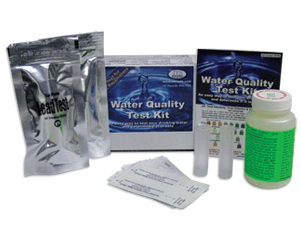
National Testing Labs Water Test Kit

Today’s question comes to us from someone in NYC (Brooklyn to be more precise) who has apparently installed a water filtration system in their home… but still has ‘floating white stuff’ in their water.

M. Elbaz wrote, “How can i check if water has copeds or bugs or parasytes? I use filter in Brooklyn ans still see white things floating around
Please advise asap”

Quite frankly, this question has a number of possible answers, but from what you have described, one of many situations may have resulted in the floating particulates you described:

  1. You have installed a water filter with too high a porosity rating, meaning the contaminants you want to filter out have too small a size for your filter to remove them.


  2. The installation of your water filtration system requires adjustment because some part of the unit is allowing unfiltered water to bypass the filtering process — or the actual filter itself has started to break down.


  3. Since we don’t know what class of filter you have installed (i.e. undersink, countertop, whole house, etc.) we will just throw this one out there for the heck of it: Often when people install filters that will still allow water to pass though existing faucets they fail to replace the screens in their faucets.

    Studies have shown that screens in faucets, if left unchanged for too long, will tend to collect specific deposits of contaminants in contaminated water — and then potentially release those contaminants into the water stream at a later time.


  4. Floating white particulates make us think more of mineral deposits than parasites, but it should still trigger an alarm that something isn’t quite right. Perhaps, and those kind of goes back to the last bullet point, the lines in your home post-filter have collected mineral deposits over the years and those now appear in your water?

As for your question regarding the possibility that your water contains parasites, bacteria, etc., contact a certified water testing laboratory in your area and have them perform a thorough analysis of your water.

Well Water Test Kit for Homeowners and Professionals
Well Water Test Kit for
Homeowners and Professionals

Steer clear of water treatment companies offering ‘free in-home testing’. Why? Simple: For one, no in-home test kit we have ever found can provide the thoroughness of testing required if you suspect parasites or other unwanted biological contaminants exist in your water supply.

Besides… a person from a water treatment company going to your home has one goal in mind: to make commission off the sale of a (potentially useless or otherwise unqualified) water treatment system.

Need help finding a qualified water testing laboratory in your area? Take a look through the EPA’s listing of State Certified drinking water laboratories. The laboratories on this list have passed rigorous qualification programs designed to weed out labs whose testing programs lack what it takes to accurately and professionally analyze drinking water samples.

Does that mean at-home bacteria test kits such as the WaterWorks™ Bacteria Water Test Kit have no purpose? Nonsense! Periodic testing for coliform bacteria — especially for well owners since no one government agency checks the quality of their water on a regular basis — will always make sense.

Important factors to think about when it comes to deciding when and/or how often to test the quality of your water:

  • For Well Owners: Changes in weather patterns (i.e. excessive rain, long periods without rain, flooding, etc.) can have adverse effects on the quality of water coming out of your well.

  • For City/Municipal Water Customers: Anything can happen to the miles of underground piping between the water treatment facility and no one will ever investigate until people start to get sick.

Performing regular spot checks on your water’s quality may allow you to detect potential problems well in advance of anyone becoming ill.

“It’s your water, your health… and ultimately your LIFE!”

Aug
29

Water Testing for Industry

Water Testing BlogBacteria, hydrogen sulfide, Nitrate, sensafe, Testing Devices, Water Quality Testing, Water Test Kit, Water Testing

Most days we entertain questions from folks who want to make sure industrial facilities have not somehow contaminated or otherwise altered the quality of their water. Today’s question, however, deals with testing water before it gets used in a manufacturing operation.

Hi.

We are a detergent manufacturing company here in Malta and we need to make regular checks on water that is used in the manufacturing process especially for nitrates, bacterias, sulfide and others. What you can suggest me ?

Thanks and Regards

Jesmond F.

Thank you, Jesmond, for your inquiry. Given the items you wish to test for, we have a few suggestions:

  • SenSafe manufactures a product it calls ‘Water Quality Test Kit‘ and we believe it contains tests for all of the items you mentioned.

  • Another kit made by SenSafe called the Well Driller Test Kit includes tests for all of the tests you asked about and will make it possible for you to test quite a few water samples — up to 50 samples in some cases.

  • No if you’d rather use a meter to perform testing, naturally we suggest the eXact Micro 7+ Meter which, according to the latest information we’ve read, can test for Ammonia, Bromine, Chloride/Salt, Chlorine Dioxide, Chromium (Hexavalent), Copper, Cyanuric Acid, Fluoride, Iodine, Iron, Low Range Total Hardness, Manganese, Nitrate, Nitrite, Ozone, Acid pH, Alkali pH, Potassium, Sulfate, Sulfide, and Turbidity. Granted the meter cannot test for bacteria, but you can always pick up tests for bacteria separately.

  • Speaking of separately, simple dip-n-read test strips exist for the purpose of testing each of the tests you asked about — with the exception, of course, of bacteria which uses a presence/absence ‘mug’ test procedure if you wish to test down to drinking water standards: Bacteria, Sulfides (as hydrogen sulfides) and Nitrates.

Hopefully one or more of the options above will suit your water testing needs.


Water Quality Test Kit


Well Driller Test Kit


eXact Micro 7+

Aug
26

Premature Degradation of Polyethylene Pipes Due to Water-Based Disinfectants

Water Testing BlogBacteria, Disinfectant

We won’t pretend to understand everything in the article we just read ( Chemical degradation of polyethylene pipes due to water-based disinfectants )… because we certainly did NOT understand a a good deal of the mathematics used in the various examples given.

We did, however, take away a few valuable points we believe worthy of mentioning on our site:

  • Many folks believed polyethylene piping would stand up to the rigors of continuous exposure to low levels of water-based disinfectants (i.e. chlorine, chloramines, peroxides, etc.) but now scientists realize that improperly balanced water quality parameters such as pH, alkalinity, hardness, etc. can aid in allowing those water-based disinfectants to prematurely degrade piping in our homes, offices, schools and pretty much anywhere it exists.

  • Scientists and health officials really don’t know EVERYthing about the disinfectants commonly used to treat our water supplies but they (and we) firmly believe that NOT having them in our water supplies certainly cause a lot more problems than having them in our water could ever cause.

    Need an example? Just look at Haiti or any other Third World area that lacks properly sanitized drinking water. Waterborne diseases whose causes (bacteria, pathogens, etc.) would ordinarily get wiped out by the low levels of things like chlorine and chlorine dioxide spread like wildfires and kill thousands of people in no time. Have you already forgotten the cholera epidemic that happened, we believe, less than a year ago?

So… if we can’t use polyethylene for this reason, PVC because of the additives it can leach into water, metal because it costs too much can also leach unwanted contaminants into drinking water, what CAN or SHOULD we use?

Unfortunately no one seems to have an answer to that question just yet so we will all have to wait until science solves that mystery. In the meantime, Water Testing Blog will continue testing its water regularly using the tools available at the time to make sure the contaminants we do know about don’t sneak into our water supply somehow.

Filter Water: Crystal Quest Voyager Triple Water Filter
Crystal Quest Voyager
Triple Water Filter
Ultrafiltration, Multi-Stage and Carbon Block

Filter Water: Well Water Quality Test Kit
Well Water Quality Test Kit
Test for 14 Parameters
Very Easy to Use

Filter Water: Bacteria in Water Test Kit, 12 Tests
Bacteria in Water Test Kit
Tests for E. Coli
Includes 12 Tests

Aug
2

Reduced Fee Water Testing

Water Testing BlogBacteria, Nitrate, Water Quality Testing, Water Testing, Well Water

As a special treat for the lucky residents of McHenry County in Illinois, and in honor of Safe Drinking Water Month, the McHenry County Department of Health has decided to offer coliform bacteria and nitrate testing for the reduced rate of $18.

While not the be all, end all signs of well and ground water contamination, the presence of either certainly warrants immediate action and, in our opinion, the performance of more thorough testing by a certified drinking water testing laboratory.

Testing wells regularly is the only way to determine whether well water is safe to drink; many contaminants are colorless and odorless. Water from a public or municipal water system is regularly tested for contaminants regulated by federal and state standards. ( source )

For those not living in McHenry County, we suggest contacting your local health department to see what sort of free or reduced water testing programs they have available. Many times programs of that nature go under advertised (or not advertised at all).

If no options exist that way, do not simply do nothing… it’s you water, your health… and ultimately your life!

Inexpensive screening methods exist that will allow you to quickly and economically perform basic water tests on your own that will let you know whether or not you should spend the money required for more laboratory testing.

While at-home drinking and well water test kits work as great screening tools, one should not rely on them to fully diagnose every possible water contamination problem.


Drinking/Well Water Test Kit


Disposable Nitrate Plus Filter


Whole House Nitrate Plus Filter

Aug
1

NSF/ANSI Standard 55 Class A or Class B for Home UV Water Treatment Systems?

Water Testing BlogBacteria, Coliform, Personal Water Filter, UV Sterilizer, Water Filter

Every once in a while we find ourselves faced with a water quality question whose answer we thing we ought to know, but for some reason never had cause to seek out in the past. A reader named ‘Nikelhoss’ recently asked,

“Which part of the nsf ansi standard 55 for ultraviolet water treatment systems applies to home units? Much thanks and thanks for the site, useful stuff on here.”


Trojan UV Max Pro 10, 20 & 30
Tested & Certified to NSF/ANSI Standard 55
for Class A UV Water Treatment Systems

My friends, flattery may not get you everywhere, as the old saying claims, but it will make us blush. Plus we may answer your question faster. Ha ha. :P

Rather than bore you by quoting the official definition of NSF/ANSI Standard 55 for Ultraviolet Microbiological Water Treatment Systems, we would like to point out a simple, yet often overlooked, truth that many people forget when exploring the wide world of water treatment systems for their home or business: Not every system will work for every water quality situation… and then we will provide a very relevant example to illustrate our point.

In the case of ultraviolet water filtration systems, two classes of NSF Certified ultraviolet water filtration systems exist:

But first, let us preface this by saying NSF/ANSI Standard 55 applies only to point-of-use (POU) and point-of-entry (POE) ultraviolet systems not intended for use on public water supplies (i.e. in water treatment facilities).

  • Class A — These ultraviolet water treatment systems must have an ‘intensity & saturation’ rating of at least 40,000 uwsec/cm2 and possess designs that will allow them to disinfect and/or remove microorganisms from contaminated water. Affected contaminants should include bacteria and viruses and the devices should perform in a manner that reduces threats posed by affected to a safe level.

  • Class B — These ultraviolet water treatment systems must have an ‘intensity & saturation’ rating of at least 16,000 uw-sec/cm2 and possess designs that will allow them to provide supplemental bactericidal treatment of water already deemed ‘safe’ by an official (i.e. State or Local) health agency.

So… Which type (class) of ultraviolet water treatment system makes the most sense for home use? That all depends on the source water for the home. If the home has well water and uses no other disinfection method or draws its water from bodies of surface water, we think investing in an NSF/ANSI Standard 55 Class A ultraviolet water treatment system may work out best.

As an example, check out the Trojan UV Max Pro 10, Trojan UV Max Pro 20 or Trojan UV Max Pro 30 on the Trojan UV Water Systems page on WaterFilters.Net.

If, on the other hand, you live in town and have municipal water or use a reverse osmosis system with a large holding tank, we think an NSF/ANSI Standard 55 Class A ultraviolet water treatment system may work out best — though, as always, we suggest testing your tap water for a period of time to establish a water quality baseline (to make certain more sinister bacterial contamination issues do not exist) before investing in a water treatment system designed to serve as a backup disinfection device.

For the purpose of putting a final UV polishing on drinking water previously determined ‘safe’, a device such as those listed on the Water Quality Association’s Gold Seal Certified Class B Disinfection Ultraviolet Water Treatment Systems may work out best, though one could easily still use a Class A unit in a Class B unit’s place — but not the other way around!

Jul
29

Is Your Family’s Health Worth $6 per Month?

Water Testing BlogBacteria, Coliform, Home Water Test Kits, Home Water Testing, Testing Devices, Water Quality Testing, Water Test Kit, Water Testing, Well Water

We believe more people need to ask that question — especially if they have well water in their homes or rely upon municipal water systems that may have older, potentially damaged water mains to deliver water to their homes. In both scenarios bacteria could suddenly, and without warning introduce itself to water supplies and put the health of entire families at risk.

Filters Fast: EZ Coliform Cult Bacteria Check
EZ Coliform Cult Bacteria Check

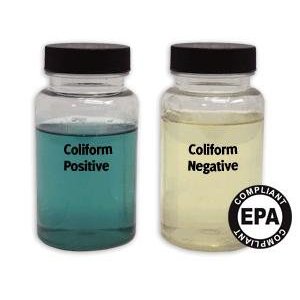
So… What can $6 a month do to help? Simple: For around just $6 per month homeowners can now perform testing for coliform bacteria at home using a test kit such as the WaterWorks EZ Coliform Test Kit which uses an EPA Compliant test procedure to test for the presence of coliform bacteria in drinking water and, with assistance of a UV light source, will positively identify E. Coli, a particularly unpleasant type of coliform bacteria associated with fecal matter, if present in the water.

Boil Water Advisories….

If you found yourself saying, “I don’t need to worry about bacteria in my water supply. My city/town/village issues ‘boil water advisories if a problem exists in the water supply.”

Very true since the law requires public water systems to issue public warning in the event of a water main break or other noticeable problem with the system that could possibly allow unwated contaminants (like bacteria) to infiltrate the water supply.

Problem: What if officials don’t KNOW about a cracked line miles away from the water treatment plant on a low pressure leg of the water delivery system that runs under an area where a bit of added moisture in the ground really wouldn’t catch anyone’s attention?

Problem: What if the pipes connecting your home or business to the public water supply have somehow become damage?

Not too Likely but Still a Potential Problem: What if the folks assigned to take care of water testing in your local water treatment plant decided to skimp on testing because of budgetary constraints — or just plain laziness — and a contamination issue caused by a failing check valve goes unnoticed for a period of time.

Moral of the story?

No one but YOU has ultimate responsibility for the purity and safety of the water that you and your family consume and as you can clearly see, that applies to folks on municipal water supplies as well as folks on private wells.

Conducting a simple $6 test every month on your water could potentially keep you and your family from suffering the ill effects of E. Coli contamination.

Filter Water: Well Water Test Kit
Well Water Test Kit
Includes Bacteria Test Kit

Filter Water: Water Quality Test Kit
Water Quality Test Kit
Includes Bacteria Test Kit

Jun
30

Harmful Bacteria in Swimming Pools?

Water Testing BlogBacteria, Coliform, Pool Water, Testing Devices, Water Quality Testing, Water Test Kit, Water Testing

While we all would LOVE to believe swimming pool water contains no harmful bacteria, in reality many swimming pools — despite the apparent presence of chlorine odors — actually DO contain harmful bacteria.

Bacteria Test Kit for Pool Water
Bacteria Test Kit for Pool Water Provides
Results You Can Trust in Just 20 Minutes

Granted the levels of contaminants often pose no danger to swimmers, also called bathers (hence the term ‘bather load’ rather than ‘swimmer load’ when discussing a pool’s usage), but for people with compromised immune systems, the elderly and/or the extremely young these levels may pose a health risk.

In other swimming pools, however, the levels do sometimes become dangerous for the general population and waterborne bacterial and/or viral contaminants may spread from bather to bather without anyone knowing until later on when the contaminant has worked its way into bloodstreams, reproduced and starting causing stomach pains, cramping, diarrhea, etc.

Some cases of bacterial contamination by swimming pool have resulted in hospitalization and, in rare instances, even deaths.

So… Can the average person (or pool operator) perform some sort of test on their pool water that could help to determine if the pool water sanitizer has effectively killed off any potentially harmful water bacteria?

Of COURSE someone makes a test kit for bacteria in swimming pools!

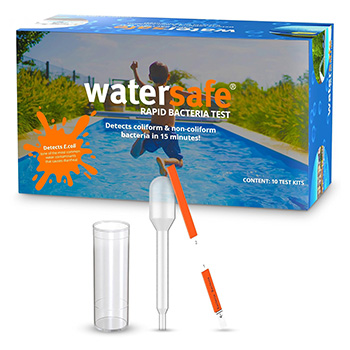
The WaterSafe Rapid Bacteria Test Kit provides reliable positive/negative results for ‘popular’ pool water contaminants such as Pseudomonas, Aeromonas, E.coli, species of Salmonella, Shigella, Enterobacter, Klebsiella, and other Coliform and non-Coliform bacteria.

If you want more information on this product, you can find it on FilterWater.Com.


AquaChek 7-Way Test Strips


AquaChek Pro II for CyA, TDS & Hardness

May
17

Question: Who is/are National Testing Labs?

Water Testing BlogBacteria, Home Water Test Kits, Home Water Testing, Water Quality Testing, Water Test Kit, Water Testing

WaterCheck 97 Contaminant Test Kit
Test for 97 Potential
Drinking Water Contaminants

For the longest time we have mentioned a company called National Testing Laboratories and a number of their testing products, but thus far we have not really talked about the company and why we keep mentioning them.

At some point between 2005 or 2007 one of the founders — and main writers for this site — had the pleasure of meeting a person of importance at National Testing Laboratories staff while working at a (National Ground Water Association [NGWA]) trade show.

Over the following months (and years) the information learned about National Testing Laboratories from his contact at the company and from independent sources made him a solid believer in the company’s firm commitment to providing accurate, affordable and reliable water testing services to both the general public and the private sector.

And in National Testing Laboratories’ own words. . .

The National Testing Laboratories, Ltd. network of certified laboratories performs drinking water analysis for customers worldwide according to US EPA and standard methods. We test for compliance and informational purposes and hold certifications across the U.S. Our laboratories successfully participate in US EPA Proficiency Testing Programs. We offer test packages to meet federal, state, FDA and International Bottled Water Association requirements. We maintain memberships in the Water Quality Association, Eastern Water Quality Association, International Bottled Water Association, Canadian Bottled Water Association, Northeast Bottled Water Association, National Ground Water Association, and many other national or regional associations. Members of our technical staff are contributing members of various IBWA and WQA committees. ( source )

And, just because it will save us a lot of typing, take a look at what else National Testing Laboratories has to say about itself. Yeah, we took the easy way out on this company profile, but WHY reinvent the wheel, right?

National Testing Laboratories (NTL) is one of the largest independent laboratories in the U.S. specializing in the analysis of drinking water for chemical and microbiological contamination. The corporate office in Cleveland, Ohio is integral to the operation of our laboratory facility in Ypsilanti, Michigan. For more than 25 years, we have offered a wide range of services for residential and commercial customers. Commercial customers include public water systems (city water), environmental consultants, engineers, water treatment professionals, bottled water plants, well drillers, food producers, pharmaceutical companies, laboratories and home inspectors. In 1998, Environmental Hazards Services, LLC. (EHS) of Richmond, Virginia was added to the network. EHS offers analysis for lead and asbestos in air and solids. Their strength is in high-quality analysis with very short turnaround time. The addition of EHS further enhances the broad capabilities of the network to better serve valued customers.

The network laboratories perform analysis according to USEPA and standard methods to meet state compliance in addition to performing informational tests for quality control purposes. Certifications are held across the country to meet customers’ needs. Network laboratories successfully participate in the USEPA, NIST and AIHA Proficiency Testing Programs and rank in the top percentile when compared to all other participants. ( source )

So there you have it; straight from the horse’s mouth. Wait. Did we just call ourselves a HORSE? Never mind. Moving on.

Don’t they just want to sell me a water treatment system?

Many times in the past we have advised folks interested in having their water tested to steer clear of water testing offers by companies who ALSO just happen to sell water treatment systems… because those companies ONLY want to find a problem (real or semi-real) and sell a product to fix the ‘problem’ their testing revealed.

Since National Testing Laboratories does not sell any water treatment equipment, you won’t have to worry about some pushy salesperson giving you the old ‘razzle-dazzle’ water chemistry show in your home and then pressuring you into buying a (potentially worthless) water treatment system at an inflated price.

National Testing Laboratories’ test kits work using mail-in submission methods… so no commission-hungry sales droid will ever go near your home. A definite plus in our book!

Fluoride in Water Test Kit

Iron Bacteria in Water Test Kit

WaterCheck Laboratory Test Kit with Pesticides
for 97 Possible Drinking Water Contaminants

WaterCheck Laboratory Test Kit
for 83 Possible Drinking Water Contaminants

May
16

Simple ‘Tests’ for Iron Bacteria

Water Testing BlogBacteria, Home Water Test Kits, Home Water Testing, hydrogen sulfide, Iron, manganese, Testing Devices, Water Quality Testing, Water Test Kit, Water Testing

We have gotten a number of requests for information on iron bacteria recently. Most notably, people have asked us what ‘clues’ to look for to determine if they should test for iron bacteria

Bad Taste and Foul Odor — Iron bacteria often produce nasty tastes and odors commonly reported as: “smells swampy,” “has an oily or petroleum like smell,” “smells remotely like cut cucumber,” “sewer smell” “stinks like rotten vegetation,” or “stale and musty.”

Often times the bad tastes and odors will seem noticeably stronger after a long period where the water has not run.

Note: If you smell a “rotten egg” smell, this odor most likely comes from something other than iron bacteria. You may want to test, instead, for dissolved hydrogen sulfide in your water.

Discoloration — Iron bacteria have a knack for leaving orange, brown, red or slightly yellow stains on your normally pristine white fixtures and may even cause water in toilets and toilet tanks to become discolored.

Some folks (who have lots of iron bacteria in their water) have even reported seeing rainbow-colored oily residues on surfaces exposed to their water.

Slimy Red Deposits — Should you happen to notice a sticky slime with a rust-like color — or possibly orange, brown, red, slightly yellow or even gray color — in your toilet tank, iron bacteria may have made their home in your water supply.

So… Those Simple ‘Tests’ Always Work?

Not even in a fairytale world, pal! Each of the ‘signs’ and ‘indicators’ of iron bacteria listed above could also come from drinking water contaminants such as ferrous iron, sulfate, hydrogen sulfide, manganese and/or other biological organisms frequently found in water supplies such as sulfur bacteria.

So… How Can I Know for Sure That I’ve Got Iron Bacteria?

No method other than having your water tested by a certified water testing laboratory (such as National Testing Laboratories) will tell you for certain whether or not you have iron bacteria in your water.

Test Products: Sulfate in Water Test Kit
Sulfate in Water Test Kit

Filter Water: Hydrogen Sulfide Test Kit
Hydrogen Sulfide in Water Test

Filter Water: Manganese Test Kit
Manganese in Water Test

May
13

Iron Bacteria — Can Homeowners Test For It?

Water Testing BlogBacteria, Water Quality Testing, Water Test Kit, Water Testing, Well Water

Until just now we have always said, “Not really”, but our response officially changes today since we have recently located an iron bacteria test kit designed for use by homeowners. Granted the kit still requires the homeowner to mail in their sample, but the test kit doesn’t cost TOO much and the analysis will get performed by a certified water testing lab.

To paraphrase Charles Barkley, “To use any other kind of lab would be uncivilized.”

Without further ado, let us introduce you to the WaterCheck Iron Bacteria Test Kit which gives the average person the ability to test for iron bacteria and get laboratory quality results in a matter of days.

What harm does iron bacteria cause?

In a nutshell, Iron Bacteria can cause your water to taste and smell quite bad as well as aid in the corrosion of your plumbing. It can also clog screens and cause water pressure to become diminished over time.

Simple indicators that you may have iron bacteria?

Take a quick look at your toilet tank to see if you’ve got a brownish slime growing on the sides of the tank. If so, you may have iron bacteria in your water supply.

A reddish, brownish or yellowish color to your water may also serve as an indication that you have iron bacteria in your water.

Does your water have a musty smell to it? Perhaps it has a scent that reminds you of sewage? If so, then that may indicate the presence of iron bacteria in your water.