About
Do you know what's in YOUR water? Learn about water quality, water quality testing, and water quality testing products that can help you make informed, educated decisions regarding the water treatment options for your home, office, swimming pool... and life.
Contact Us
Got a question about water quality? Want to share a water quality article or water quality article with others?

Visit our Contact Us Page to ask a water quality question or submit water quality information.

RSS Feed
Get the most recent water quality posts and comments by subscribing to the Water Testing Blog RSS Feeds.
Subscribe to RSS! Subscribe to RSS Comments!

Archive for the ‘DPD’ Category

Dec
27

Locating a Hanna Checker HC Photometer for Free Chlorine

Water Testing BlogChlorine Testing, DPD, DPD ReagentStrip, eXact Strip DPD, Free Chlorine, sensafe, Testing Devices, Total Chlorine, Water Quality Testing

Hanna Checker HC Chlorine Photometer
Hanna Checker HC
Chlorine Photometer

Every once in a while we get requests from foreign countries asking for pricing and availability of specific products.

Unfortunately we do not know a whole lot about the International market and what products exist in countries outside of the United States and Canada, but we generally assume that interested parties can acquire the same stuff we can, just at a higher cost due to import taxes and shipping fees.

Having said that, though, today’s international inquiry comes from ‘Zahid Afzal’ in Pakistan who asked who wants to know, specifically, about places to purchase a product called the Hanna Checker HC Photometer for Free Chlorine

Dear Sir/Madam,

Can you please give us the price for the “Hanna Checker HC Photometer for Free Chlorine” for our project in the Flood affected areas of Pakistan.

Regards,

Zahid Afzal

Thanks for the inquiry, Zahid. We really don’t know all that much about the “Hanna Checker HC Photometer for Free Chlorine“… except that a swimming pool supply company ( In the Swim ) began carrying this product at some point last Summer.

Having said that, do you really want to use a pool water testing device to test drinking water?

Granted we have said over and over again that doing ANY testing of drinking water in an area recently affected by flood waters makes more sense than performing no testing at all, but we would suggest looking into other meters… or possibly even into simpler testing methods that do not rely upon chemical reagents (i.e. DPD powders, DPD tablets, DPD reagentstrips, DPD liquids, etc.)

Filter Water: WaterWorks 2 Free & Total Chlorine Test Strips
WaterWorks 2 Free & Total Chlorine Test Strips

Filter Water: EPA Approved Free Chlorine Test Strips
EPA Approved SenSafe Free Chlorine Test Strips

Dec
10

New DPD Delivery System for Free Chlorine Testing

Water Testing BlogChlorine Testing, DPD, DPD Powder Pillows, DPD ReagentStrip, DPD Tablets, eXact Strip DPD, Free Chlorine, Testing Devices, Water Quality Testing, Water Testing

OK, so maybe not ‘new’, but having spoken with the manufacturers of this product, we can safely say that a whole lot of people who could really use this product do not know of its existence.

eXact DPD-1 ReagentStrip

For years people conducting tests for certain varieties of oxidizers (Free Chlorine, Chlorine Dioxide, Bromine, Iodine, and Permanganate) have relied upon DPD-1 tablets, DPD-1 powders and DPD-1 liquids to help them obtain accurate, repeatable results.

Now, however, an easier method of adding DPD-1 reagent to test samples has become available on FilterWater.Com, an online retailer of water quality testing and water quality improvement products.

Why consider switching to DPD-1 ReagentStrips?

  • The United States Environmental Protection Agency has deemed the DPD-1 ReagentStrip test procedure equivalent to USEPA method 330.5 for wastewater when used in conjunction with a Palintest Chlorometer 1000 equivalent meter (i.e. the eXact Chlorine Photometer).

  • The United States Environmental Protection Agency has deemed the DPD-1 ReagentStrip test procedure equivalent to USEPA method Standard Method 4500-Cl G for drinking water when used in conjunction with a Palintest Chlorometer 1000 equivalent meter (i.e. the eXact Chlorine Photometer).

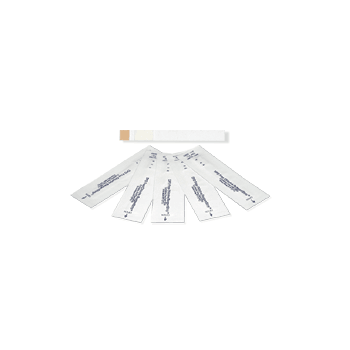
  • eXact DPD-1 Reagentstrips deliver a precise dose of DPD-1 reagent into a 10 mL sample without the need to count drops (DPD-1 liquids).

  • Working in the field with DPD-1 Reagentstrips becomes much easier since testing personnel will not have to worry about small or large gusts of wind blowing away their reagent as they attempt to add it to a sample (DPD-1 powders).

  • Due to the ‘dehydrated nature’ of DPD-1 Reagentstrips, they will dispense rapidly and easily into hard and cold water without the need for laborious, time consuming tablet crushing (DPD-1 tablets).

  • As long a the test instrument (i.e. meter or test kit) uses as standard 10 mL sample size, an eXact DPD-1 Reagentstrip will provide consistent test results regardles of who made the test kit/meter.

If you use DPD-1 on a regular basis we think you owe it to yourself to give eXact DPD-1 ReagentStrips a try.

Note: For those who know a thing or two about DPD, you may find yourself wondering why we didn’t compare the DPD-1 ReagentStrip to an old school method of reagent delivery called ampuoles which involves breaking glass tips off into test samples. Ahem… Breaking of glass in order to perform testing. Need we say anything more about ampuoles?

Filter Water: SenSafe Free Chlorine Water Check
EPA Approved Free Chlorine Test Strips
Range: 0 – 6 ppm

Filter Water: eXact Chlorine Photometer
eXact Chlorine Photometer
EPA Compliant for Free/Total Chlorine

Filter Water: WaterWorks Free Chlorine Check Ultra High II
Free Chlorine Testing Strips
Range: 0 – 2,000 ppm

Dec
8

DPD-Based Free Chlorine Testing

Water Testing BlogChlorine, Chlorine Testing, DPD, DPD Powder Pillows, DPD ReagentStrip, DPD Tablets, eXact Strip DPD, Free Chlorine, Water Quality Testing, Water Testing

Most people looking to test their drinking water for chlorine want to know the concentration of free chlorine, also called the free chlorine residual, in their drinking water. Basically speaking, free chlorine (hypochlorous acid) acts as an effective sanitizing and disinfecting agent in lower concentrations but can cause serious harm and damage to organic material (i.e. human skin, hair, cells, etc.) in higher concentrations.

The US Environmental Protection Agency has set the Maximum Contaminant Level (MCL) for free chlorine at 4.0 parts per million, also known as milligrams per liter (mg/L).

The most commonly used test for free chlorine residual uses a reagent called DPD (what is DPD?). More specifically, it requires DPD-1 and DPD-1 comes in several different forms: liquid, powder, tablet and reagentstrip form.

DPD-1 ReagentStrip
DPD-1 ReagentStrips

eXact Chlorine Photometer

DPD-1 Powder Reagent

DPD-1 Tablet Reagent
DPD-1 Tablet Reagents

Liquid DPD-1 Reagent

Aug
24

Testing for High Range Free Chlorine (Over 10 parts per million)

Water Testing BlogChlorine, Chlorine Testing, City Water Test, Combined Chlorine, DPD, DPD Powder Pillows, DPD ReagentStrip, DPD Tablets, Free Chlorine, Sanitizer, Test Strip, Total Chlorine, Water Quality Testing, Water Test Kit, Water Testing

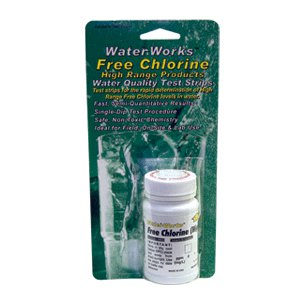
WaterWorks High Range Free Chlorine Test Strips

While the average person does not have a need to for chlorine levels much above 3 to 5 parts per million, and even then they would typically only need to do so to make sure their swimming pools had a sufficient amount of free chlorine, but other folks have the need to test for free chlorine levels in excess of 25 or 50 parts per million on a regular basis. Below we will list a few of the places where you might expect to see a need for high range free chlorine testing.

Fruit & Vegetable Processing

After fresh produce leaves the fields it travels to a processing facility where it typically gets washed with a solution containing some sort of sanitizer such as chlorine, ozone, etc. In cases where the produce processing plant uses chlorine employees must make sure the rinse water contains a certain amount of free chlorine after it has passed over the fruit/vegetables.

Levels of free chlorine drop with an increase in biological load (contamination) and the rinse water having free chlorine left after use indicates that the produce no longer contains biological contamination on its surfaces.

Childcare Facilities

State laws require that childcare facilities clean their surfaces with properly mixed sanitizing and disinfecting solutions that contain an appropriate concentration of sanitizing or disinfecting chemicals. In many cases these facilities use chlorine bleach solutions for cleaning purposes.

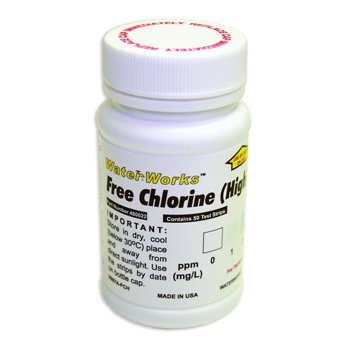
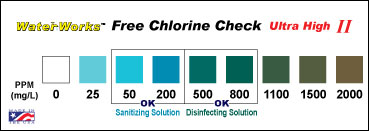
As a general rule these solutions must contain anywhere from 50 to 200 parts per million free chlorine for sanitizing solutions and anywhere from 500 to 800 parts per million free chlorine for disinfecting solutions. In case like this the Waterworks High Range Free Chlorine Test Strips will not work because they have an upper detection limit of only 120 parts per million free chlorine, but WaterWorks Free Chlorine Check Ultra High II has an upper detection limit of 2,000 parts per million free chlorine and works well in this application.

Some states leave it up to individual childcare facilities to determine testing frequency of sanitizing and disinfecting solutions while other states, like North Carolina for example, have strict laws dictating how often childcare facilities must perform testing.

As of January 1, 2006, all licensed, non-in-home daycare centers in the State of North Carolina had to have the ability to test the chlorine bleach content in both their sanitizing and their disinfecting solutions. Previously the law stated that they had to test only the chlorine concentration in their sanitizing solutions. ( source )

If interested in purchasing a test kit for testing sanitizing & disinfecting solutions in a childcare facility, you can find them readily available on the Filters Fast web site.

Water Lines and Water Mains

Before a water line can go into service for the first time or go back into service after a breakage or leak has gotten repaired technicians must flush (burn) the lines with water containing a high concentration of free chlorine to clean out any and biological contaminants. Typically the technicians must test the discharge water periodically until the free chlorine level remains constant at a high level for a set amount of time.

Waterworks High Range Free Chlorine Test Strips work very well for this application.

Product-specific information about Waterworks High Range Free Chlorine Test Strips:

  • Testing requires just 32 seconds
  • Each bottle contains 50 ready-to-use tests
  • Color chart has easily distinguished color blocks at 1, 5, 10, 20, 40, 80, 120 ppm
  • No harmful chemicals or reagents to handle

Childcare Test Kit
Free Chlorine Check Ultra High II
0 to 2,000 parts per million

WaterWorks Free Chlorine Check 480023
WaterWorks Free Chlorine Check
0 to 25 parts per million

SenSafe Free Chlorine Water Check
Free Chlorine Test Strips
0 to 6 parts per million

Aug
19

The Guys Don’t Like Using ‘Powder Pillers’ for Chlorine Testing

Water Testing BlogChlorine, Chlorine Testing, DPD, Free Chlorine, Test Strip, Testing Devices, Water Quality Testing, Water Test Kit, Water Testing

The other day we received a question from a reader in California who asked a question about free and total chlorine readings in what she called the ‘high range’.

I work at the front desk of a company that works on water lines and the guys are always complaining about ‘powder pillers’ and so today I finally asked what a ‘powder piller’ was. I learned two things today. One never ask a cranky engineer a question unless you know what your asking cuz they’re called POWDER PILLOWS and two the guys use them to test chlorine and they are a real pain to work with on a job. Do you have something else the guys can use cuz they REALLY don’t like those things nad they don’t test very high either it seems. Thanks for helping. MandyMandy113

A very interesting question, indeed, Mandy, and definitely one many people besides yourself probably would like to have answered — especially that cranky ‘ole engineer! He probably has spent years testing for free chlorine residual in water mains using DPD-Based test kits that require users to tear open a tiny foil packet and pour a pre-measured amount of reagent powder into a small test tube or vial.

Believe it or not, opening those small foil packets, often referred to as powder pillows, and pouring their contents into tiny openings using dirty, wet hands in cold, windy conditions really DOES take a lot of concentration and effort. Who knew, right?
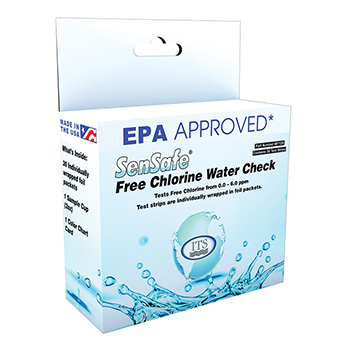
So anyways, Mandy, other options do exist and they have a few bonuses they your co-workers, even the cranky ‘ole engineer, might appreciate. One option in particular even has approval by the EPA for use when testing the free chlorine residual in drinking water! See how he likes THEM apples. We think he will. :)

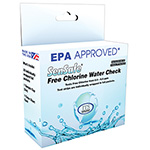
The SenSafe Free Chlorine Water Check test kit for free chlorine residuals in drinking water detects free chlorine residuals as low as 0.05 parts per million in a matter of seconds and requires the user to do nothing more than dip the strip into a sample, wait a few seconds, and compare the color on the test pad to a color chart.

Now before you say, “Oh great… a test strip…” let us remind you that the USEPA has thoroughly evaluated the SenSafe Free Chlorine Water Check test strips and found them more than adequate for testing free chlorine levels in municipal water supplies.

In the past test strips had color charts with hard to read colors, but this products stands as testament to the fact that times have changed and test strip technology has progressed quite far. See for yourself.

Many people (like several of the people here at Water Testing Blog) have difficulty telling the difference between different shades of colors with red in them so the fact that Free Chlorine Water Check uses a reagent that turns different shades of blue can really make a difference in how accurately a tester can interpret test results.

Testing higher levels of free chlorine

Since Mandy’s co-workers work on water lines, they most likely need to test for higher levels of chlorine (between 20 and 50 ppm) when flushing a new line or putting a repaired water line back in service. For testing like that they probably had to dilute samples 4 or 5 to 1 so they could get readable results with their dpd-based test kits. Not a fun task, especially since they would need to carry a supply of chlorine-free water with them to dilute their test samples.

As an alternative to diluting and testing with dpd reagents, SenSafe created a dip-n-read test strip that uses the same reagent as Free Chlorine Water Check, but has the ability to accurately detect up to 120 parts per million free chlorine w/ no monochloramine interference: WaterWorks Free Chlorine High Range.

12/08/2010 UPDATE: Online distributor of water quality testing and water quality improvement products FilterWater.Com recently started carrying DPD-1 ReagentStrips. If you use DPD-1 tablets or powder pillows, you owe it to yourself to take a look at the advantages offered by this product.

Aug
16

EPA Compliant Chlorine Testing Meter

Water Testing BlogChlorine, Chlorine Testing, DPD, eXact Strip DPD, Free Chlorine, Testing Devices, Total Chlorine, Water Quality Testing, Water Test Kit, Water Test Meters, Water Testing

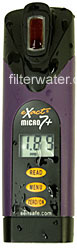
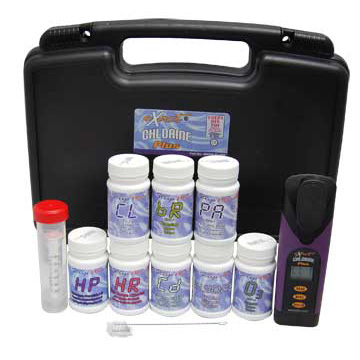
We recently learned that the maker of SenSafe Water Test Kits has released a new version of the eXact Micro Meter Water Testing Kit that makes accurate chlorine testing with DPD-based chemistry easy for experienced testers and novices alike.

Introducing, for all your chlorine testing needs, the eXact Chlorine Photometer… a digital meter for testing chlorine that has a detection range of 0 to 11 parts per million for both free and total chlorine without the need for drop counting, crushing tablets or dissolving powders.

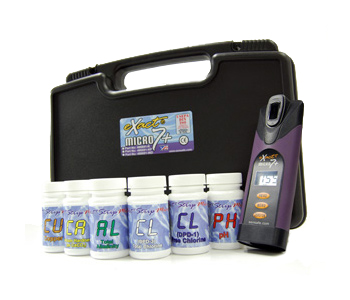
Using the same hardware platform as the eXact Micro 7+ Meter, this new kit comes with 100 tests for free chlorine (using DPD-1) and 100 tests for total chlorine (using DPD-4)

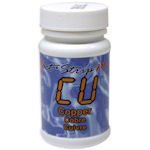
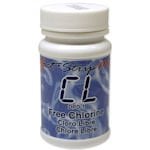
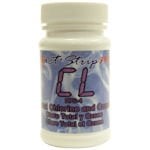
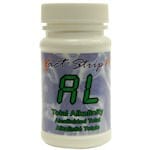
Aside from the 0.01 ppm resolution with +/- 0.02 ppm accuracy between 0.00 and 2.39 ppm chlorine and its high detection limit of 11 parts per million, the eXact Chlorine Photometer also offers a great deal of versatility for those who may want to test for other water quality parameters such as… Ammonia, Bromine, Chloride/Salt, Chlorine Dioxide, Chromium (in Hexavalent Form), Copper, Cyanuric Acid, Fluoride, Iodine, Iron, Low Range Total Hardness, Manganese, Nitrate, Nitrite, Ozone, Acid pH, Alkali pH, Potassium, Sulfate, Sulfide, and Turbidity.

If the need arises where you need, or want, to test for parameters other than free and total chlorine, simply pick up a bottle of the appropriate reagentstrip and follow the simple instructions in your meter’s manual.

eXact Micro 7+ pH Test: 486639
eXact Micro 7+
pH Test
486639

eXact Micro 7+ Copper Test: 486632
eXact Micro 7+
Copper Test
486632

eXact Micro 7+ Free Chlorine: 486637
eXact Micro 7+
Free Chlorine
486637

eXact Micro 7+ Total Chlorine: 486670
eXact Micro 7+
Total Chlorine
486670

eXact Micro 7+ Total Alkalinity: 486641
eXact Micro 7+
Total Alkalinity
486641

eXact Micro 7+ Calcium Hardness: 486629
eXact Micro 7+
Calcium Hardness
486629

Aug
13

ChlorineTests.Com — New Chlorine Testing Web Site

Water Testing BlogChlorine Testing, DPD, DPD Tablets, pH, Test Strip, Testing Devices, Water Quality Testing, Water Test Kit, Water Test Meters, Water Testing

Whether you need a basic test kit for chlorine & pH, a set of easy-to-use chlorine test strips, or an electronic chlorine testing meter, you will find the product to suit your testing needs on ChlorineTests.Com.

You can also find replacement reagents for several different chlorine test kits on ChlorineTests.Com, which naturally means you will find DPD tablets on the site for sure.

chlorine test kits: liquid
Chlorine Test Kits: Liquid

chlorine test strips
Chlorine Test Strips

chlorine testing meters
Chlorine testing Meters

And now for a few basic chlorine testing facts:

  • Test kits containing only OTO as their chlorine testing reagent will test for total chlorine only.

  • Free chlorine testing requires DPD-1. Adding DPD-3 to the sample after adding DPD-1 allows a person to test for total chlorine.

  • The USEPA has set the maximum contaminant level for chlorine in drinking water at 4.0ppm. This limit applies to both free chlorine levels and total chlorine levels.

  • When testing for parameters other than chlorine, some test kits will require the use of chlorine eliminating agents such as sodium thiosulfate before testing can take place.

  • Water containing the same amount of total chlorine as it does has very little or no free chlorine.

  • The difference between the free chlorine level and the total chlorine level equals the chloramine concentration.
Jun
4

Direct Reading Digital Chlorine Meter

Water Testing BlogChlorine, Chlorine Testing, Disinfectant, DPD, DPD Tablets, Testing Devices, Total Chlorine, Water Quality Testing, Water Test Kit, Water Test Meters, Water Testing

With so many news stories surfacing about pool water and/or drinking water not having adequate disinfectant levels many health officials have started pushing for increased testing and they don’t mean testing for chlorine residuals with test strips or liquid test kits which both require testers to match colors to get readings.

Rather than trust test personnel to use established methods of chlorine testing such as the Taylor FAS DPD Test Kit and/or the recently EPA Approved SenSafe Free Chlorine Water Check product, some folks want to remove as much subjectivity from the chlorine testing process as possible… and that means using meters to test chlorine residuals.

One example of a meter that some folks have turned to goes by the name of Extech (CL200) Exstik Direct Digital Reading Chlorine Meter and you can see a picture of that meter to the left.

The Extech CL200 Chlorine Testing Meter tests only for TOTAL chlorine, uses DPD as its reagent, requires roughly 2 minutes for testing, stores up to 15 readings internally, and detects total chlorine levels down to 0.01ppm (mg/L).

Extech, the manufacturer, claims the EPA has deemed the meter, with its associated DPD testing method, acceptable for wastewater compliance monitoring of Total Chlorine.

From what we can see on the IsoPureWater web site, this meter cannot used generic DPD tablets, DPD powder pillows, or DPD liquids designed for 10 mL sample sizes… and that means having fewer shopping options when the time comes to acquire replacement DPD reagents.

Not necessarily a show-stopper by any stretch of the imagination since a pack of 100 DPD reagent tablets for this meter costs under $30.

Definitely keep this meter in mind should you need a fast, compact meter for testing total chlorine levels in water.

Jun
4

Question: Where Can I Purchase DPD Tablets in Africa?

Water Testing BlogChlorine Testing, DPD, DPD Tablets

A plethora of health-related problems afflict many people living in Africa and many of those health conditions stem from the fact that the continent lacks an infrastructure capable of delivering clean, safe drinking water to many of its residents.

With that in mind, please excuse our departure from the normal subject matter and indulge us as we answer a question about purchasing DPD test tablets for chlorine testing in Zambia, an African Nation.

“Robert K” asked…

I need to know if there is company in Zambia or Sub-sahara Africa selling DPD #1 tablets.

This is a very informative site, keep it up

Thank you, Robert, for contacting Water Testing Blog with this question. We don’t know a whole lot about companies doing business with other areas of the world such as Zambia, but we did find a few links that may prove useful information.

Sorry we cannot provide more assistance than we have, but we do hope one of the links above will point you in a useful direction.

For those interested in learning more about DPD and its uses, please check out an earlier posting entitled What is DPD?.

If you would like to purchase DPD from a retailer/distributor in the US, the following links will take you to a site where you can order DPD #1 and/or DPD #3 in packs of 100 and packs of 1,000.

DPD #1 Tablets
(100) DPD #1 Tablets

(1,000) DPD #1 Tablets

DPD #3 Tablets
(100) DPD #3 Tablets

(1,000) DPD #3 Tablets

May
14

Simple Chlorine Testing Meter

Water Testing BlogChlorine Testing, DPD, DPD Tablets, Free Chlorine, Home Water Test Kits, Home Water Testing, Testing Devices, Water Quality Testing, Water Test Meters, Water Testing

Hanna Checker HC Photometer for Free Chlorine

While many companies have moved away from single parameter water testing meters and now produce meters that can test for a number of parameters instead of just one, Hanna recently released its new Hanna Checker HC Photometer for Free Chlorine which tests exclusively for free chlorine using EPA Approved DPD-1 as its reagent.

Specifications for the Hanna Checker HC Photometer for Free Chlorine:

  • Detection Range: 0.00 to 2.50 ppm (mg/L)
  • Resolution: 0.01 ppm (mg/L)
  • Precision: ±0.03 ppm (mg/L) @ 25°C
  • Power Source: (1) 1.5 Volt AAA Battery
  • Light Source: 525 nm LED
  • Sample Size: 10mL
  • Applicable Testing Method: Adaptation of the EPA approved DPD method Standard Method 4500-ClG

Does the Hanna Checker HC Photometer for Free Chlorine use DPD?

We already answered this one, but yes, it does. The Hanna Checker HC Photometer for Free Chlorine uses an adaptation of the EPA approved DPD method Standard Method 4500-ClG. Given that the test uses a standard 10mL sample, we would guess that the meter can use any standard DPD reagents for a 10mL sample size.

Our opinion of the meter?

  • Many of us here at Water Testing Blog have large hands with clumsy fingers so meters like this one that still use cuvettes, and GLASS cuvettes at that, kind of scare us. On top of that, most pool areas prohibit the use of glass in the pool area and many food processing facilities do as well.

  • The meter appears to use pouches of powder which get ripped open prior to use… and we see people accidentally spilling the DPD powder and/or having trouble pouring the powder into the little cuvette — especially if testing outdoors in a breezy climate like one might find poolside.

  • Having said all that, we DO, however, think that Hanna hit a nice price point w/ this meter; not too expensive and not too inexpensive.

  • Hanna MISSED the mark w/ its pricing for the DPD-1 reagents. Each test will cost nearly $0.40 to run… when other testing methods use DPD-1 reagents (i.e. DPD tablets) that cost less than $0.10 per test.