About
Do you know what's in YOUR water? Learn about water quality, water quality testing, and water quality testing products that can help you make informed, educated decisions regarding the water treatment options for your home, office, swimming pool... and life.
Contact Us
Got a question about water quality? Want to share a water quality article or water quality article with others?

Visit our Contact Us Page to ask a water quality question or submit water quality information.

RSS Feed
Get the most recent water quality posts and comments by subscribing to the Water Testing Blog RSS Feeds.
Subscribe to RSS! Subscribe to RSS Comments!

Archive for the ‘Bromine’ Category

Jun
15

Test 4 Important Pool Water Parameters Regularly

Water Testing BlogBromine, Chlorine, Chlorine Testing, Copper, Free Chlorine, Hardness, Iron, Metals, pH, Pool Water, TDS, Test Strip, Water Quality Testing, Water Test Kit, Water Testing

Most pool water professionals will agree that pool owners and pool maintenance staff should check the sanitizer levels (chlorine, bromine, etc.), pH, calcium hardness and total alkalinity on a regular basis.

To check those basic parameters a pool owner can use pool test strips, wet chemistry pool test kits and/or pool testing meters. Each method has its own distinct advantages and disadvantages:


click here for more details
Part Number: A8105

Inexpensive to replace reagents on a yearly basis but requires counting drops and relies heavily on the user’s ability to interpret/compare colors.


click here for more details
Part Number: A8000

Fast and efficient, but a little more expensive and still relies heavily on the user’s ability to interpret/compare colors.


click here for more details
Part Number: A8070

Typically the most accurate method since users do not interpret/compare color but by far the most expensive method as well.

While the four parameters mentioned above (sanitizer levels, pH, total alkalinity and calcium hardness) should get checked on a regular basis, pool owners should also keep a watchful eye on other pool water parameters such as cyanuric acid levels, mineral content (i.e. iron, copper, etc.), TDS (total dissolved solids), and acid/base demand.

Jun
5

eXact Micro 7+ Water Testing Meter

Water Testing BlogBromine, Chlorine, Chlorine Testing, Copper, Free Chlorine, Hardness, Home Water Test Kits, Home Water Testing, Iron, Metals, Nitrate, Nitrite, Ozone, pH

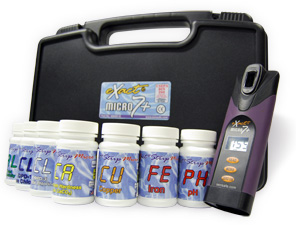
Interested in taking your testing to the next level? Got a need for fast, accurate and very versatile water testing meter system that won’t break your budget? Take a quick look at the eXact Micro 7+ Standard Photometer Kit and you may very well find what you seek.

Making use of the reliable and quite convenient reagentstrip delivery system for many of its tests, the eXact Micro 7+ Standard Photometer Kit greatly reduces testing times without affecting the quality of its water test results.

eXact Micro 7+ Standard Photometer Kit

The new eXact Micro 7+ Standard Photometer Kit from Industrial Test Systems offers homeowners and water quality professionals the ability to test for 26 different parameters to ensure their water is safe and suitable for a variety of uses. Ideal for residential, commercial or municipal testing, this waterproof meter provides faster, easier and more accurate testing than strips alone can provide.

This kit comes with 25 test strips each of the following parameters: free chlorine (DPD-1), total chlorine (DPD-3), pH, bromine (DPD-1), total alkalinity, calcium and copper.

In addition to these, the following 17 parameters may also be tested through the kit’s Tr-7 transmission function (requires the use of a conversion table): Ammonia, Chloride/Salt, Chlorine Dioxide, Chromium Hexavalent, Cyanuric Acid, Iodine, Iron, Low Range Total Hardness, Manganese, Nitrate, Nitrite, Acid pH, Alkali pH, Potassium, Sulfate, Sulfide and Turbidity. ( source )

Jun
2

Replacement Reagents for 2-Way Taylor Test Kits

Water Testing BlogBromine, Chlorine Testing, Copper, Free Chlorine, Hardness, Iron, Metals, pH, Pool Water, Total Chlorine, Water Quality Testing, Water Test Kit, Water Testing

OK, so we broached the topic of pool water testing and told folks to replace their reagents at the start of each new season. Now, as one would expect, folks want to know where they can get replacement reagents for their pool water test kits.

At this time we only have listing for replacement reagents to work with Taylor Pool & Spa Test Kits. We will add links to other types of reagents for other types of test kits as we locate them.

2-Way Liquid Solution Water Test Kit 2-Way Test Kit

“Pool water test kit reagents should be replaced every year. Testing swimming pool water every day will ensure proper chlorine, pH and alkalinity levels in the pool water. In The Swim pool test kits.” Your Cost: $7.99


2-Way Liquid Solution Water Test Kit Reagent 1 (chlorine) 1 oz.

“Pool water test kit reagents should be replaced every year. Testing swimming pool water every day will ensure proper chlorine, pH and alkalinity levels in the pool water. In The Swim pool test kits.” Your Cost: $2.27


2-Way Liquid Solution Water Test Kit Reagent 2 (pH) 1 oz.

“Pool water test kit reagents should be replaced every year. Testing swimming pool water every day will ensure proper chlorine, pH and alkalinity levels in the pool water. In The Swim pool test kits.” Your Cost: $2.27

Again, we stress that pool water can cause major illnesses in children and adults if not kept properly balanced. Adding chlorine, bromine or any other sanitizer will NOT pretect you and your loved ones against infectious diseases if other pool water parameters have drifted out of recommended ranges.

May
21

Pool & Spa Water Testing

Water Testing BlogBromine, Chlorine, Chlorine Testing, Copper, Free Chlorine, Hardness, Home Water Test Kits, Home Water Testing, Iron, Metals, pH, Pool Water, Sanitizer, TDS, Total Chlorine, Water Quality Testing, Water Test Kit, Water Testing

As a result of a massive influx of questions related to pool & spa water testing, we have decided to branch off our normal topic of drinking water quality testing and post a few things related to testing pool & spa water. Why? Simple: Some people have not yet made the connection that bad tap or ground water stays bad whether you drink it or fill your swimming pool with it.

For most people opening their swimming pool means raising the water level off with fresh, untreated water from a garden hose or in some cases, a delivery truck. Once full of water, the testing can begin.

How Should Pool & Spa Owners Test Their Water?

Excellent question! In the ‘old’ days most pool and spa owners had a simple two-sided test kit for chlorine/ bromine and pH which looked like this:


click here for more details
Part Number: A8100

2-Way Liquid Solution Water Test Kit 2-Way Test Kit

“Pool water test kit reagents should be replaced every year. Testing swimming pool water every day will ensure proper chlorine, pH and alkalinity levels in the pool water. In The Swim pool test kits.” Your Cost: $7.99

… and each year the owners of these pool water and spa water owners made a pilgrimage to their local pool store to acquire replacement reagents for their pool and/or spa water test kits which looked like this:


click here for more details
Part Number: A8120

2-Way Liquid Solution Water Test Kit Reagent 1 (chlorine) 1 oz.

“Pool water test kit reagents should be replaced every year. Testing swimming pool water every day will ensure proper chlorine, pH and alkalinity levels in the pool water. In The Swim pool test kits.” Your Cost: $2.27


click here for more details
Part Number: A8122

2-Way Liquid Solution Water Test Kit Reagent 2 (pH) 1 oz.

“Pool water test kit reagents should be replaced every year. Testing swimming pool water every day will ensure proper chlorine, pH and alkalinity levels in the pool water. In The Swim pool test kits.” Your Cost: $2.27

While at their local pool store picking up the replacement reagents for their pool/spa water test kits, pool and spa owners would usually submit a sample of water from their freshly filled pool or spa to a smiling person behind the counter at the ‘water testing station’. Within minutes of handing over a soda can, mason jar, yogurt container or other (hopefully) sealed container full of water the same smiling water station attendant would return with a sheet of paper telling them the free chlorine, total chlorine, ph, alkalinity, total (or calcium) hardness, cyanuric acid, total dissolved solids, copper and iron levels in their water.

Can’t Pool & Spa Owners Test Their Own Water?

Of course they can. Swimming pool and spa water test kits

Then came the fun part: Picking up and paying for all the various tubs and canisters of powders and liquids that would hopefully bring their water back in line with what pool and spa water professionals consider healthy.

This seems like a good time to end today’s posting. Later we will go into the different methods a person can use to test their OWN pool or spa water: At-Home Pool & Spa Water Test Kits & Water Testing Meters and At-Home Pool & Spa Water Test Kits and Testing Supplies

Jul
14

Testing for Bromates

Water Testing BlogBottled Water, Bromine, DBP, Disinfection Byproducts, Water Quality Testing, Water Test Kit, Water Testing

At this time the staff of Water Testing Blog does not know of a simple testing method for bromates. This does not mean companies who bottle water cannot have their product(s) tested for bromates.

“MWH Labs has received accreditation for testing of bromate by EPA Method 317 under the Stage 2 Disinfection/Disinfection Byproducts (DDBP) Rule. Method 317 is, a very accurate and very precise analytical method for bromate, that avoids many of the problems with false negatives and false positives that are associated with the existing analytical method (EPA 300.1). Additionally method 317 is capable of detecting bromate as low as 1 ppb (vs 5 ppb for method 300.1), helping clients to more accurately assess their bromate treatment options. Bromate is regulated in bottled water and potable water at a level of 10 ppb.”(source)

Jul
11

Bottled Water and Bromates

Water Testing BlogBottled Water, Bromine, Water Quality Testing, Water Testing

A while back the newspapers and television reports filled up with reports that some bottled water contained high levels of bromates and everyone agreed that bottled water ought not contain bromates. But how many of you ever stopped to ask where the bromates came from in the first place?

“Bromate is a chemical that is formed when ozone used to disinfect drinking water reacts with naturally occurring bromide found in source water. EPA has established the Stage 1 Disinfectants/Disinfection Byproducts Rule to regulate bromate at annual average of 10 parts per billion in drinking water. This standard will become effective for large public water systems by December 2001 and for small surface water and all ground public water systems in December 2003.” (source)

Jun
2

Potential Harm of Disinfection Byproducts

Water Testing BlogBromine, Chlorine, DBP, Disinfection Byproducts, HAA5, Haloacetic Acid, THM, Trihalomethane

While oxidizers such as chlorine, bromine and chlorine dioxide do an excellent job of cleaning up water so that it contains no microorganisms and/or harmful strains of bacteria, their success as disinfectants does not come without a price.

Byproducts of the chemical reaction between the ‘bad’ components and the oxidizers form each time one of those ‘bad’ components gets eliminated and we call the disinfection byproducts. See below for a list of the ones listed in the National Primary Drinking Water Regulations for Disinfection ByProducts along with their MCL’s (Maximum Contaminat Levels) and potential hazards to humans:

  • Bromate — Associated with an increased risk of cancer. Maximum Contaminant Level: 0.01 mg/L
  • Chlorite — Associated with Anemia; infants and young children: nervous system effects. Maximum Contaminant Level: 1.0 mg/L
  • Haloacetic acids (HAA5) — Associated with an increased risk of cancer. Maximum Contaminant Level: 0.06 mg/L
  • Total Trihalomethanes (TTHMs) — Associated with liver, kidney or central nervous system problems; increased risk of cancer. Maximum Contaminant Level: 0.08 mg/L
May
16

What is a Biguanide Sanitizer?

Water Testing BlogBiguanide, Bromine, Chlorine, Chlorine Testing, Combined Chlorine, Free Chlorine, Home Water Test Kits, Home Water Testing, Pool Water, Test Strip, Total Chlorine, Water Quality Testing, Water Test Kit, Water Testing

biguanide test strips

The term biguanide refers to a sanitizer that uses a complex polymer as its base rather than traditional chlorine or bromine molecules. Use of a biguanide sanitizer elimiates the offensive ‘chemical smell in a pool/spa, puts a stop to the bleaching of hair and swimwear, reduces eye irritation and makes it possible for those with allergic reaction to chlorine or bromine to enjoy a dip in the pool/spa.

Mixing Biguanide With Chlorine/Bromine?

A definite no-no. The chlorine or bromine will destroy the biguanide polymer and in some cases cause insightly preciptates to fall out of solution. You will NOT enjoy cleaning up a pool or spa in which biguanides have met up with oxidizers such as chlorine or bromine.

Switching Between Biguanide and Chlorine/Bromine Sanitizers?

For those who seek to switch from a biguanide system to chlorine/bromine system, or vice versa, make certain you remove ALL of the former biguanide system’s chemicals before adding the new system’s chemicals.

In the case where a person wants to switch from a chlorine/bromine system over to a biguanide system, they should perform a test for Total Chlorine/Bromine before adding any of the biguanide chemicals. Test strips work well for this application and pool/spa owners can choose from a number of multi-parameter test strips to get the job done:

And for those who REALLY want to make sure no chlorine resides in their water, try using the WaterWorksTM Ultra Low Total Chlorine Strips. Their lowest detection block starts at 0.005ppm total chlorine — an incredibly detection level for a dip and read test strip!

Products such as Chlorine & Bromine Neutralizers effectively remove the oxidizers in most cases but you should ALWAYS test to make sure.

May
15

Chlorine, Bromine and pH Test Kits (NSN Alternate Products)

Water Testing BlogBromine, Chlorine, Chlorine Testing, Free Chlorine, National Stock Number, pH, Test Strip, Total Chlorine, Water Quality Testing, Water Test Kit, Water Testing

Per the request of several men and women currently serving in the United States Armed Forces and other branches of the Unites States Government, we will begin posting possible alternate products for popular (established) NSN’s (National Stock Numbers) related to water quality testing.

NSN: 6630010273914, 6630010440334, 6630010673827 — Chlorine, Bromine and pH Visual Test Kits

  • WaterWorks and SenSafe Test Strips — Simple dip and read test strips for a wide range of parameters. Easier to use than wet kits, longer shelf lives, and much more convenient to carry.
  • eXact EZ Water Quality Testing Meter — EPA Compliant (for free and total chlorine) handheld multi-parameter water quality testing meter. IP67 Waterproof rating.

Note: We have found that the products suggested above meet or exceed the specifications of the original NSN (National Stock Number) item. This does not mean, though, that you may substitute them in place of the item on a Government Contract. We provided the above information as possible sources of water quality testing products for consideration in future Contracts/Bids only.